
The Roman Theatre of Arles
The Roman theatre of Arles was constructed during the reign of Augustus on the colline de l’Hauture, occupying a strategically elevated position within the ancient city’s urban layout.
It represents a paradigmatic example of a Roman theatre, combining natural topography with architectural engineering: the slope of the hill was utilized to support the orchestra, the scaena, and the lower tiers of the cavea, while the remainder of the structure was erected atop substantial artificial substructures (Figure 1).
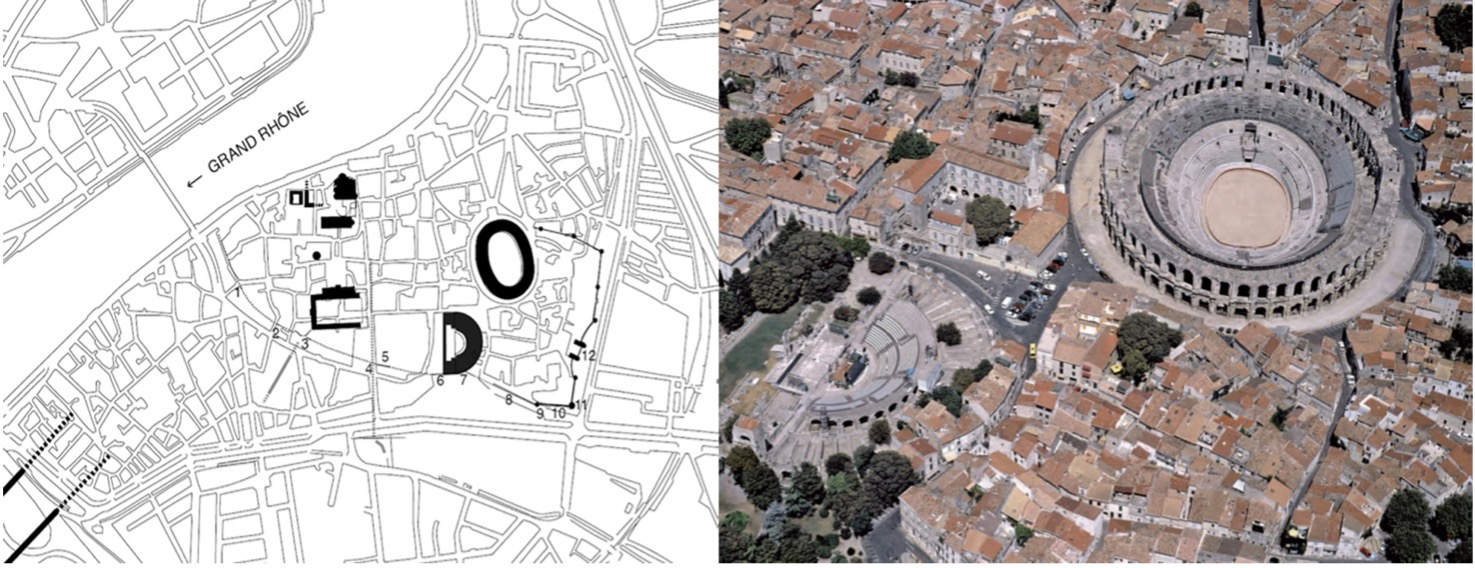
In the absence of epigraphic documentation or stratigraphic data sufficient to establish a definitive chronology, the dating of the monument relies primarily on stylistic analysis of the architectural and sculptural decorative programs. Furthermore, the urbanistic integration of the theatre with the adjacent forum—connected via the decumanus maximus—supports a terminus ante quem for the completion of the building between 20 and 10 BCE.
From the 5th century CE onward, the monument underwent systematic spoliation and progressive encroachment, ultimately becoming integrated into a residential quarter. In the post-antique period, the site was successively occupied by a Jesuit college and, later, by the Convent of the Sisters of Mercy, the latter established on the former stage area.
The monument's rediscovery began in 1651 with the unearthing of the Venus of Arles. Initially, the remains were misidentified as those of a temple. However, in 1684 Jacques Peitret produced a detailed ground plan of the visible structures, conclusively demonstrating their identification as a Roman theatre.
Excavations resumed in the second half of the 18th century, during which several major sculptural fragments were recovered, objects that would come to form the nucleus of the Arles archaeological collection: the torso of Augustus, a head of Dionysus (Bacchus), the so-called “dancers,” a female torso, draped male legs, and civic crown altars. These finds were soon displayed in the garden of antiquities established within the courtyard of the Convent of the Sisters of Mercy, thus forming one of the earliest publicly accessible museum.
Given the significance of the site, between 1822 and 1843 the Municipal Archaeological Commission of Arles intensified excavation and expropriation efforts, acquiring domestic structures that had encroached upon the ancient remains. Investigations concentrated primarily on the orchestra and stage area, resulting in the recovery of additional key artifacts, today housed in the Musée de l'Arles antique, including: the altar of Apollo, a bust of Venus, the altar adorned with swans, architectural decorative elements, a further figure of a dancer, and a silene (Figure 2 and Figure 3).
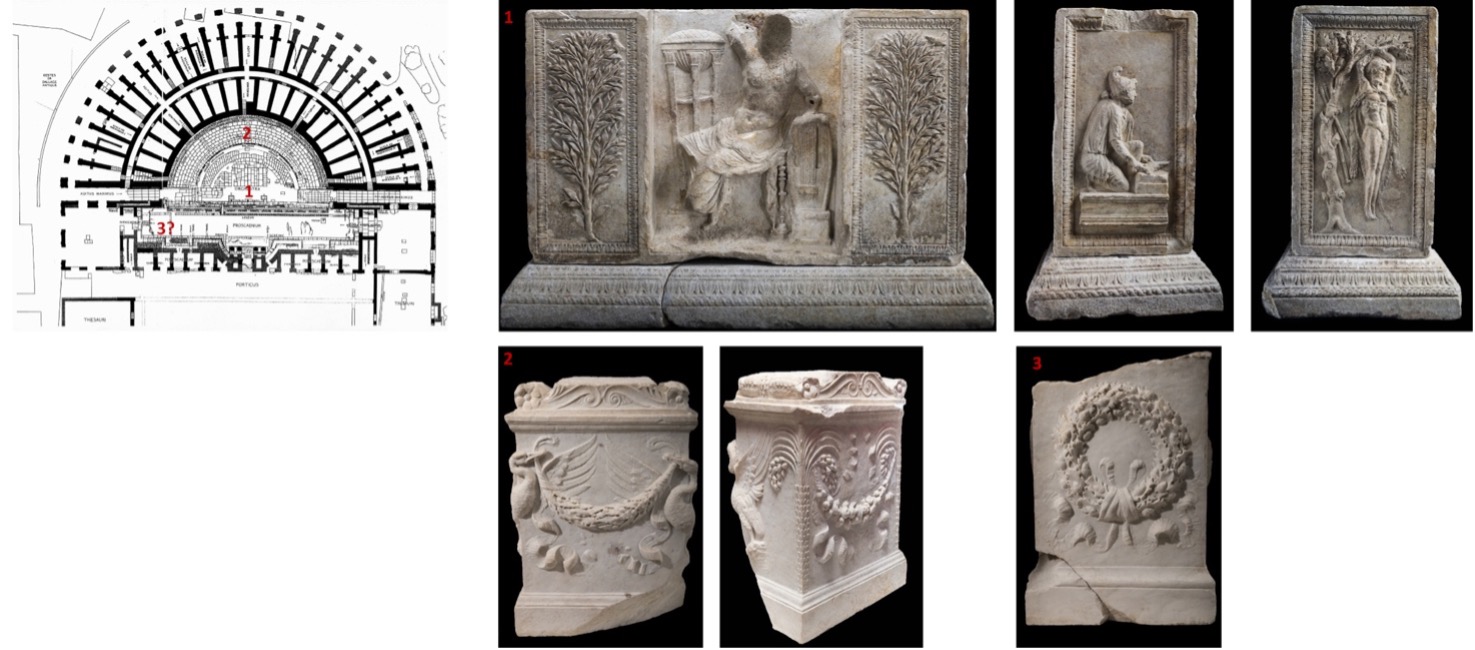
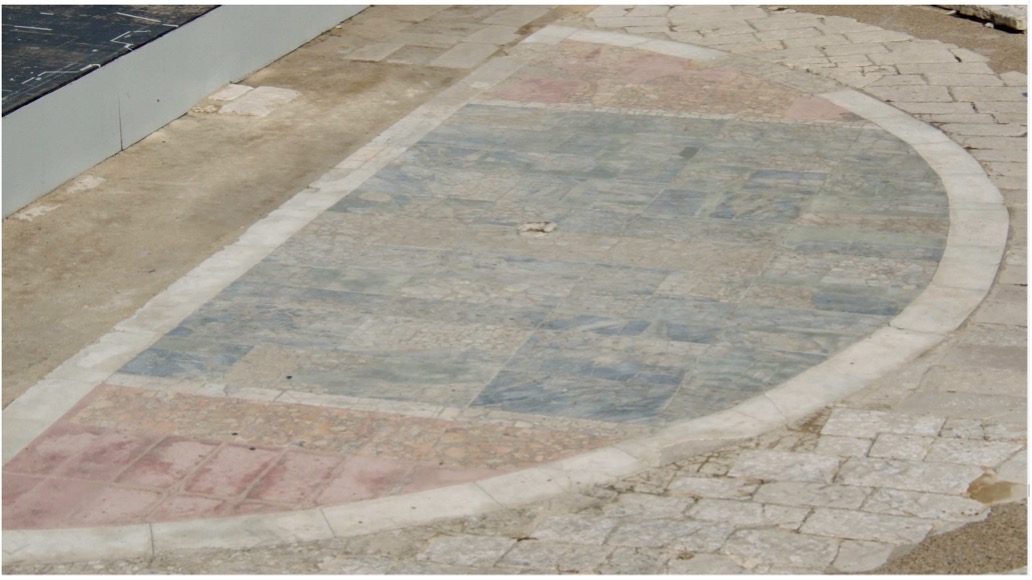
From the 1840s onward, archaeological interventions were undertaken under the auspices of the French Monuments Historiques administration. The theatre was progressively cleared and studied through the work of H. Révoil, J.-C. Formigé, and subsequently Jules Formigé, whose efforts — lasting until 1960 — contributed substantially to the monument's present state of conservation and interpretation.
Essential bibliography:
- Carrier, C 2006, “Une Nouvelle Statue Impériale Identifiée Au Théâtre D'Arles”, Revue Archéologique, vol. 2, pp. 263-276.
- Gros, P 1987, “Un programme augustéen : le centre monumental de la colonie d'Arles”, Jahrbuch des Deutschen Archäologischen Instituts, vol. 102, pp. 339-363.
- Gros, P 2008, “Arles à l’époque romaine. La colonie augustéenne. Mise en place de l’urbanisme2, in M-P Rothé & M Heijmans M (eds) Carte archéologique de la Gaule 13/5: Arles, Crau, Camargue, Acad. des Inscriptions, Ministère de l’E.N. et Maison des Sciences de l’Homme, Paris, pp. 152-155.
- Heijmans, M 2004, Arles durant l’Antiquité tardive. De la Duplex Arelas à l’Urbs Genesii, Collection de l'École française de Rome, Roma.
- Heijmans, M & Sintès C 1994, “L’évolution de la topographie de l’Arles antique. Un état de la question”, Gallia vol. 51, pp. 135-170.
- Sauron, G 1991, “Les autels néo-attiques du théâtre d'Arles”, in R Etienne & M-T Le Dinahet (eds), L'espace sacrificiel dans les civilisations méditerranéennes de l’Antiquité (Actes du colloque, Maison de l'Orient, Lyon 4-7 juin 1988), Diffusion de Boccard, Paris, pp. 205-216.
- Sauron, G 1994, Quis deum? L'expression plastique des idéologies politiques et religieuses à Rome. Bibliothèque des Écoles Françaises d'Athènes et de Rome, Roma.