
Investigation Protocol
In the study of the works presented, a standardized investigative protocol has been used, adapted from the guidelines established by the Polychromy Round Table, in order to share and compare the analytical results.
Investigating the ancient polychromy it is necessary to take into account all the post-depositional phenomena that may have altered the original rendering: atmospheric phenomena, presence of altered metal applications or modern era reworkings. Furthermore, for sculptural works, differently from pictorial ones, it is necessary to consider the difficulties linked to the three-dimensionality of the support and the usually incomplete state of conservation.
The first step consists in the visual study of the work and in the documentation of the traces of color still visible to the naked eye, with the referencing of the points of notable interest. We then proceed with a macroscopic analysis by stimulating the support at different wavelengths (multispectral imaging or MSI). Thanks to ultra-violet light (ultraviolet-reflected imaging or UVR), contrasts can be strengthened and some organic pigments identified (ultraviolet-induced luminescence imaging or UIL or UV-FL). With infrared (visible-induced luminescence imaging or VIL), on the other hand, it is possible to identify the presence of synthetic pigments (e.g. Egyptian blue). This type of investigation is carried out in a portable darkroom with the use of common defiltrated cameras and with the addition of particular sets of UV/IR filters.
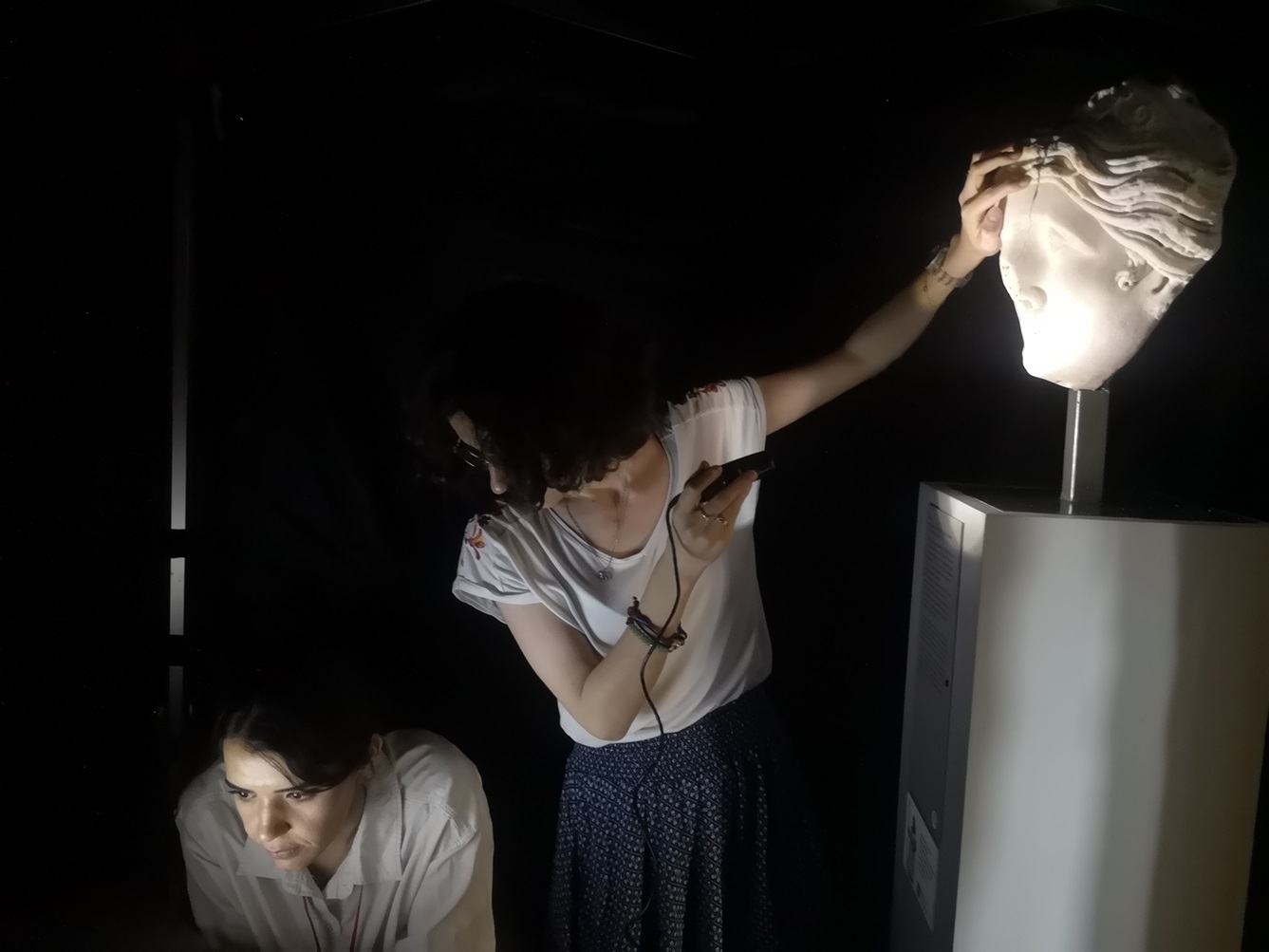
The surface of the work is then analysed thanks to the use of portable microscopes, both in the visible (VIS) and ultra-violet (UV) fields, even when apparently no traces of color appear to the naked eye. Micrographs are thus taken at different magnifications.
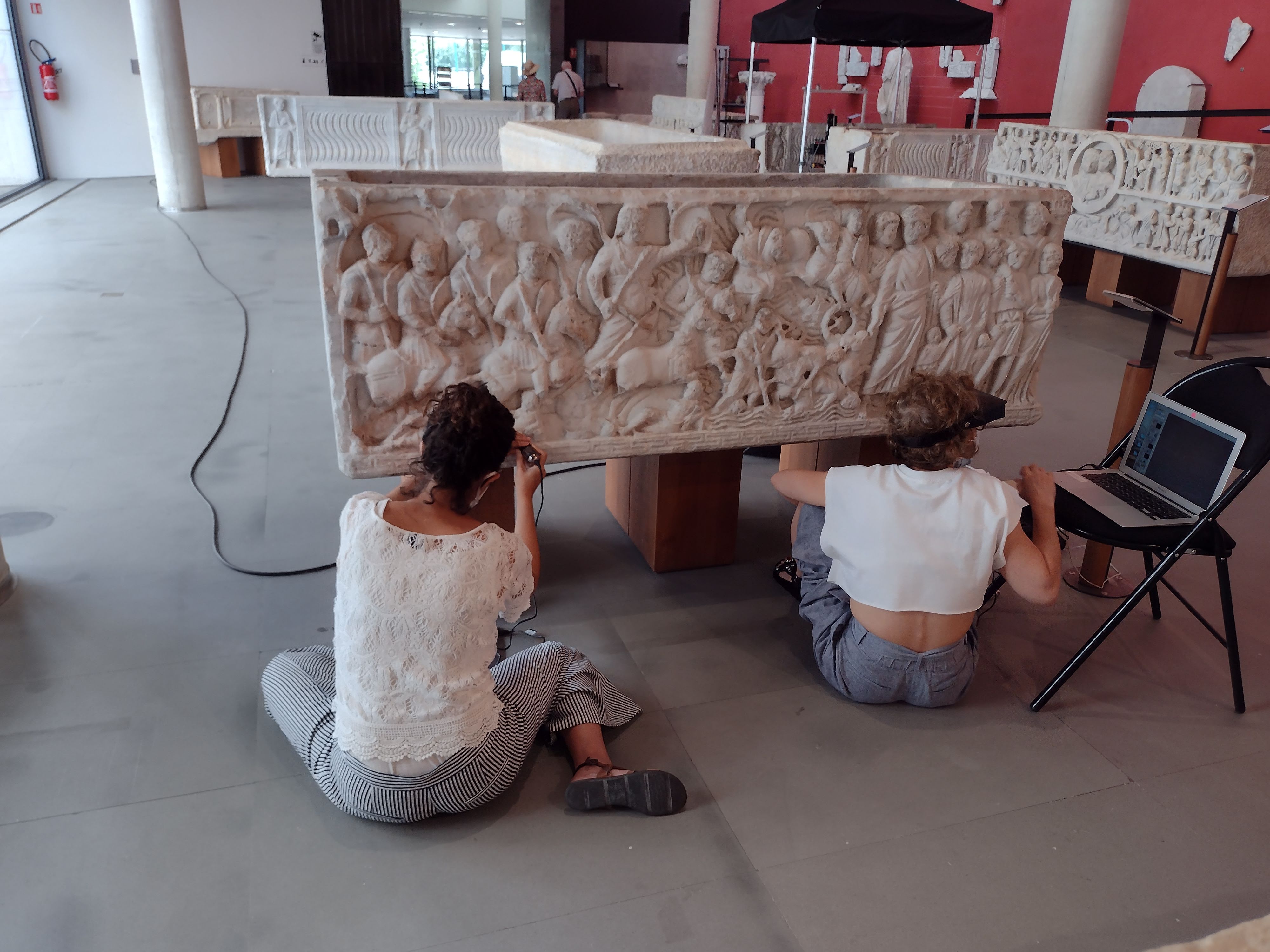
We therefore proceed with quantitative spectroscopic analyses of the individual pigments. Macro X-ray fluorescence spectroscopy (MA-XFR) allows us to measure the intensity of secondary X-ray emissions (fluorescence), characteristic for each material bombarded by high-energy X-rays.
The results, connected to data from visual and microscopic investigations, allow us to reconstruct the distribution and stratigraphy of the colours.
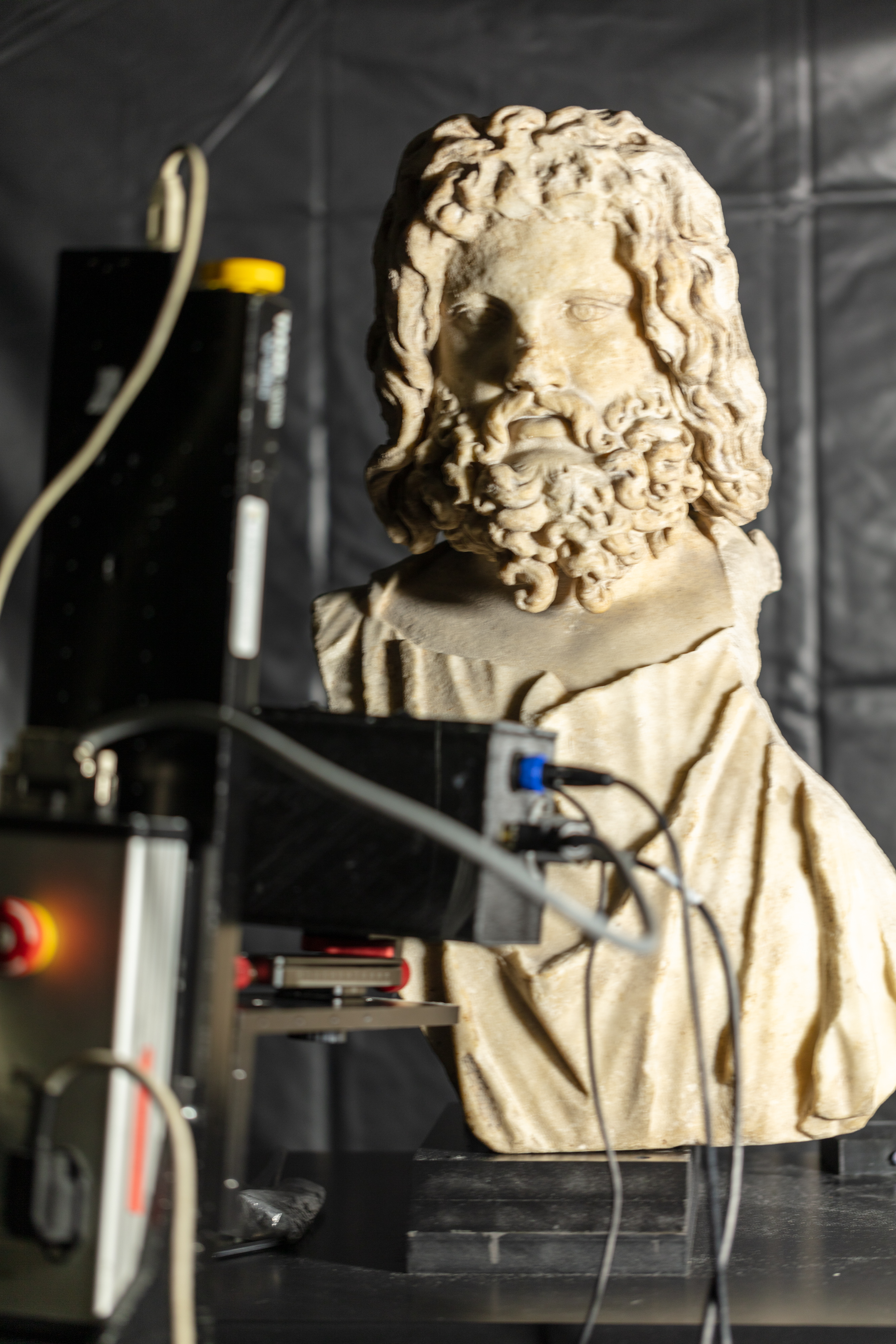
Where there are still some ambiguities regarding the chemical, structural and molecular nature of the pigments used, further investigations can be applied.
This is the case of Raman spectroscopy (MRM) and of Time of Flight Secondary Ion Mass Spectrometry (ToF-SIMS) which allows the identification of the organic and inorganic elements that make up the pigments, their spatial distribution and also the color installation techniques.
In addition, some microsamples are studied under a microscope in the laboratory, in order to verify the stratigraphy of the pictorial layers.
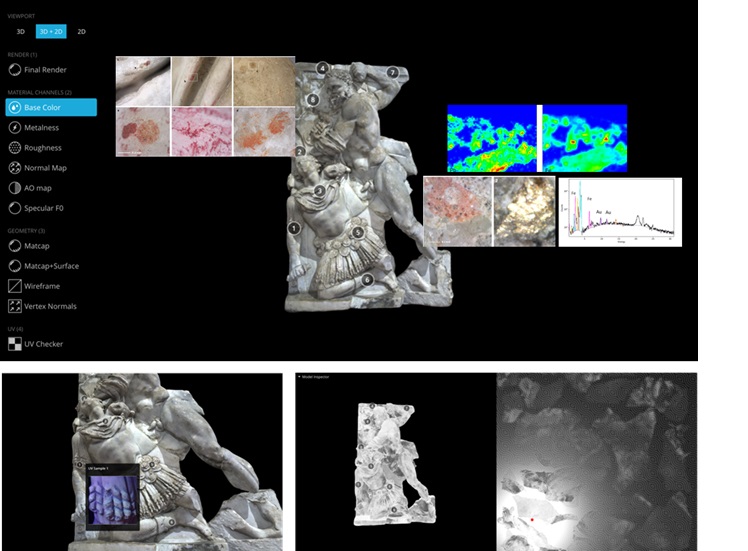
Combining all the results that come from the analysis techniques, the ultimate aim is to reconstruct the original chromatic aspect of the sculpture, attempting to understand the gestures and knowledge that led to its creation.
Essential bibliography/sitography:
- https://www.polychromyroundtable.com/;
- Bourgeois, B 2014, ‘Étudier et conserver la polychromie antique. Vidéo-microscopie et archéologie de la surface’, in B Bourgeois (eds), Thérapéia. Polychromie et restauration de la sculpture dans l’Antiquité, Techné, 40, pp. 3-7;
- Brunelle, A 2019 ‘Imagerie par spectrométrie de masse TOF-SIMS pour l’analyse de tableaux anciens’, Les techniques de l’ingénieur. Techniques d'Analyse;
- Dyer, J, Verri, G & Cupitt, J 2013, Multispectral Imaging in Reflectance and Photo-induced Luminescence modes: A User Manual, European CHARISMA Project. CHARISMA;
- Iannaccone. R, Bracci. S, Cantisani, E & Mazzei, B 2015 ‘An integrated multimethodological approach for characterizing the materials and pigments on a sarcophagus in St. Mark, Marcellian and Damasus catacombs’, Appl. Phys. A 121, pp. 1235–1242;
- Østergaard, JS 2018 ‘Polychromy, sculptural, Greek and Roman’, Oxford Classical Dictionary;
- Strivay, D & Neri, E 2024, ‘Les techniques d’analyses physico-chimiques des couleurs perdues’, in E Neri (eds), Polychroma. The Meaning of Colours in Roman Sculptures, Silvana Editoriale, Cinisello Balsamo, pp. 56-60.