
Chiragan (Martres-Tolosane)
The site of Chiragan is located on the left bank of the Garonne, about 60 km southwest of Toulouse, on the western extension of the Narbonense province bordering Aquitaine. The area occupied by the villa is at the crossroads of major communication routes and trade of goods between the Toulouse plain and the Pyrénées, utilizing the Garonne corridor and the Roman road from Toulouse to Lugdunum Covenarum.
Over the centuries, the site was exploited as a quarry for building materials and marble. Systematic exploration of the Chiragan villa began in 1826 with excavations conducted by Alexandre du Mège, Secretary and Inspector of Antiquities for the Musée de Toulouse. From 1890, investigations by Albert Lebègue finally identified the remains as a Roman villa.
However, it was only with the campaigns led by Léon Joulin (1897-99) that excavations were carried out, focusing on the layout of the buildings and their context. His surveys have been confirmed by geophysical prospections and recent sondages and his publication of the site remains a fundamental starting point for studies on the villa today.
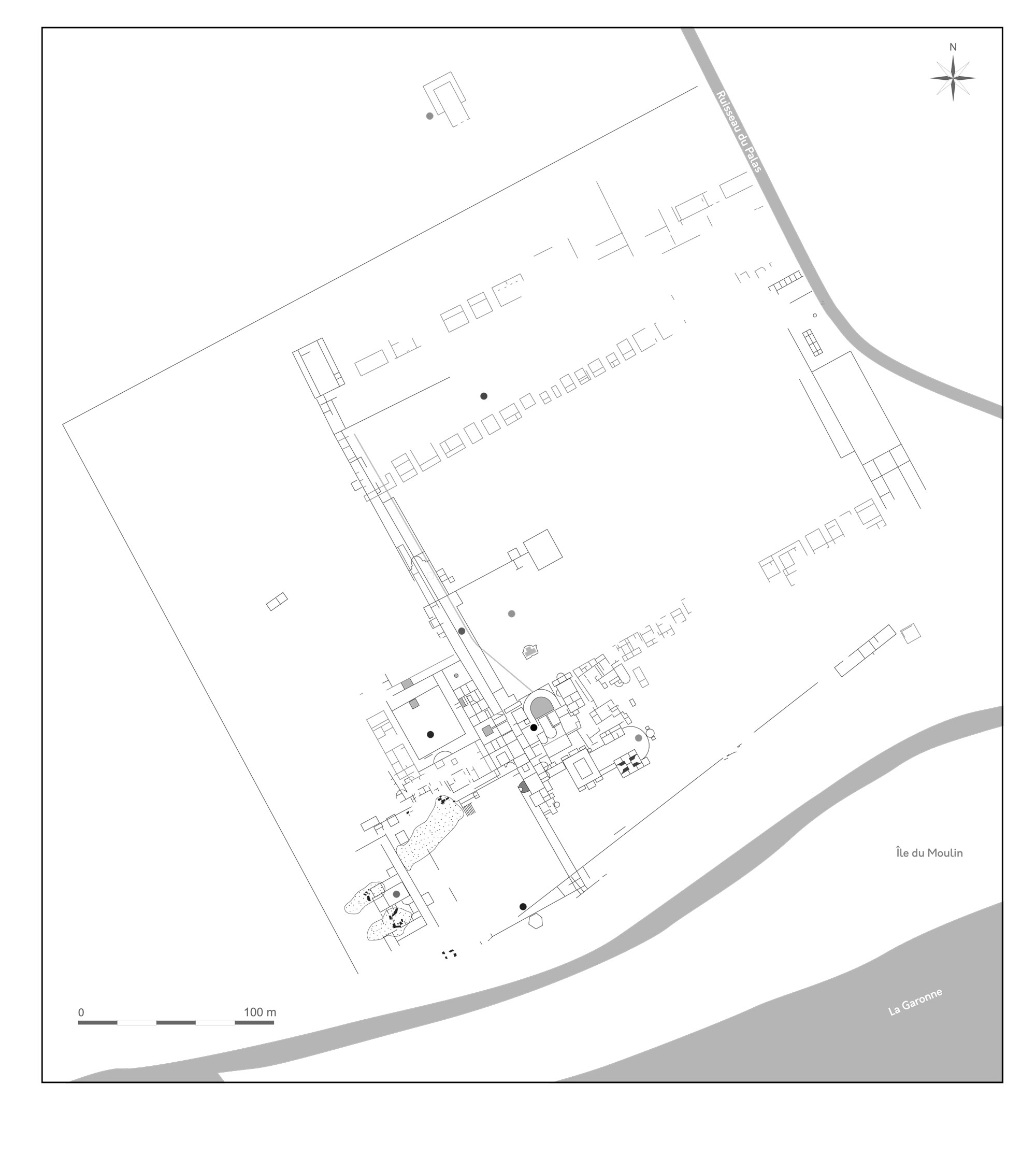
The villa is divided into a luxurious residential sector (pars urbana) and a pars rustica organized into multiple pavilions aligned respectively along the northern and southern boundary walls and near the river. It covers 16 hectares within a walled enclosure. Studies carried out on the masonry techniques and the coins found at the site indicate that the villa existed since the Augustan period till at least the early 5th century A.D. Three major renovations are supposed: the first during the early Empire and the others in later periods, with an impressive phase of restoration during the Tetrarchic period; it was abandoned during the period of greatest development and expansion.
The pars urbana, in the southwest corner of the enclosure, developed during the initial construction phase around a large peristyle measuring thirty meters per side. This luxurious core was significantly expanded perhaps as early as the same century, then in the following one, and more monumentally in late antiquity, with the addition of a large thermal complex and a series of buildings overlooking the river.
It is estimated that the villa could have managed a fundus of 1,000 hectares, with around a hundred workers housed in the pars rustica. Functionally and in terms of layout, Chiragan’s complex is designed according to the typical scheme of a rural residence. However, it differs from other rural villas known from this chronological horizon in Gaul due to its considerable size in the final phase, the evolution of the functions of its various parts, and the exceptional decorative elements discovered. Some comparisons should be made with high-level residences used in Late Antiquity (such as the villa of Orbe-Boscéaz in Gaul) or with provincial “palatial” estates (like Piazza Armerina in Sicily, Cercadilla in Córdoba, Mediana in Niš, Serbia).
From the Chiragan villa comes an impressive collection of statues made from various marbles, mainly from Asia Minor and the Pyrénées (Saint-Beat), produced in high-level workshops connected to high-ranking patrons. Most of these sculptures, now housed in the Musée de Saint-Raymond in Toulouse, were discovered during du Mège’s excavations within three large “trous de décombres”, likely intended as fornaces calcaria and associated with a single dismantling phase of the decorative apparatus.
The chronological range of these sculptures spans from the 1st to the early 5th century AD and includes numerous statues and reliefs depicting mythological subjects, imperial and private portraits, and idealplastik statuettes. This ambitious decorative program reflects the tastes and resources of the owners and attests to the circulation of artworks, models, raw materials, and artisans within this western province.
Although it is not possible to identify the villa’s owners, the large quantity and high quality of portraits, including the series of high officials, suggest that it can be interpreted as the residence of a provincial governor who had his residence both in Gallia and in the capital and was probably part of the provincial élite holding official positions in Rome. The suggestion that the gens Aconia might have been the owner of Chiragan, stems from the inscription found on the fragmentary base (no. 86, inv. 31.087) of a now lost late Imperial bust; furthermore, the name Aconii remained long associated with the site that still in the 16th century was known as “Angonia”.
The presence of the gallery of imperial portraits, which is unparalleled outside that of Hadrian's Villa, and the high quality of the sculptural apparatus have also allowed us to hypothesize that the villa was an imperial residence.
The marbles from Chiragan do not show apparent traces of polychromy; however, investigations into the original color have yielded important results in order to reposition the villa’s furnishings within their production and reception context, helping to clarify the values, ideas, and effects conveyed.
Essential bibliography:
- Balty, JC 2012, ‘Chiragan, un domaine impérial aux portes de la Narbonnaise’, in JC Balty & al. (eds.) 2012, Sculptures antiques de Chiragan (Martres-Tolosane), I.2 Les portraits romains. Le siècle des Antonins, Musée d'archéologie de Toulouse, Toulouse.
- Balty, JC, Cazes, D 2005, Sculptures antiques de Chiragan (Martres-Tolosane) I.1, Les portraits romains: Époque julio-claudienne, Toulouse, Musée d'archéologie de Toulouse, Toulouse.
- Balty, JC, Cazes, D 2008, Sculptures antiques de Chiragan (Martres-Tolosane) I.5, Les portraits romains: La Tétrarchie, Musée d'archéologie de Toulouse, Toulouse.
- Balty, JC, Cazes, D 2008, Sculptures antiques de Chiragan (Martres-Tolosane) I.5, Les portraits romains: L’époque des Sévères, Musée d'archéologie de Toulouse, Toulouse.
- Balty, JC, Cazes, D, & Rosso, E (eds.) 2012, Sculptures antiques de Chiragan (Martres-Tolosane), I.2 Les portraits romains. Le siècle des Antonins, Musée d'archéologie de Toulouse, Toulouse
- Bergmann, M 1995, ‘Un ensemble de sculptures de la villa romaine de Chiragan, œuvre de sculpteurs d’Asie Mineure, en marbre de Saint-Béat?’, in J Cabanot, R Sablayrolles & JL Schenk (eds), Les marbres blancs des Pyrénées. Approches scientifiques et historiques, Saint-Bertrand-de-Comminges, pp. 197-205.
- Bergmann, M 1999, Chiragan, Aphrodisias, Konstantinopel: Zur mythologischen Skulptur der Spatantike, Wiesbaden.
- Capus, P 2019, Les sculptures de la villa romaine de Chiragan, Toulouse, viewed august 2025, https://villachiragan.saintraymond.toulouse.fr.
- Neri, E, Capus, P, Dardenay, A & Strivay, D 2024, ‘Les sculptures de la villa de Chiragan (Musée Saint-Raymond, Toulouse): une première étude sur la polychromie’, in: E Neri (ed.), Polychroma. The Meaning of Colours in Roman Sculptures, Silvana Editoriale, Milan, pp. 256-279.