-
Description
-
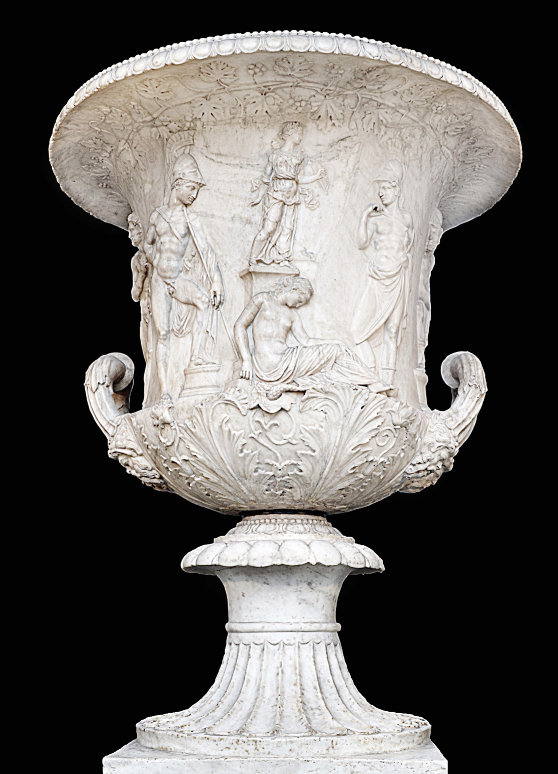
The monumental Medici Vase was probably discovered on the Esquiline Hill in the 1570s, in a fragmentary yet largely complete condition, and was reassembled shortly after its discovery. Acquired by Ferdinando de’ Medici, it was placed in his villa on the Pincian Hill and later transferred to Florence in 1780. Among the surviving ancient marble vases, the Medici Vase is distinguished by the presence of a figurative frieze with a non-Dionysiac subject, the interpretation of which remains particularly complex.
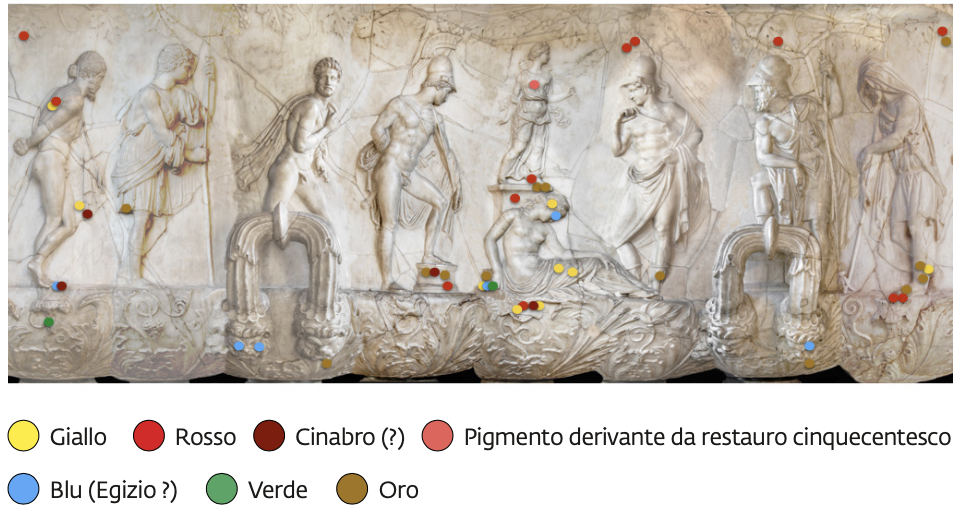
The frieze is centered on a semi-nude female figure reclining at the feet of a statue restored in the sixteenth century as Artemis but originally representing Apollo Lykeios. Around her are seven male figures, some nude and armed, generally identifiable as heroes of the Homeric epic; only Odysseus can be securely identified through a distinctive and exclusive iconographic scheme. The scene is framed above by a vine-scroll frieze, while the lower part of the vase is decorated with a rich vegetal ornamentation. Archaeometric analyses have confirmed the original polychromy of the vase, with surviving traces of green, gold, and blue.
Interpretations of the figurative scene have long been varied and debated, ranging from the liberation of Helen by the Dioscuri to the more widely accepted reading of the scene as the consultation of the Delphic oracle by the Achaean princes. Recent scholarship increasingly recognizes the subject as deliberately enigmatic, likely drawn from a now-lost poem of the Homeric epic tradition. From a chronological perspective, comparisons with other marble kraters allow the vase to be dated to the final decades of the first century BC.
Particular importance is attributed to the vegetal decoration with polycarpous acanthus scrolls, a motif of Pergamene origin imbued with strong Apollonian associations, which plays a crucial role in the overall interpretation of the monument. As in the Ara Pacis, the vegetal frieze of the Medici Vase functions as a key symbolic element and reflects the allusive and intellectually selective visual language of the early Augustan period, likely intended for an elite and highly educated audience attuned to literary and political references that are now only partially recoverable.