-
Description
-
The sarcophagus is attributed to a local workshop active in the sixth century. It is characterized by sides articulated with colonnettes and covered by a hemi-cylindrical lid. The front is organized into three aediculae: the central one, surmounted by a pediment, is flanked by two lateral aediculae framed by arches and decorated with shell motifs. Within the central aedicule, a lamb stands upon a mount from which flow the four rivers of Paradise, while behind it two doves are positioned on either side of a cross. The lateral aediculae enclose two Latin crosses. A comparable decorative scheme was intended for the rear of the sarcophagus, which, however, remains unfinished.
The short sides are occupied by two kantharoi; on the rim of one vessel two doves are depicted. The lid is entirely covered with a scale pattern, while its short ends display distinct iconographic motifs: on one side, an interlaced braid pattern centered on a cross, and on the other, two lambs feeding on the fruits of a palm tree.

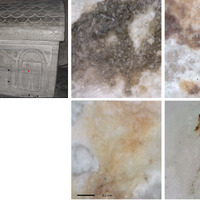 Fig_4.tif