
Statue of Minia Procula (inv. no. C 1020).
Item
- Other Media
-
 C 1020_fig.1
 -
 C 1020_fig.2
 - Description
- A larger-than-life draped and veiled female statue, found between the entrance to the cella and the door leading to the left-hand chamber. It had fallen in front of an inscribed base bearing the name of the priestess Minia Procula. The statue is generally associated with the base and, consequently, with the figure being celebrated.
- Typology
- Portrait
- Definition
- Statue of Minia Procula (inv. no. C 1020).
- Collection
- Tunis, Bardo National Museum.
- Inventory number
- C 1020
- Provenance
- Temple of Apollo, Bulla Regia.
- Date
- 2nd c. CE
- Material
- White marble
- Dimensions
- Height 184 cm
- Analytical methods
- VIS
- VIL
- UV
- MO VIS
- MO UV
- Autoptic examination
-
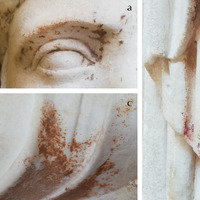
Numerous traces of colour are visible to the naked eye. Traces of yellow-orange paint are visible on the entire right side of the face and in the décolletage. A white-yellow paint is still visible in the hair, tear ducts, between the lips, and at the bottom of the tunic. The veil is colored a diffuse yellow, and the headband shows thick traces of bright orange paint, heavily altered on the surface. Thick traces of brownish-orange color are present throughout. The bottom of the cloak is highlighted with a red band, still visible in the folds of the drapery, at the level of the left arm and feet. Numerous traces of color are also noted in the drapery.
- Imaging
-
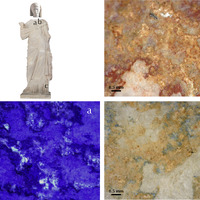
The preparatory white-yellow layer is fluorescent under UV light.
A layer of red on the skin of the face, on the folds and edges of the cloak, is superimposed on the yellow layer. Microscopy shows that the yellow layer, visible as white under UV light, covers a red layer in the cloak and a blue layer in the tunic.
- Under painting traces
- no
- Pigments
- Red, blue, yellow (sandyx).
- Binder
- n.d.
- Stratigraphy
- n.d.
- Shading
- no
- Metallic traces
- no
- Tools marks
- no
- Background colour
- no
- Apparent marble parts
- no
- Restorations
-
Two phases: 1. Polychrome; 2. monochrome .
- Polychromy technique
- The entire surface appears to have undergone a preparatory treatment of a white-yellow color, on which, a second and in some part also a third layer of pain is applied. The skin was colored with a thin layer of yellow-orange paint; the hair, as well as facial features such as the eyes, eyebrows, and mouth, received a third, thicker layer of paint in a red-orange color. An ancient restoration of the color is attested on the cloak and on the tunic, where a second phase of yellow paint covers respectively a red and a blue layer.
- Anthropomorphic/realistic
-
Phase 1: Antropomorphe simplified?
Phase 2: metallic (imitation gilding). - Imitation of other supports
- metal