
Statue of Faustina as Ceres (inv. no. C 1015)
Item
- Other Media
-
 C 1015_fig.1
 -
 C 1015_fig.2
 -
 C 1015_fig.3
 -
 C 1015_fig.4
 - Description
-
The colossal statue of Faustina as Ceres was discovered in the cella of the Temple of Apollo at Bulla Regia, to the left of the Apollo Citharoedus.
Initially it was identified as Demeter, then, based on the portrait, as Sabina, and more recently, N. de Chaisemartin considered it a Faustina Minor, the product of a provincial workshop that combined several models.
The colossal proportions and the idealized portrait offer a posthumous and deified image of the empress. This also allows the statue to be dated to the end of the third quarter of the 2nd century, as has also been proposed for the Aesculapius and the Apollo found in the temple cella. The location and typology could suggest a possible cultic function for the statue, if the context of its display is not secondary.
- Typology
- Portrait
- Definition
-
Statue of Faustina as Ceres (inv. no. C 1015)
- Collection
- Tunis, Bardo National Museum.
- Inventory number
- C 1015
- Provenance
-
Temple of Apollo, Bulla Regia (cella).
- Date
-
The end of the third quarter of the 2nd c. CE
- Material
- White marble
- Dimensions
- Height 224 cm
- Analytical methods
- VIS
- VIL
- UV
- MO VIS
- MO UV
- Autoptic examination
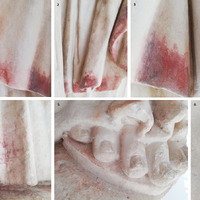
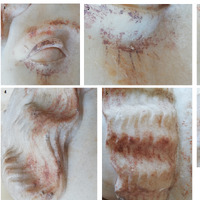
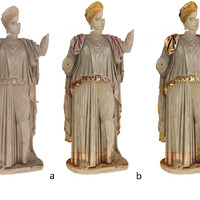
- Traces of paint are visible to the naked eye; the polychromy is well preserved. Large painted areas are observed on the hair and eyebrows (orange), on the diadem (yellow), and the eyes (violet), on the peplos, which has a red border and a rose with motifs, on the base. The eye is drawn with a very fine brush that meticulously renders the eyelashes and corners.
- Imaging
-
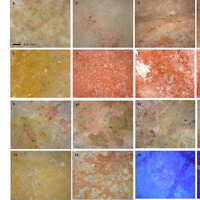
Microscopic examination clarifies the tone and spatial distribution of the pigments.
The skin of the face and neck was rendered matte with a light yellow layer, preserved on the left cheek, under the chin and in the right eye, as well as between the drapery of the peplos and the neck in the upper right. The same treatment (light yellow layer) is found on the feet, preserved only between the toes and in the nail folds, where the shading effects are emphasized by layers of black and red paint. The lip canal shows traces of bright red paint applied over the yellow layer. The right eye retains violet paint on the eyelid and the lower part of the eye, where the eyelashes are clearly defined.
The hair and the eyebrows are painted a brownish-orange. Two layers of yellow paint remain on the diadem, creating a gilded effect: one applied to the marble, which fluoresces under a 750 UV lamp, and another more matte layer. Over this second layer, in the center of the diadem, are traces of a third, brownish layer, probably indicating the presence of an indistinct decoration.
The peplos bore scattered traces of a yellowish-white layer, maybe to conceive as concretion; it’s possible that the marble of the peplos was originally exposed.
A red border characterized the fabric's hem, with two layers of red on the right and left sides: one thinner layer resting on the marble, the other, a thicker, darker, superficial layer, suggesting a restoration of the border. The garment's lower edge was decorated with a yellow band adorned with pink flowers; the pink fluoresces under UV 750 lamps.
The soles and straps of the sandals are red and show superimposed traces of black paint. The upper surface of the base was also painted yellow and red highlights the garment's shadows.
- Under painting traces
- Purple lines around the eyes.
- Pigments
-
Red, yellow, white, purple, pink.
- Binder
- n.d.
- Stratigraphy
- n.d.
- Shading
- Darker gradient on the skin, red shadow projected onto the base.
- Metallic traces
- no
- Tools marks
- 2,2 mm brushstrokes for preparatory traces.
- Background colour
- no
- Apparent marble parts
- Peplos
- Polychromy technique
-
The first layer of yellow paint on the diadem has a very glossy appearance, which could suggest the use of an organic binder (wax?).
- Imitation of other supports
- chryselephantine
- Polychromy type
-
The statue features a complex polychrome program that enriches the makeup and refines the details of the diadem, peplos and shoes to produce an illusionistic and idealizing effect. The use of a finish paint, extending beyond the contours of the eye as defined by the sculptural form, made the statue's gaze more visible, suggesting it was likely intended to be viewed from below and from a distance, from a low angle. This suggests that the color is related not only to the statue's dimensions but also to its location. This detail could indicate an original placement at a height and, consequently, the secondary nature of the context. The yellow paint of the upper surface of the base simulates a metallic effect.