
Statue of Aesculapius (inv. no. C 1014)
Item
- Other Media
-
 C 1014_fig.1
 -
 C 1014_fig.2
 - Description
-
This colossal statue of Asclepius, was found in the cella of the Temple of Apollo at Bulla Regia. According to Merlin's description, in the cella this statue flanked on the right the statue of Apollo, standing in the center, while on its left there was one of Ceres, now recognized as a colossal portrait of Faustina the Younger. The statue of Aesculapius gave its name to the "Tunis type" of representation of the healing god. Derived from a 4th-century original, it’s particularly widespread in Africa (23 out of 40 examples) where, with a few exceptions, other statuary models of the god are virtually unknown. This widespread presence has led to talk of an "African monopoly" in the dissemination of this type and to seeing it as a specific characteristic of the African representation of Asclepius.
- Typology
- Ideal sculpture
- Definition
-
Statue of Aesculapius (inv. no. C 1014)
- Collection
- Tunis, Bardo National Museum.
- Inventory number
- C 1014
- Provenance
- Temple of Apollo, Bulla Regia.
- Date
- 2nd c. CE
- Material
- White marble
- Dimensions
- Height 251 cm
- Analytical methods
- VIS
- VIL
- UV
- MO VIS
- MO UV
- Autoptic examination
-
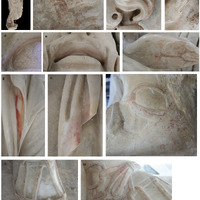
Traces of polychromy in several places; the statue is currently displayed in a reclining position, so that it has only been analyzed on its front side. The hair, both on the crown and in the curls, as well as the beard, retains a uniform and thick layer of orange; some strands are painted with dark brown, others with a brighter red. The dark brown is found in the strands on the right, while the red paint is on the strands near the neck on the left. The left eye is outlined in orange and traces of a darker paint remain in the lacrimal caruncle. A yellow painted area remains on the pupil, and below it are black lines that may belong to the preparatory drawing of the iris. The lips show translucent pink paint in the labial sulcus.
The cloak is painted red with varying shades and has yellow areas, probably positioned at the points of light. These are located either inside or on top of the fold.
The snake, especially on its head, has a glossy light brown paint with a more superficial blue-green layer visible in places.
The sole and straps of the sandals are colored only by a dark reddish-brown line, drawn in the middle of the strap's surface, except for the transverse strap, which is colored a bright red closer to that of the drapery.
The eyelets around the ankles, connected by a wide lace that fastens the sandal at the ankle, feature a floral design, likely applied using a stencil, visible only on the left foot.
The support, shaped like a bundle of rollers, displays a linear painting identical to the straps.
On the base, the statue's shadow is created as a red halo around the feet.
- Imaging
-
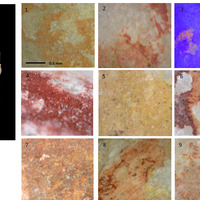
Microscopic examination is conducted only in certain areas and warrants further investigation; it confirms the pictorial nature and the color palette observed with the naked eye. The pink paint observed in the labial sulcus under UV light, exhibits a pink fluorescence, which could suggest the use of an organic pigment. However, this fluorescence differs from the typical orange color of madder lacquer, usually used as a colorant in Roman statuary.
- Under painting traces
- no
- Pigments
- Red, pink, yellow, orange
- Binder
- n.d.
- Stratigraphy
- n.d.
- Shading
-
Darker gradient on the skin, red shadow projected onto the base.
- Metallic traces
- no
- Tools marks
- no
- Background colour
- no
- Apparent marble parts
- no
- Restorations
- no
- Polychromy technique
- The pigments, with their large grain size, are applied directly to the marble and have very vibrant tones. The refined tonal variations in hair treatment were probably intended to give shine and movement. The presence of green and blue paint superimposed on the first layer—orange, brown, red—that colors the hair confirms the intention to reproduce volumetric effects with paint. In some cases (pink on lips) the paint is probably applied very diluted.
- Anthropomorphic/realistic
- Anthropomorphic
- Polychromy type
-
The polychrome program was probably intended to bring the divine nature closer to human one, by offering realistic coloring of the hair, beard, lips, cloak, sandals, and serpent. The physical presence of the god of health is also conveyed by the shadow cast on the base. The white skin against the exposed, shadowless marble, unless it depends on his preservation, distances him from the human dimension.