
Fragment of leg and draped support (inv. no. 010326 417)
Item
- Other Media
-
 010326 417_fig.1
 - Description
- Fragment of a leg from the knee above the ankle and a draped garment providing support.
- Typology
- Ideal sculpture
- Definition
- Fragment of leg and draped support (inv. no. 010326 417)
- Collection
- Tunis, Bardo National Museum.
- Inventory number
- 010326 417
- Provenance
- The original provenance of the sculpture is unknown.
- Date
- ?
- Material
- White marble
- Dimensions
- Height 58 cm (support); height 28 cm (leg)
- Analytical methods
- VIS
- VIL
- UV
- MO VIS
- MO UV
- MAXRF
- Autoptic examination
- Some traces of red paint are visible to the naked eyes on the drapery, while yellow patches are prominent on the left calf and knee. The paint layers are thin, except on the front surface of the support, at the tenon, where they are preserved in a considerable thickness.
- Imaging
-
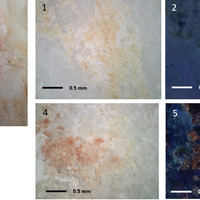
Examination under a video microscope reveals the color distribution and stratigraphy. The drapery exhibits a homogeneous off-white-yellow preparatory layer, which appears white under UV light. Over this layer is a yellow, orange, or red coloration, depending on its position within the folds. The yellow appears gray under UV light, suggesting a probable composition containing hematite, derived from the use of iron-based earths. The orange and red colors exhibit orange fluorescence; this could indicate the use of an organic pigment such as madder lake. If the state of preservation corresponds to the original color distribution, the cloak was dyed white with highlights in orange-red and yellow to emphasize the folds.
The leg is painted yellow with brown highlights at the knee.
- Under painting traces
- no
- Pigments
- White, red (ochres and lacquer), orange, yellow
- Binder
- n.d.
- Stratigraphy
- Directly applied on the marble?
- Shading
- Gradient of shades on the drapery.
- Metallic traces
- no
- Tools marks
- no
- Background colour
- no
- Apparent marble parts
- no
- Restorations
- no
- Polychromy technique
- The sum of analytic data could suggest a layering of lead white over a pigment composed of a mixture of vermilion, hematite, and probably an organic dye. On the leg, the presence of the association of lead, iron, and arsenic suggests the use of mimetite over a layer of lead white.
- Imitation of other supports
- metal