
Venus Anadyomene (inv. no. 010326 181)
Item
- Other Media
-
 010326 181_fig.1
 -
 010326 181_fig.2
 - Description
- The headless statue of Venus Anadyomene is smaller than life-size and was probably once adorned with drapery in the lower section. The lower edge has a smooth rim and internal pecking, indicating that the upper body was fitted into a second piece. It would have been displayed from behind, probably in a niche.
- Typology
- Ideal sculpture
- Definition
- Venus Anadyomene (inv. no. 010326 181)
- Collection
- Tunis, Bardo National Museum
- Inventory number
- 010326 181
- Provenance
- The original provenance of the statue is unknown
- Date
- 2nd c. CE
- Material
- White marble
- Dimensions
- Height 365 cm
- Analytical methods
- VIS
- VIL
- UV
- MO VIS
- MO UV
- MAXRF
- TOF/SIMS
- Autoptic examination
-
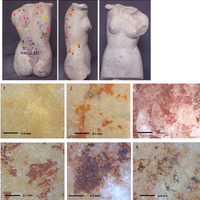
There are large areas of red and orange paint on the back and sides, in particular on the left shoulder blade, the right flank, and in the hollows of the lower back.
- Imaging
-
Observation under UV light shows that the paint layers appear black, suggesting the use of hematite. Microscopic examination reveals a variety of shades, from yellow to brown, including orange and red. The color is darker, almost brown, on the right side of the back, particularly on the lower back. In the lower half of the back, green dots are observed on the reddish-brown paint.
- Under painting traces
- no
- Pigments
-
Red, yellow (ochre), orange, brown, blue (terres-vertes)
- Binder
- Punic wax
- Stratigraphy
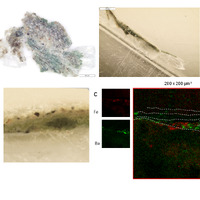
- Directly on the marble
- Shading
- Green shades
- Metallic traces
- no
- Tools marks
- no
- Background colour
- no
- Apparent marble parts
- no
- Restorations
- no
- Polychromy technique
-
The presence of palmitic acid and natron indicates the use of a wax-based organic binder, probably applied cold, saponified with natron, according to the recipe transmitted by Pliny and Vitruvius. Pigments are applied directly to the marble.
- Polychromy type
-
It can be argued that red is the predominant colour.
The chromatic finish in the lower half of the back emphasizes the movement of the statue and accentuates the shadows cast by the sculptural form.