
Statue of Athena Parthenos
Item
- Other Media
-
 SSN_fig.1
 - Typology
- Ideal sculpture
- Definition
- Statue of Athena Parthenos
- Collection
- Tunis, Bardo National Museum.
- Inventory number
- SSN
- Provenance
- Capitol of Oudna
- Date
- 2nd c. CE
- Material
- White marble
- Dimensions
- Height: 29 cm
- Analytical methods
- VIS
- VIL
- UV
- MO VIS
- MO UV
- MAXRF
- Autoptic examination
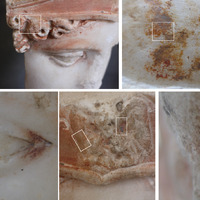
- There is a wide variety of colored surfaces, particularly on the helmet, that has different shades of brownish-yellow and red, while the visor is pinkish-red and the bird relief at the top of the forehead is brown, pink and blue. The hair, the right eyebrow and the corners of the lips are red. The area around the eyes is purplish-red, and the eyeballs show traces of yellow on their surface (as well as brownish concretions, due to the poor state of preservation of the sculpture). Traces of yellow are noted on the wings of the nose.
- Imaging
- The skin is colored yellow only near the helmet, hair, and corners of the mouth. The eyes are outlined in a darker red tone, like the hair. Bright yellow is seen on the helmet visor medallion; here the eagle is highlighted in pink overlaid with blue
- Under painting traces
- no
- Pigments
-
Yellow (mimetite), orange (vanadinite), red (minium) Egyptian blue.
- Binder
- n.d.
- Stratigraphy
- Directly on the marble
- Shading
- Red shades on the temples
- Metallic traces
- no
- Tools marks
- no
- Background colour
- no
- Apparent marble parts
- no
- Restorations
- no
- Polychromy technique
- The upper part of the helmet retains two superimposed layers of translucent colors: brown overlaid on yellow. The pigments were probably applied very diluted, compared to the denser, thicker pigments seen on the eyes, hair, and forehead
- Polychromy type
-
The polychromy of the helmet, achieved with synthetic pigments, the layering, and the mixing of colors, could evoke a polychrome bronze with a gilded visor and an enhanced eagle.
As for the hair, the dark circles around the eyes, and the red shadows cast on the face, we cannot know whether these represent the final state of the polychromy or are simply a quirk of preservation.
We can observe that different shades of red lead were used for the shadows on the face, reminding us that this head was intended to be viewed from a low angle and from a distance. The coloring seems to draw attention to the details of the helmet, the eyes, the hair, and the lips of the goddess.
It can be argued that red is the predominant colour.