
Statue of Apollo Citharoedus (inv. no. C1013)
Item
- Other Media
-
 C1013_fig.1
 -
 C1013_fig.2
 - Description
-
This colossal statue of the god stands facing forward, with his head turned upwards and to the left; it has the torso strongly inclined and slightly to the right, with right arm folded across his head and his left arm resting on the cithara. His hips are tilted forward, his right leg supporting his weight, his left leg slightly bent and resting on a raised section of the base.
The model is that of the Apollo Citharoedus attributed to Trimalchides (MC628), which derives from the Lycian Apollo of Praxiteles - Typology
- Ideal sculpture
- Definition
- Statue of Apollo Citharoedus (inv. no. C1013)
- Collection
- Tunis, Bardo National Museum.
- Inventory number
- C1013
- Provenance
- Temple of Apollo of Bulla Regia
- Date
- 2nd c. CE?
- Material
- White marble
- Dimensions
- Height max: 302 cm
- Analytical methods
- VIS
- VIL
- UV
- MO VIS
- MO UV
- Autoptic examination
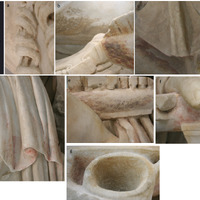
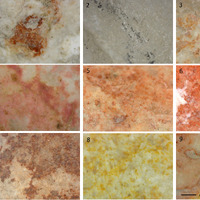
- Numerous and consistent traces of color across the entire surface of the statue. The hair shows traces of yellow pigment with brown highlights. The skin on the temples, on the corners of the mouth, on the neck, the lower torso where it meets the cloak and feet retains traces of a thick, homogeneous white paint layer that likely characterized the flesh. Yellow and off-white hues are documented on the left side under the left arm and behind the right shoulder, and between the cloak's drapery and the torso. On the face, the details of the paint finish have not been preserved due to abrasion of the pupils and the mutilation of the lips. Only black (preparatory?) lines encircle the eyes. The cloak shows traces of red paint on the folds of the left edge
- Imaging
- Across the entire surface of the cloak, including the back, there is red and pink colour, with varying shades: the folds and the edge at the hips and arm are darker, while where the cloak is fitted around the left leg, it’s lighter. There are traces of brown paint on the straps and on sandal soles; brown pigment is mixed with black on the right sole. The cithara and the molded pillar on which it rests are painted yellow, as the double row of dentils and the conical ends of the crossbar
- Under painting traces
-
Black lines around eyes
- Pigments
- White, red, black, brown, yellow
- Binder
- n.d.
- Stratigraphy
- no
- Shading
- Darker gradient on the skin, red shadow projected onto the base
- Metallic traces
- no
- Tools marks
- no
- Background colour
- no
- Apparent marble parts
- no
- Restorations
- no
- Polychromy technique
- The paint is applied directly to the marble. The scrolls and uprights of the cithara show no highlights or attempts at shading, except on the figures (Marsyas, naked and hanging from a tree, and the Scythian sharpening his knife). The crossbar features a well-preserved, drawn and painted scale decoration. Six vertical lines and probably horizontal reference points allow for the creation of the decoration, which alternates between white and red half-peltes. The upper side of the base, left pitted and unpolished, features yellow paint overlaid with a red layer near the feet. This layer probably creates the effect of the shadow cast by the statue on the base
- Anthropomorphic/realistic
- Anthropomorphic
- Polychromy type
-
The decoration on the crossbar imitates the carapace from which the instrument is made.
The presence of paint on the back of the statue, in areas accessible for examination, as well as the spiral modeling with projecting hips suggests that the statue was originally exhibited freely