
Fragment of relief depicting a libation scene (inv. no. 010326 113)
Item
- Other Media
-
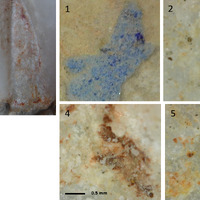 010326 113_fig.1
 - Description
-
This fragment of relief depicts a libation scene: a (heroic?) figure wearing a cloak draped over his left shoulder and forming a large fold around his left arm pours the liquid from a patera onto a votive altar. Headless, he likely wore a capite velato, according to Roman ritual practices.
- Typology
- Relief
- Definition
- Fragment of relief depicting a libation scene (inv. no. 010326 113)
- Collection
- Tunis, Bardo National Museum.
- Inventory number
- 010326 113
- Provenance
- The original provenance of the statue is unknown
- Date
- 2nd c. CE?
- Material
- White marble
- Dimensions
- Height: 165 cm
- Analytical methods
- VIS
- VIL
- UV
- MO VIS
- MO UV
- Autoptic examination
-
Yellow, red, and orange traces, visible to the naked eye, are preserved mainly on the lower part of the relief and on the altar's crowning element.
- Imaging
-
An examination under a video microscope documents the distribution of colours in areas where they are not visible to the naked eye: the background retains blue areas, as attested in the majority of reliefs from the classical period; the colour of the flesh (bust and right leg) is rendered through a mixture of white, orange and black grains, highlighted in yellow or brown in the transverse sternal, pectoral and abdominal lines; the mantle is dark red (purple); pulvilli, Attic band and moldings of the base are tinted in red, while the body in yellow with details (of a decoration?) in red; the patera retains yellow and a bright orange rim.
- Pigments
- Yellow, red, orange, dark red, mixture of white, orange, black
- Binder
- n.d.
- Stratigraphy
- Preparation layer of calcium sulfate
- Shading
- no
- Metallic traces
- no
- Tools marks
- no
- Background colour
- blue
- Apparent marble parts
- no
- Restorations
- no
- Polychromy technique
- The flesh colour (bust and right leg) is rendered through a mixture of white, orange and black grains, highlighted in yellow or brown in the transverse sternal, pectoral and abdominal lines.