
Colossal right foot of a male figure (inv. no. 10326 345)
Item
- Other Media
-
 010326 345_fig. 1
 -
 010326 345_fig. 2
 -
 010326 345_fig. 3
 - Description
- Colossal right foot (h. 0.29 m) from a male figure, wearing a sandal composed of a strap ending in three points above the second toe and encircling the finger joints, and a second strap covering the instep. The sole, made of three layers, is horizontal. The foot thus appears to rest flat on a base, of which a fragment is preserved. The generic provenance from Carthage does not allow the contextual setting of the piece to be determined. Carefully polished and precise in the rendering of the footwear details, this foot could have belonged to a male divinity or to an imperial statue.
- Typology
- Ideal sculpture
- Definition
- Colossal right foot of a male figure (inv. no. 10326 345)
- Collection
- Tunis, Bardo National Museum
- Inventory number
- 10326 345
- Provenance
- Carthage
- Date
- 2nd century C.E.
- Material
- White marble
- Dimensions
- H 29 cm
- Analytical methods
- VIS
- VIL
- UV
- MO VIS
- MO UV
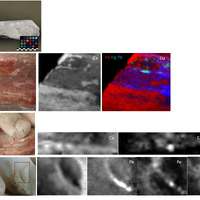
- MAXRF
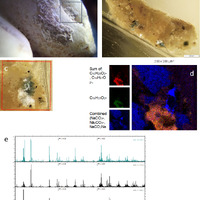
- TOF/SIMS
- Autoptic examination
-
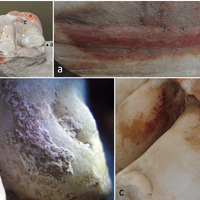
Under visual examination, the foot shows a translucent orange layer on the sandal strap, applied directly on the marble, above which a yellow-orange layer can be observed on the sole. This is itself covered by a stratum of red-orange paint. Within the thickness of the sole, this red layer partially covers the orange, and the trace of a brushstroke—likely a retouching—can be recognised.
The more superficial red paint is characterised by blue dots.
The skin displays an initial yellow layer applied directly onto the marble, darker in the area between the big toe and the sole, where the brushstrokes seem to create shadow effects, in accordance with techniques commonly found in Roman painting.
Between the toes and on the toenails, a very thick white layer with brown flecks was applied over the skin. - Imaging
-
Between the toes and on the toenails, a very thick white layer with brown flecks was applied over the skin. Under UV light, the white layer appears covered with superficial black incrustations. We may therefore affirm the authenticity of this whitening of the skin and exclude the possibility that it is merely an incrustation.
The superficial red layer of the sandal partially overlaps the yellow layer of the skin between the strap and the toes, between the toes themselves, and between the sole and the skin.
Videomicroscopy confirms the distribution of colours: red tones on the sandal, yellow ochre on the skin. The superposition of the red layer over the yellow and orange, and of the white over the yellow, is likewise confirmed. - Under painting traces
- no
- Pigments
- Phase I: yellow (ochre), red (vermilion), Egyptian blue; Phase II: red (minium), calcium sulfate, and lead white
- Binder
-
Punic wax
- Stratigraphy
- Phase I: directly on the marble; Phase II: calcium sulfate preparatory layer
- Shading
- Phase I: shaded in ochre tones; Phase II: blue dots.
- Metallic traces
- no
- Tools marks
- Overflow of the red paint from the strap onto the skin; retouched with a 4 cm brush
- Background colour
- no
- Apparent marble parts
- no
- Restorations
- Two phases and one retouch
- Polychromy technique
- The superficial red layer of the sandal partially overlaps the yellow layer of the skin between the strap and the toes, between the toes themselves, and between the sole and the skin.
- Polychromy type
- The superposition of the red layer over the yellow and orange led to deduce that the sole and strap were repainted several times, whereas the skin was restored only once. Since the superficial layers cover the underlying ones, there are at least two polychromy phases on the foot: one with ochre-yellow skin and a yellow-orange sandal, and a second with white skin and a dark-red sandal with blue dots.