
Head of Athena Lemnia (inv. no. 10326112)
Item
- Other Media
-
 010326112_fig. 1
 - Description
- This female sculpture, under life size (H. 0.165 m), attributed to the 2nd century CE and generally recorded as coming from Carthage, represents an Athena Lemnia. It displays classical features: a straight nose, fine eyelids, and a small, full mouth. The wavy hair is parted in the middle and wound around the ribbon of the headband. The fine-grained white marble of the face is polished, and the hair is finely chiselled. Its scale, type, and chromatic finish suggest that it may have been displayed in a domestic context.
- Definition
- Head of Athena Lemnia (inv. no. 10326112)
- Collection
- Tunis, Bardo National Museum.
- Inventory number
- 10326112
- Provenance
- Carthage, house?
- Date
- 2nd century C.E.
- Material
- White marble
- Dimensions
- H 16,5 cm
- Analytical methods
- VIS
- VIL
- UV
- MO VIS
- MO UV
- MAXRF
- Autoptic examination
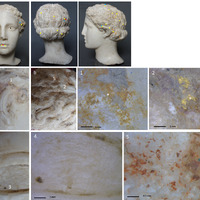
- To the naked eye, traces of orange-red colour are clearly visible in the hair, particularly above the right ear. The face shows no colour remains except for a few isolated traces at the eyes (yellow on the lower left eyelid and black along the right eyeball) and at the mouth (yellow on the lips and a red dot at the corner of the mouth).
- Imaging
- Microscopic examination confirms the presence of yellow, black, and red pigments at the eyes and mouth. A brown-orange colour is spread homogeneously across the hair, darker in the recesses of the locks, where small blue dots are also observed to create shadow effects. This layer served as the base for gold leaf, fragments of which are partially preserved, especially around the ears. In this area, a violet alteration is noted, likely due to the presence of an organic adhesive and its interaction with the gold. The headband and the skin preserve no paint and may have been left as visible marble.
- Under painting traces
- no
- Pigments
- Yellow (ochre), gold leaf
- Binder
- n.d.
- Stratigraphy
- Directly on the marble
- Shading
- no
- Metallic traces
- Gold leaf on the hair
- Tools marks
- no
- Background colour
- no
- Apparent marble parts
- skin
- Imitation of other supports
- chryselephantine
- Polychromy type
- The headband and the skin preserve no paint and may have been left as visible marble. We cannot exclude a metallic application on the headband, since it is recessed and not polished. The statue most likely presented a chryselephantine-like appearance, with elements highlighted in gold contrasting with the visible marble.