
Colossal statue of Isis (inv. no. C982)
Item
- Other Media
-
 C982_fig. 1
 - Description
-
Colossal female statue of Isis (2.46 m) found at Carthage, probably out of context, in the sebkha of Khéreddine.
The goddess, standing with her weight on one leg, is dressed in a fine tunic (chiton) and a heavy mantle (himation), the ends of which are knotted between the breasts. She is most likely represented according to a statuary type thought to originate in Alexandria and created in the 2nd century CE. She wears a solar diadem. The other attributes usually associated with the Roman representation of Isis are lost, as the arms have been mutilated. - Definition
- Colossal statue of Isis (inv. no. C982)
- Collection
- Tunis, Bardo National Museum.
- Inventory number
- C982
- Provenance
- Carthage
- Date
- 2nd century C.E.
- Material
- White marble
- Dimensions
- H 246 cm
- Analytical methods
- VIS
- VIL
- UV
- MO VIS
- MO UV
- Autoptic examination
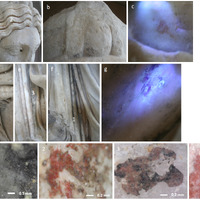
- To the naked eye, the hair displays in several areas residues of brown paint on the locks on either side of the central parting, and brown or black on the corkscrew curls falling over the shoulders and on the frontal strands in contact with the face.
- Imaging
-
Videomicroscopic examination reveals that the brown tone is obtained through the superposition of yellow, black, and red. The diadem preserves a black line outlining its border; on the bezel, the central gemstone and the band show remains of brown and yellow paint in varying shades.
On the skin of the face and feet, a translucent yellow paint is preserved, probably applied in liquid form directly onto the marble. It appears brown under UV light. The abraded eyes show no trace of definition of the pupil or iris. On the mouth, between the lips, micro-traces of red paint can be observed, well documented under the videomicroscope.
The most evident traces, however, are those of the black paint covering the tunic, mantle, and V-shaped sandals, applied in broad areas without tonal variation.
Under UV light, the black layer appears dark purple and seems to lie over a preparatory layer that fluoresces white. A more detailed microscopic analysis of the surface could help clarify the structure of the pictorial finishing. - Under painting traces
- no
- Pigments
- Black, pink, brown
- Binder
- n.d.
- Stratigraphy
- Directly on the marble
- Shading
- Shading on the skin
- Metallic traces
- no
- Tools marks
- no
- Background colour
- no
- Apparent marble parts
- no
- Restorations
- no
- Polychromy type
- The contrast between the light skin on the one hand, and the dark hair and drapery on the other, allows us to suppose that the polychromy was intended to imitate statues of Isis in bigio morato combined with light marble, a combination generally attested for the so-called Isis Pelagia type.