
Colossal statue of Apollo (inv. no. C939)
Item
- Other Media
-
 C939_fig. 1
 -
 C939_fig. 2
 - Description
-
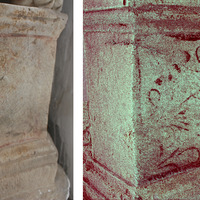
Colossal Apollo (2.39 m) from the theatre of Carthage. Standing frontally, with a slight contrapposto, leaning on a tripod, he wears a mantle that leaves the torso, genitals, and arms uncovered. The posture corresponds to the type of the citharode Apollo with tripod, such as the example from the Villa Palombara on the Esquiline, but differs by the apparent absence of the musical instrument and by the laurel wreath with a central medallion on the head, an attribute of the citharode Apollo in the Vatican Museums. To his left, on a moulded trapezoidal base, stands the tripod on which he leans: three sheath-like legs ending in feline paws support the hemispherical bowl, itself resting against a palm trunk around which a serpent coils.
The upper part of the head is unfinished. This detail, together with the frontal modelling, suggests placement within a niche (perhaps in the scaenae frons of the theatre) - Typology
- Ideal sculpture
- Definition
- Colossal statue of Apollo (inv. no. C939)
- Collection
- Tunis, Bardo National Museum.
- Inventory number
- C939
- Provenance
- Carthage, Theatre
- Date
- 2nd century C.E.
- Material
- White marble
- Dimensions
- H 239 cm
- Analytical methods
- VIS
- VIL
- UV
- MO VIS
- MO UV
- Autoptic examination
-
Observation with the naked eye reveals abundant remains of the original painted scheme (fig. 22). The statue is entirely covered with a thick yellow-ochre paint applied directly over a white preparatory layer. This layer survives unevenly, yet across all parts of the sculpture. Its thickness suggests that the paint was relatively dense at the time of application.
On the hair, red lines can be observed in the groove of the central parting, in the recesses separating the locks, and on the corkscrew curls falling over the shoulders. The skin shows a yellow-ochre colour. - Imaging
-
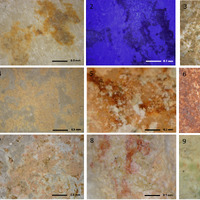
Microscopic examination of a limited number of points confirms the pictorial nature of the observed layers and reveals the palette and tonal variations of the colours used.
The yellow-ochre paint appears black under UV light, clearly distinguishing it from the encrustations and confirming the presence of pigments. Despite the apparent homogeneity of this layer, lighter tones appear in areas of illumination and darker tones in areas of shadow. As also visible upon careful naked-eye inspection, the veins of the wreath’s leaves and the outline of the diadem are highlighted in brown.
The red paint on the mantle seems to have been applied selectively over the yellow layer to enhance the movement of the drapery. The base, tripod, and serpent—beyond the side decoration—are painted yellow, with the detailed, calligraphic elements repainted in red. Under the microscope, the red lines over the yellow paint are clearly documented. The bowl displays a pinkish tone, while green is observed in certain areas on the palm trunk. - Under painting traces
- no
- Pigments
- Ochre (yellow, red, brown, purple), Egyptian blue
- Binder
- n.d.
- Stratigraphy
- n.d.
- Shading
- Darker shading on the skin, wreath, and drapery
- Metallic traces
- no
- Tools marks
- Brushwork on the base decoration: 0.5 cm, and 1.5 cm for the border
- Background colour
- no
- Apparent marble parts
- no
- Polychromy technique
-
The red lines on the heir, lying beneath the yellow layer, may have helped counteract a flat or uniform appearance of the yellow ochre paint, enhancing the contrast between recess and surface that a more homogeneous application would have flattened. A comparable device is used for the details: the veins of the leaves of the wreath and the border of the medallion are drawn with a darker colour.
Whereas the skin shows a yellow-ochre colour—slightly lighter than that of the hair and wreath and documented on the face, ears, torso, arms, legs, and feet—the eyes appear untouched by any pictorial treatment, and no trace of the iris is preserved.
- Imitation of other supports
- metal
- Polychromy type
-
The calligraphic attention to detail served to make the wreath more visible from a distance. The absence of colour on the eyes raises the question of whether the eye details were originally painted at all, and whether the untouched marble may have been intended to represent the deity’s vacant, divine gaze.
The impression emerging from the examination is that the statue displayed a monochrome (yellow-ochre) base that was nonetheless multi-tonal, from which not only the mantle with its red folds stood out, but also the details of the attributes, carefully outlined with precision.