
Statue of Serapis (inv. no. C922)
Item
- Other Media
-
 C922_fig. 1
 - Description
-
The god is represented according to the statuary type of the Great Serapeum of Alexandria, supposedly created by the renowned Athenian sculptor Bryaxis. It belongs to the type characterised by a frontal fringe (Fransentypus).
Wearing a modius and dressed in a chiton with numerous folds and a wide neckline exposing the base of the neck, he is draped in a himation that passes over the left shoulder. On the right side, a support with a serpent is preserved. - Typology
- Ideal sculpture
- Definition
- Statue of Serapis (inv. no. C922)
- Collection
- Tunis, Bardo National Museum.
- Inventory number
- C922
- Provenance
- Carthage, cisterns of the Odeon
- Date
- 2nd century C.E.?
- Material
- White marble
- Analytical methods
- VIS
- VIL
- UV
- MO VIS
- MO UV
- Autoptic examination
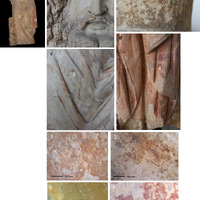
- Observation with the naked eye reveals a trichrome scheme that differentiates the parts of the statue. The head in all its components (hair, beard, face, neck) is painted in brown with broad areas of colour; the modius preserves its upper border and several areas—probably belonging originally to a painted decoration—coloured in black. The chiton is coloured yellow, with no variation in tone, and the himation is rendered in red. The support was likewise covered with brown paint, from which the serpent stands out, retaining a vivid red.
- Imaging
- Videomicroscopic examination confirms the pictorial nature of the colour layers, which are very thick and applied directly onto the marble.
- Under painting traces
- no
- Pigments
- Yellow, brown, red
- Binder
- n.d.
- Stratigraphy
- n.d.
- Shading
- no
- Metallic traces
- no
- Tools marks
- no
- Background colour
- no
- Apparent marble parts
- no
- Restorations
- no
- Polychromy technique
- The restricted palette observed with the naked eye is also confirmed, with no apparent tonal variations or attempts at chiaroscuro. The colouring of the head in black or brown doesn't show differentiation between the hair, beard, and face.
- Predominant colour
-
With a predominant colour scheme: a dark yellow–brown bichromy