
Colossal statue of Livia (inv. no. C933)
Item
- Other Media
-
 C933_fig. 1
 -
 C933_fig. 2
 - Description
-
This colossal statue (H. 2.60 m) of Livia was initially identified as Faustina the Younger after its discovery. However, on the basis of its scale, clothing, hairstyle with a central parting, and the presence of diadems, Bartman and Alexandridis have reinterpreted it as a deified Livia, dating it to the late Tiberian or early Claudian period. Indeed, after the death of Augustus in 14 CE, Livia became priestess of the cult of the Divus Augustus and was declared diva after her own death by Claudius.
The statue has prompted considerable debate due to its state of preservation and the extent of its restorations. At the time of its discovery, the figure had been broken into several pieces by diagonal cuts, and a pre-restoration photograph of the head shows that the fragments of the diadem had no joining points. The head was reattached to the neck. A comprehensive restoration of the statue now appears necessary to determine the correct association of the head with the body and of the diadems with the head. - Typology
- Portrait
- Definition
- Colossal statue of Livia (inv. no. C933)
- Collection
- Tunis, Bardo National Museum.
- Inventory number
- C933
- Provenance
- Carthage, cisterns of the Odeon
- Date
- 1st century C.E.
- Material
- White marble
- Dimensions
- H 260 cm
- Analytical methods
- VIS
- VIL
- UV
- MO VIS
- MO UV
- Autoptic examination
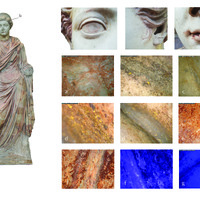
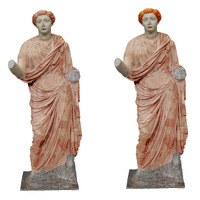
- The statue displays, to the naked eye, substantial traces of bright red paint, still clearly visible only on the original surfaces of the hair, eyes, and drapery. The overall coloured effect is produced by the plaster used in the restoration, made with a pink mortar in which the colour results from a mixture of stucco and terracotta rather than from paint.
- Imaging
-
Videomicroscopic analysis refines the identification of the original colour nuances, observed at 200 points on the sculpture in the non-restored areas. Regarding the head, the flesh bears traces of light yellow paint, applied directly onto the marble, better preserved and thicker along the right edge of the face, between the face and the neck. On the skin, the temples and facial features (eyebrows, inner eyelid margins, iris, nostrils, and lips) are delineated with an orange-red paint, also applied directly onto the marble. The pupils are lightly marked with a darker tone, particularly visible under UV on the left eyeball; the eyes display orange accents at the inner canthus and on the eyelid.
The two original fragments of the diadems show no trace of paint. The lips preserve substantial layers of dark red colour in different shades, over which gold leaf was applied. The hair was painted in various shades of reddish-brown laid over an orange layer, with some preserved traces of gold leaf. On the tunic and on the mantle, a treatment similar to that of the hair is observed, though distinguished by a slight tonal variation: broad areas of dark red colour applied over a thin orange-red layer. - Under painting traces
- Brown-yellow lines around the eyes and in the pupils
- Pigments
- Red, yellow, gold leaf
- Binder
- n.d.
- Stratigraphy
- n.d.
- Shading
- Darker shading in the recesses
- Metallic traces
- In the hair and on the lips
- Tools marks
- no
- Background colour
- no
- Apparent marble parts
- no
- Restorations
- no
- Polychromy technique
- The palette is based on tones of yellow, orange, and red, favouring partial or full gilding. Moreover, the hair and lips, where traces of gold leaf are preserved, may have been entirely or partially gilded, either to highlight a semantically significant feature or simply to enhance their brilliance.
- Imitation of other supports
- metal
- Polychromy type
-
The absence of finishing on the back suggests that the statue was likely positioned against a wall or inside a niche; its colossal scale and the facial features accentuated with paint, by contrast, appear designed to enhance legibility and visibility from a distance.
The polychromy analysis confirms a consistent treatment of the head and drapery, which is not seen on the diadem. This observation would support attributing the body and head to the same original sculpture, while considering the diadem in its current form as an element that may not have belonged to the statue.
The traces of gilding provide an additional element expressing the divine status of this figure, already conveyed unequivocally by its colossal scale and the idealized treatment of its facial features.