
Head of young boy (inv. no. 24-03-26-187)
Item
- Other Media
-
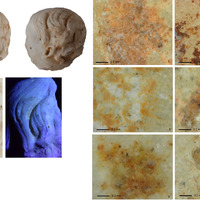 24-03-26-187_fig. 1
 - Description
- Fragmentary head (h. 12 cm) depicting a child with full cheeks and wide-open eyes, topped by a hairstyle arranged in rows of decorated locks. It probably belongs to a children or an Erote.
- Typology
- Ideal sculpture
- Definition
- Head of young boy (inv. no. 24-03-26-187)
- Collection
- Dougga, storerooms
- Inventory number
- 24-03-26-187
- Provenance
- Unknown
- Date
- Second half of the 2nd century C.E.
- Material
- White marble, slightly translucent and coarse-grained, with a faint greyish tone, similar to Pentelic marble
- Dimensions
- H 12 cm
- Analytical methods
- VIS
- VIL
- UV
- MO VIS
- MO UV
- Imaging
- UV examination reveals black traces between the locks of hair, on the nape, in the hollow of the ears, on the eyebrow, and around the eyes, beneath the encrustations and remnants of mortar that attest to the statue’s reuse as building material. Microscopic analysis of these areas (31 analysis points) reveals the presence of two layers of colour.
- Under painting traces
- no
- Pigments
- Brown, orange, and yellow
- Binder
- no
- Stratigraphy
- Whitish-yellow preparatory layer
- Shading
- A darker tone in the recesses of the locks
- Metallic traces
- no
- Tools marks
- no
- Background colour
- no
- Restorations
- no
- Polychromy technique
- A whitish-yellow preparatory layer, applied directly onto the marble, is preserved across the entire head. Superimposed on this ground are colours in various shades: brown, orange, and yellow. Brown traces are located between the locks and on the top of the skull, while yellow and orange cover the thickness of the locks. The skin is likewise painted in white-orange with brown highlights on the nape and inside the ear, confirming that brown was used to create shadows and mark separations between the different parts of the composition. The eye is outlined with an orange line, within which remnants of yellow-white paint survive in the sclera, while brown is detected in the area of the iris. The eyebrow, like the hair, retains orange traces.
- Anthropomorphic/realistic
- Simplified anthropomorphic
- Polychromy type
-
The distribution of brown or orange between the locks or on their upper surfaces was probably intended to create light shadow effects and define the volumes. The locks falling over the face are highlighted with a bright yellow-orange.
The polychrome rendering appears to follow a visual code that imitates and respects natural appearance.