
Statuette of Venus of the Callipyge type (inv. no. 24-03-26-160)
Item
- Other Media
-
 24-03-26-160_fig. 1
 - Description
-
The bust is preserved from the navel up to the base of the neck. Dressed only in a drapery falling across the back and the left shoulder, with the right arm raised or extended, she is identified as Venus.
The pose of the statuette and the arrangement of the garment recall the type of the Venus Callipyge, depicting the goddess lifting her chiton with one raised arm and turning her head to admire herself in the water. The chiton falling diagonally across the back may also draw inspiration from the Aphrodite Doria-Pamphilj type, which represents the goddess holding, above her shoulder, a drapery covering half of her back and wrapping one of her legs. This latter type is frequently reproduced in small format, as attested by the discovery of numerous statuettes in marble or terracotta.
The proportions and bodily features of this figure do not allow a date earlier than the Severan period, and the small format of the statuette suggests an attribution to the early 3rd century. - Typology
- Ideal sculpture
- Definition
- Statuette of Venus of the Callipyge type (inv. no. 24-03-26-160)
- Collection
- Dougga, storerooms
- Inventory number
- 24-03-26-160
- Provenance
- Dougga, Northern Baths
- Date
- Early 3rd century CE
- Material
- Fine-grained white marble of Pentelic type
- Dimensions
- H 11 cm
- Analytical methods
- VIS
- VIL
- UV
- MO VIS
- MO UV
- Autoptic examination
- The colours are not visible to the naked eye
- Imaging
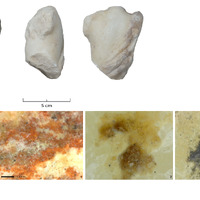
- UV light reveals numerous black areas. Observation of these zones under the videomicroscope (15 analysis points) makes it possible to document shades of brown, orange, yellow, red, and black. The skin shows yellow traces with brown highlights around the arms, near the abdominal groove, and on the back close to the drapery. On the drapery itself, at shoulder level, remains of orange and red have been recorded
- Under painting traces
- no
- Pigments
- Brown, orange, yellow, red, and black
- Binder
- n.d.
- Stratigraphy
- Directly on the marble
- Shading
- no
- Metallic traces
- no
- Tools marks
- no
- Background colour
- no
- Apparent marble parts
- no
- Restorations
- no
- Polychromy technique
- The paint is applied directly onto the marble, without a preparatory layer
- Imitation of other supports
- metal