
Statue depicting a nymph with a dolphin ridden by an Eros (inv. no. 24-03-26-245
Item
- Description
-
Discovered in 1960 by M. Boulouednine during an exploration of the south-western sector of the forum, the life-size sculpture (h. 123 cm) depicts a half-nude woman draped in a cloth that wraps around her left arm and covers her leg. To her right, a dolphin dives toward the ground, ridden by a naked child of whom only the buttocks and legs are preserved. The marine creature suggests that the statue represents a divinity associated with aquatic themes, most likely a nymph accompanied by a putto.
G. Becatti identified the figure as Ino Leucothea: the bare torso would indicate her status as a nymph, the dolphin her savior, and the child her son, who became the sea god Palaemon. He also proposed a date in the 2nd century CE.
The subject matter and dimensions therefore indicate that the sculpture served a decorative purpose. Since the back of the figure shows only broad, flat folds, it is reasonable to assume that it was originally displayed within a niche.
Artwork
- Typology
- Ideal sculpture
- Definition
- Statue depicting a nymph with a dolphin ridden by an Eros (inv. no. 24-03-26-245
- Collection
- Dougga, storerooms
- Inventory number
- 24-03-26-245
- Provenance
- Forum of Dougga, south-west area
- Date
- 2nd century CE
- Material
- White marble
- Dimensions
- H 123 cm
Analytical results
- Analytical methods
- VIS
- VIL
- UV
- MO VIS
- MO UV
- Autoptic examination
- Chromatic residues are still discernible to the naked eye: ochre-yellow pigmentation on the drapery; on the torso, remnants of off-white and red pigments, the latter concentrated along the contact zone with the scarf encircling the hips; and additional red traces preserved on individual strands of the hair.
- Imaging
-
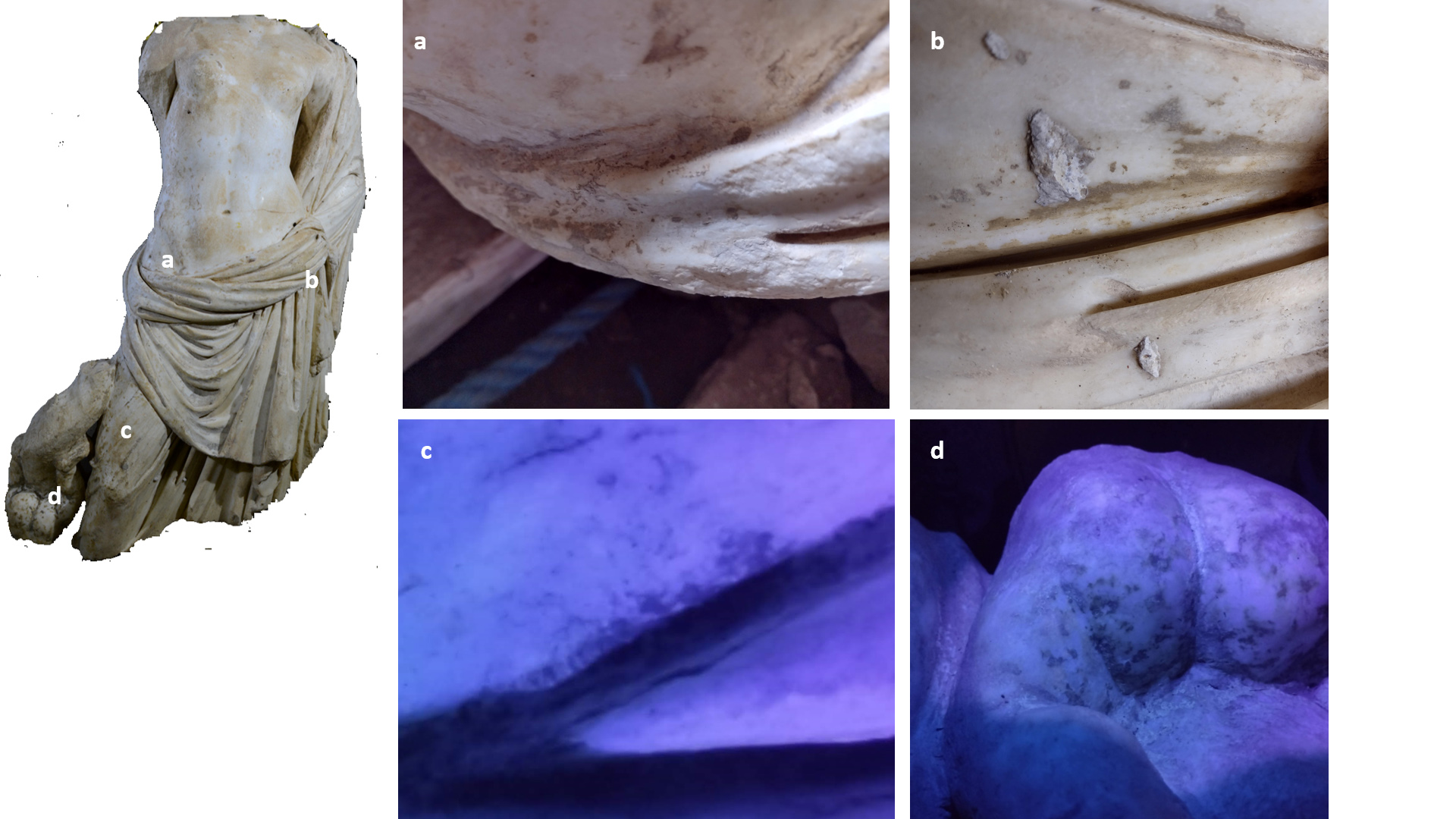
The remnants of the paint layers appear black under UV illumination. This phenomenon indicates the possible use of iron-rich ochres (goethite or hematite). The morphology, thickness, and consistent stratigraphy of these layers exclude the possibility that they result from positional or alteration-related deposits. On both the putto and the dolphin, even though no color is perceptible under visible light, black areas are documented under UV.
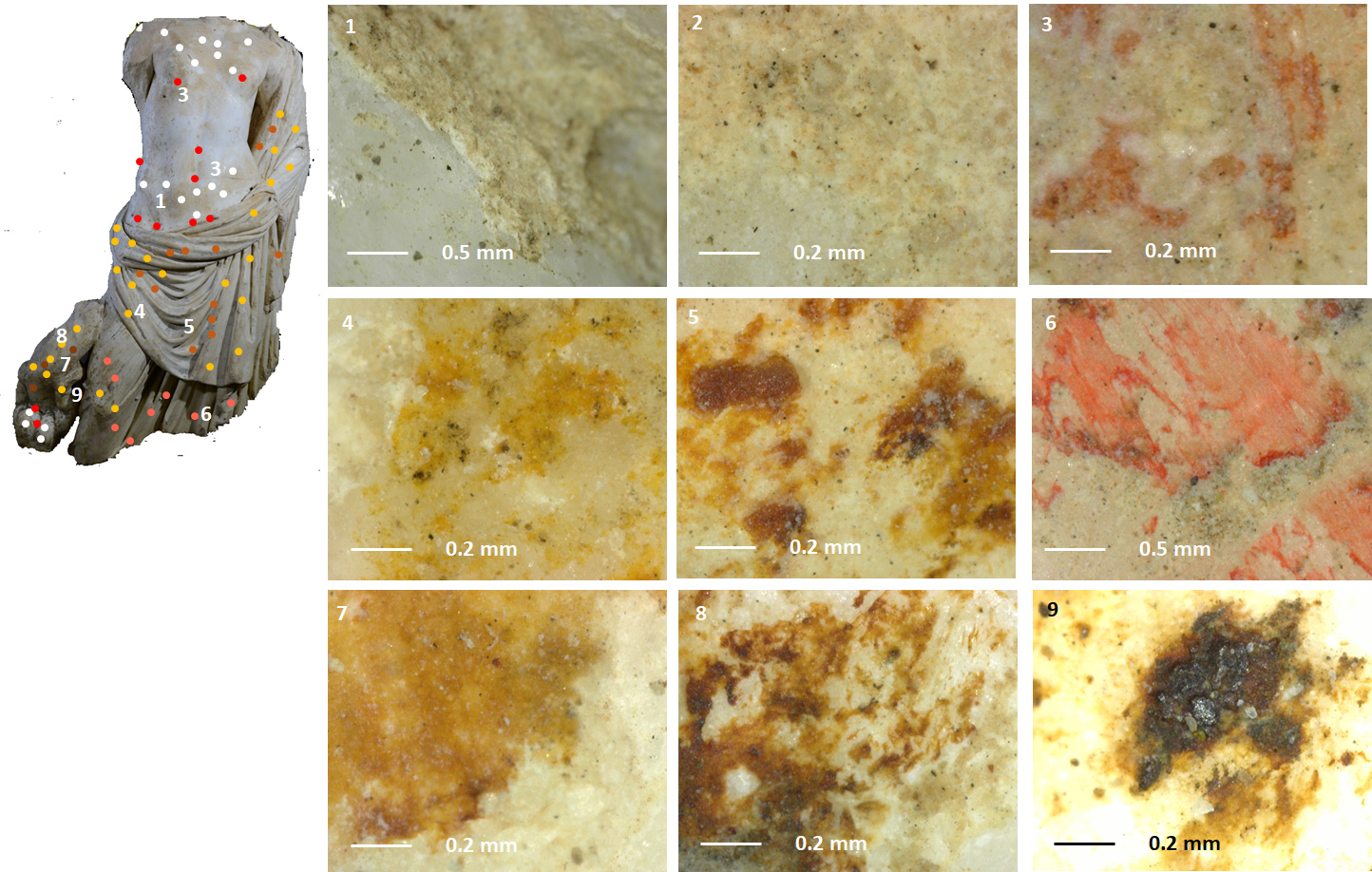
Microscopic examination refines the identification of chromatic nuances and the distribution of pigments. While a red outline is visible along the strands of hair, the flesh tones consist of a very thick off-white/yellowish preparatory layer, enhanced with red and orange accents on the abdominal groove, the nipples, and the area between the drapery and the abdomen. These red highlights emphasize shadows and musculature, making anatomical volumes perceptible through polychromy.
The drapery shows a thick, matte ochre-yellow layer directly in contact with the marble, over which various nuances of yellow, brown, and light red were applied, likely to animate the folds. The chromatic distribution suggests that the lower part of the scarf was originally painted in a vivid red with yellow highlights, whereas the upper part—wrapped around the arm—displayed a matte yellow with folds accented in red and brown.
The flesh tones of the putto were treated in the same manner as those of the female figure. The dolphin was painted in a bright yellow, with the fin, eye, and rostrum detailed in brown.
Polychromy technique
- Under painting traces
- no
- Pigments
- white, red, orange, brown, beige
- Binder
- n.d.
- Stratigraphy
- A white preparatory layer on the flesh areas, applied directly onto the marble
- Shading
- no
- Metallic traces
- no
- Tools marks
- no
- Background colour
- no
- Apparent marble parts
- no
- Restorations
- no
- Polychromy technique
- preparatory layer on the flesh areas, applied directly onto the marble
Polychromy type
- Anthropomorphic/realistic
- Anthropomorphic
- Highlighting motifs
- The statue’s polychromy thus relied on a range of yellow, red, and translucent brown tones applied directly onto the marble, creating a marked contrast with the matte whiteness of the flesh.