
Statuette of Venus Pudica type (inv. no. 24-03-26-98)
Item
- Other Media
-
 24-03-26-98_fig. 1
 - Description
-
The female statuette preserves only the upper torso, cut obliquely at the level of the navel and horizontally at the neck. The fragment shows a small dowel hole at the neck.
The left breast, the right shoulder, and the scapula have been broken off, and the left arm was severed just beyond the shoulder; the surfaces are well polished. The female figure is slightly bent forward, nude, with the left arm held close to the body, slightly extended. Only a single lock of hair falling over the left shoulder is preserved.
Identified as Venus, the statuette may originally have been represented either in a modest pose, with the hands crossed toward the pubic area and chest, or seated, as in a comparable example from Caesarea (in Mauretania), likewise unclothed. The long, slender torso with small, high-set breasts recalls creations of the early 3rd century and is difficult to date earlier than that period. - Typology
- Ideal sculpture
- Definition
- Statuette of Venus Pudica type (inv. no. 24-03-26-98)
- Collection
- Dougga, storerooms
- Inventory number
- 24-03-26-98
- Provenance
- Unknown
- Date
- 3rd century CE
- Material
- Fine-grained white marble
- Dimensions
- H 15 cm
- Analytical methods
- VIS
- UV
- MO VIS
- MO UV
- VIL
- Autoptic examination
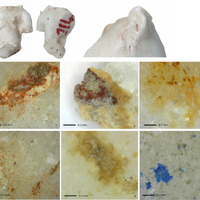
- Under UV light, the surface appears dark. Observation with the videomicroscope allows for a more detailed study of the polychromy (30 analysis points). The hair displays a red-orange coloration applied over a yellow-white ground layer. The locks falling over the left shoulder are highlighted with red-brown. The skin retains a bright yellow tone with a brown edging around the neck, situated between the junction with the hair and the beginning of the neck. On the back, the skin is accented with orange in the hollow of the armpit. A shadow effect is created with blue and brownish-green on the left side of the vertebral groove, where small black and blue dots can be observed, probably intended to accentuate the figure’s sense of movement. The lower back bears a darker brown coloration. On the skin, the paint is applied directly onto the marble. In several areas, the marble shows shiny finishing traces, which may correspond to residues of an organic coating, also detected under UV light as an orange fluorescence.
- Pigments
- Brown, orange, yellow, red, and blue
- Binder
- n.d.
- Stratigraphy
- Directly on the marble
- Shading
- Blue and green
- Metallic traces
- no
- Tools marks
- no
- Background colour
- no
- Apparent marble parts
- no
- Restorations
- no
- Polychromy technique
- It employs a sophisticated technique that treats the skin (without a preparatory layer) and the drapery (with a ground layer) differently, constructing shadow effects on the back not only through variations in hue but also through the creation of black, blue, and green shadows.
- Imitation of other supports
- metal
- Bibliography
- E. Neri, C. Damay, A. Riahi, Lost colours on fragments of painted statuettes of roman Dougga/Thougga: a preliminary analysis by video-microscopy, in E. Neri (eds), Polychroma. The Meaning of Colours in Roman Sculptures, Silvana Editoriale, Cinisello Balsamo, 2024, pp. 176-187
- E. Neri, C. Damay, A. Riahi, Lost colours on fragments of painted statuettes of roman Dougga/Thougga: a preliminary analysis by video-microscopy, in E. Neri (eds), Polychroma. The Meaning of Colours in Roman Sculptures, Silvana Editoriale, Cinisello Balsamo, 2024, pp. 176-187