
Head of a young crowned satyr (Inv.no. 010326.139)
Item
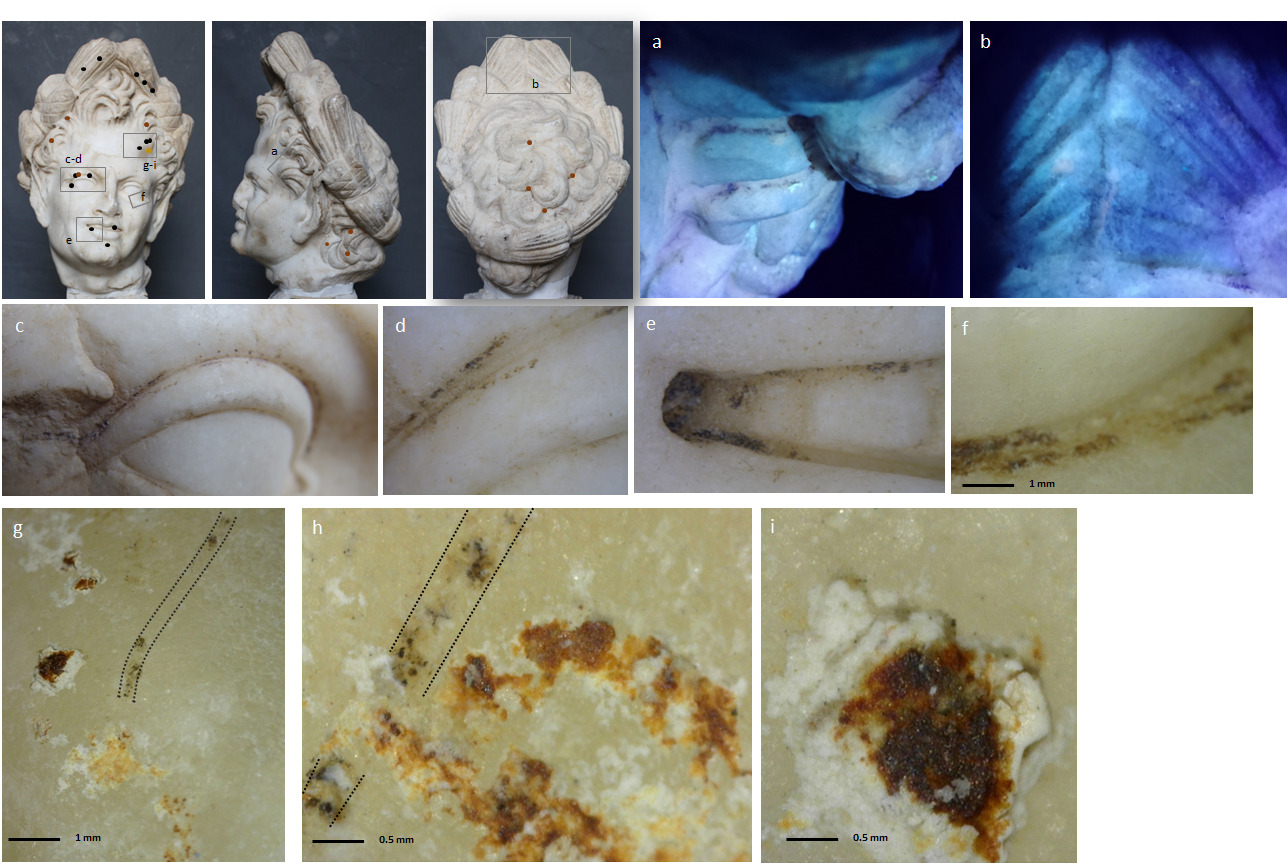
- Description
- Head of a beardless satyr wearing a thick crown in which ears of corn and pine cones alternate.
Artwork
- Typology
- Ideal sculpture
- Definition
- Head of a young crowned satyr (Inv.no. 010326.139)
- Collection
- Tunis, Bardo National Museum.
- Inventory number
- 010326.139
- Provenance
- The original provenance of the sculpture is unknown.
- Date
- 2nd c. CE?
- Material
- White marble
- Dimensions
- Height: 31 cm
Analytical results
- Analytical methods
- VIS
- VIL
- UV
- MO VIS
- MO UV
- MAXRF
- TOF/SIMS
- Autoptic examination
- Modest traces of color can be documented around the eyes, mouth, and teeth.
- Imaging
- Some lines that can be interpreted as preparatory outlines are also visible under UV light on the crown and the locks of hair. When viewed under a microscope, these traces appear as black lines, and in the locks of hair and on the eyebrows, they are covered with a yellow-brown layer applied over a lighter ground. The yellow-brown layer could be the visible coloring of the hair and eyebrows. The same stratigraphy is observed on the horn on the left. In this area, the black preparatory outlines that delineate the horn, dark brown on the inside and yellow on the outside, are particularly visible.
Polychromy technique
- Under painting traces
- Black lines around the eyes, mouth, and teeth.
- Pigments
- white, brown, red
- Binder
- n.d.
- Stratigraphy
- Preparation layer of calcium sulfate
- Shading
- no
- Metallic traces
- no
- Tools marks
- no
- Background colour
- no
- Apparent marble parts
- no
- Restorations
- no
- Polychromy technique
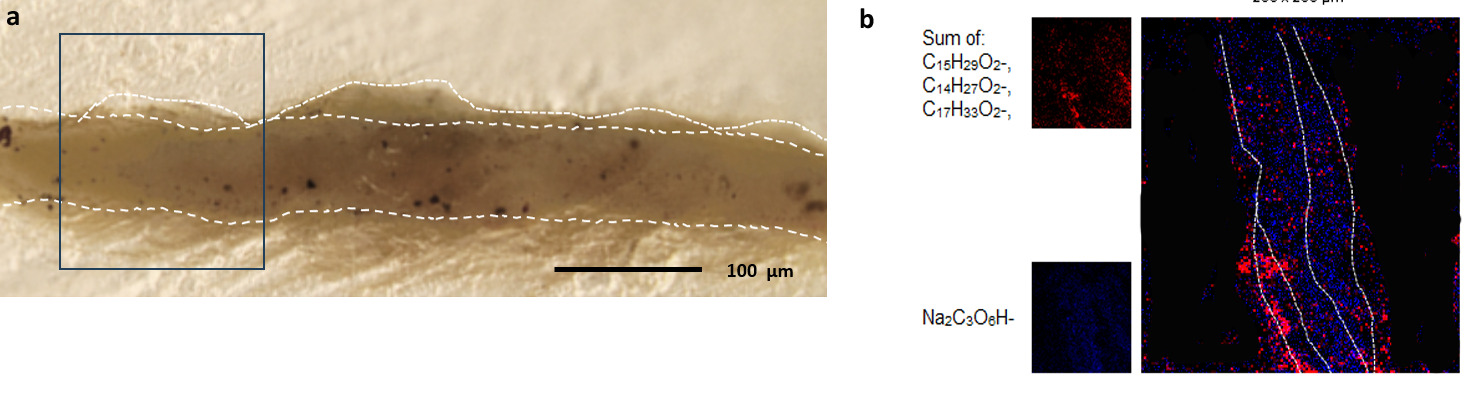
- MA-XRF analysis in the left horn area confirms the use of black, brown and yellow pigments and documents the presence of colocalized sulfur and iron. The original presence of a layer of stucco, onto which an earth-based paint was applied, suggests the use of bone black for the preparatory drawings. Localized traces of phosphorus may indicate the use of bone black. TOF/SIMS analysis on a sample of the yellow-beige layer of the hair reveals the nature of the preparatory layer, primarily sulfur-based, and the earth-based pictorial layer. A concentration of wax fatty acids appears at the top of the sample. A substance with the same composition has been documented in the pigment body, colocalized with the natron and on the surface. It is deduced that the liquid wax, applied cold through saponification, acts as a binder, and that the beeswax, applied hot, acts as a waterproofing agent. This technique of applying the binder and a waterproofing layer has been documented in a portrait by Dougga. No traces of paint are documented on the polished skin.
Polychromy type
- Imitation of other supports
- coloured marbles