Artwork
-
Typology
-
Portrait
-
Definition
-
Statue of a Initiate holding ears of corn (inv. no. C1021)
-
Collection
-
Tunis, Bardo National Museum.
-
Inventory number
-
C1021
-
Provenance
-
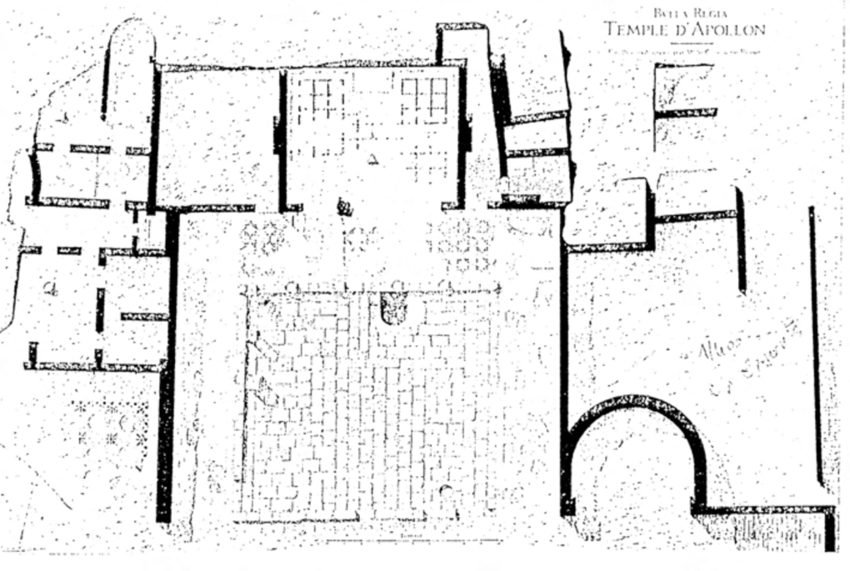
The statue was found in the left corner of the portico of the Temple of Apollo in Bulla Regia. The slight thickness and rough finish led to the assumption that it was placed in a high niche. Fittschen proposes that she could be part of a statuary group exhibited in the nearby theater.
-
Date
-
2nd c. CE
-
Material
-
Marble.
-
Dimensions
-
Height:198 cm.
Analytical results
-
Analytical methods
-
VIS
-
UV
-
MO VIS
-
MO UV
-
Autoptic examination
-
Traces of color visible to the naked eye are rare and discontinuous.
-
Imaging
-
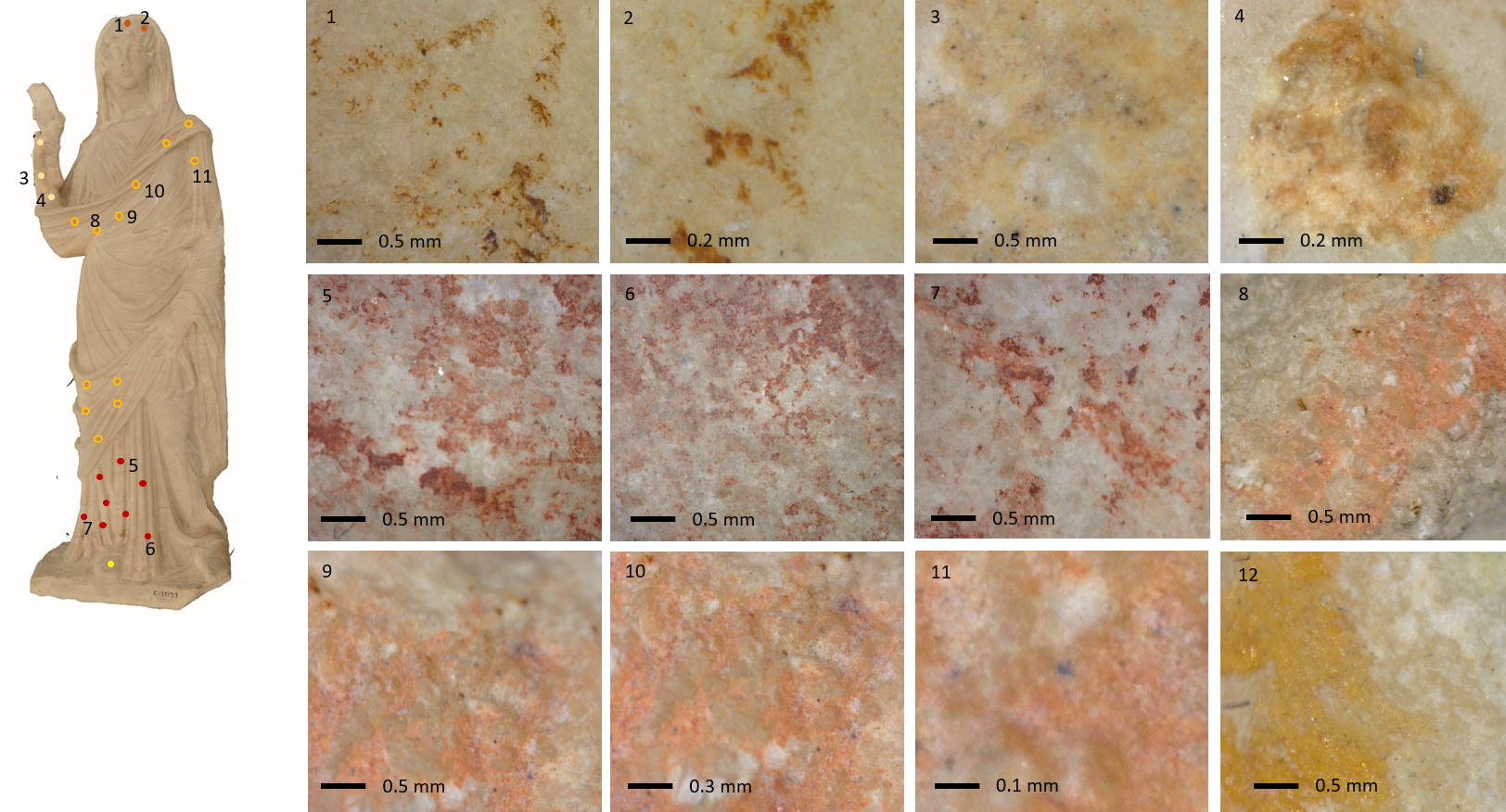
98 points were investigated through the microscope and numerous traces of color were detected: a thick yellow layer on the wrist of the right hand; a brown pigment on the midline and on a lock of hair; dark red on white preparatory layer at the bottom of the tunic and in the folds; brown and orange traces on white preparatory layer for the coat, along with small dots of Egyptian blue, in the folds, to create shadow effects.
Polychromy type
-
Imitation of other supports
-
metal
-
Polychromy type
-
The polychrome rendering of the statue is mainly given by the use of various shades of yellow, red and brown, probably in order to simulate a metallic effect. The palette used is very similar to that of the seated Marcus Aurelius (see inv. no. 01032610): this makes Fittschen's hypothesis more probable according to which the female statue must have been part of a sculptural group of the theatre, inserted within a high niche.