-
Analytical methods
-
VIS
-
UV
-
Autoptic examination
-
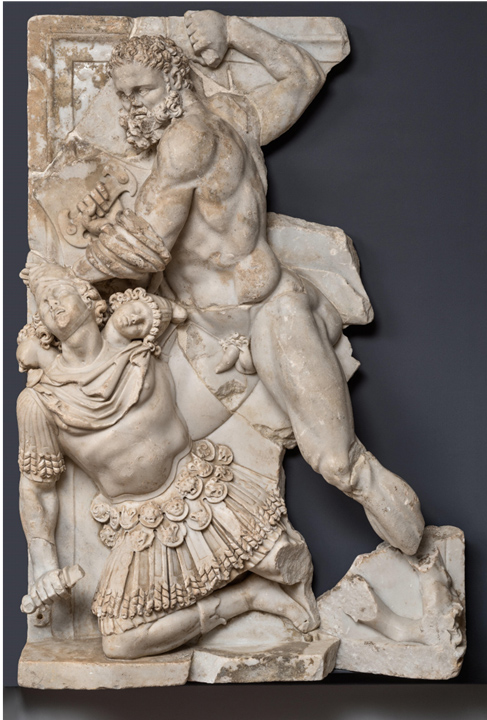
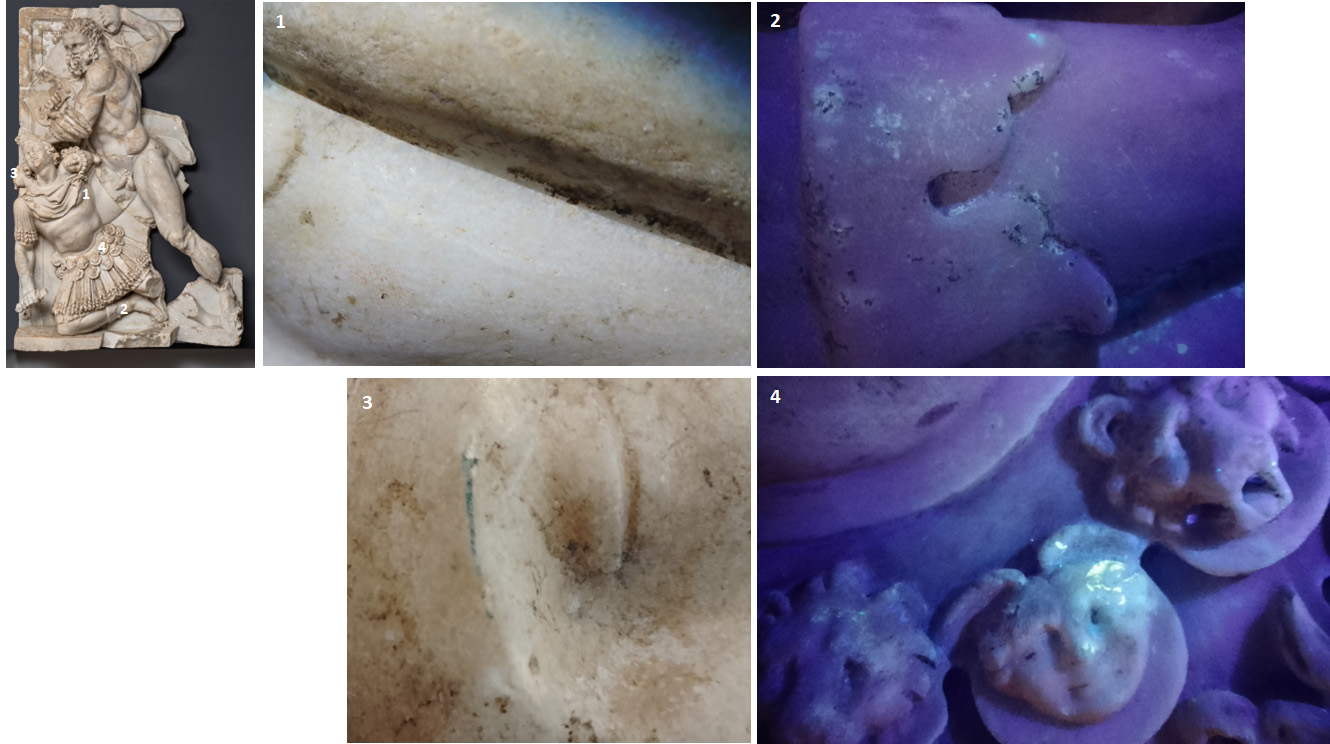
Visible traces of pigment have been observed with the naked eye on the background to the right (dark brown-grey), on the body of Heracles (orange, off-white), on the right head of Geryon (brown helmet and blue-painted eyebrow), as well as on the helmet of the left head.
-
Imaging
-
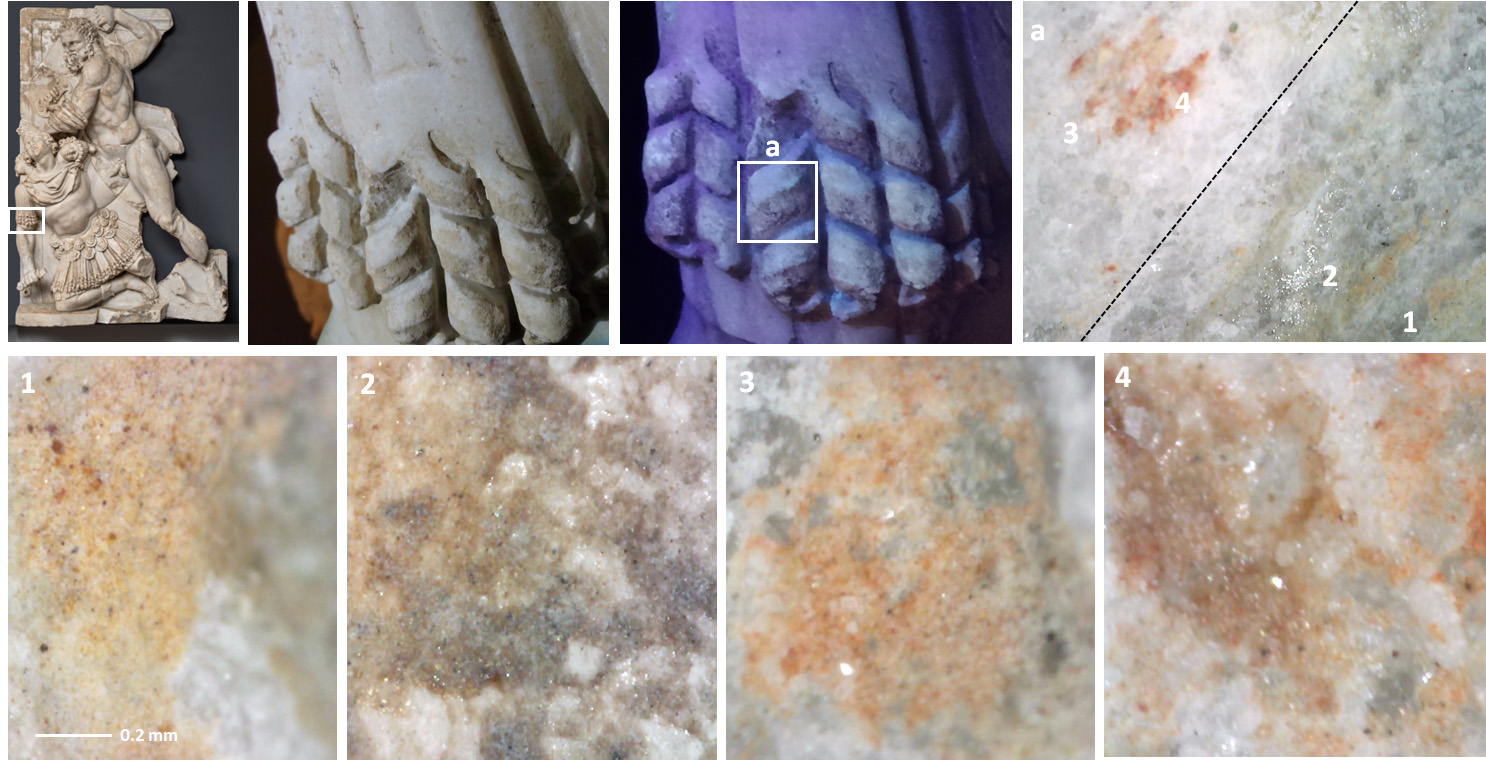
Ultraviolet (UV) examination confirms the distribution of these pigments and assists in distinguishing original coloration from surface encrustations. Particularly notable is the bicolored treatment of the woolen curls of the subarmalis, which is confirmed by microscopic analysis: an alternation of yellow and brown tones enhances the legibility of the individual curls.
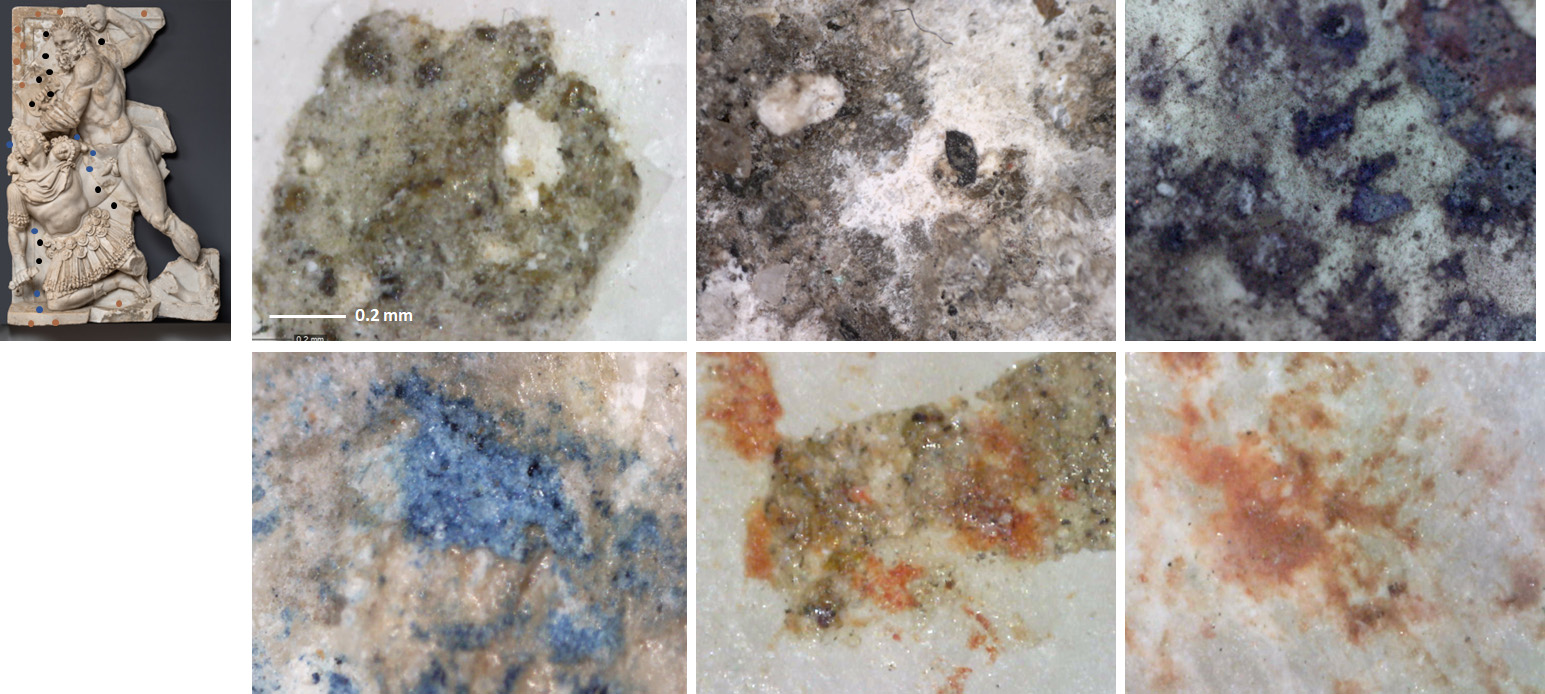
Microscopic examination (350 observation points) further revealed traces of pigmentation across the entire surface.
If confirmed, the background was originally painted in a dark palette with tonal variations between brown, black, and grey, and with cast shadows rendered in blue. The frame appears to have been painted in a reddish-brown hue.
Heracles' body exhibits an off-white coloration, similar to that observed on the figures of Attis and Aesculapius, achieved through a mixture of white, orange, yellow, and red pigments. The skin tones darken in shaded areas.
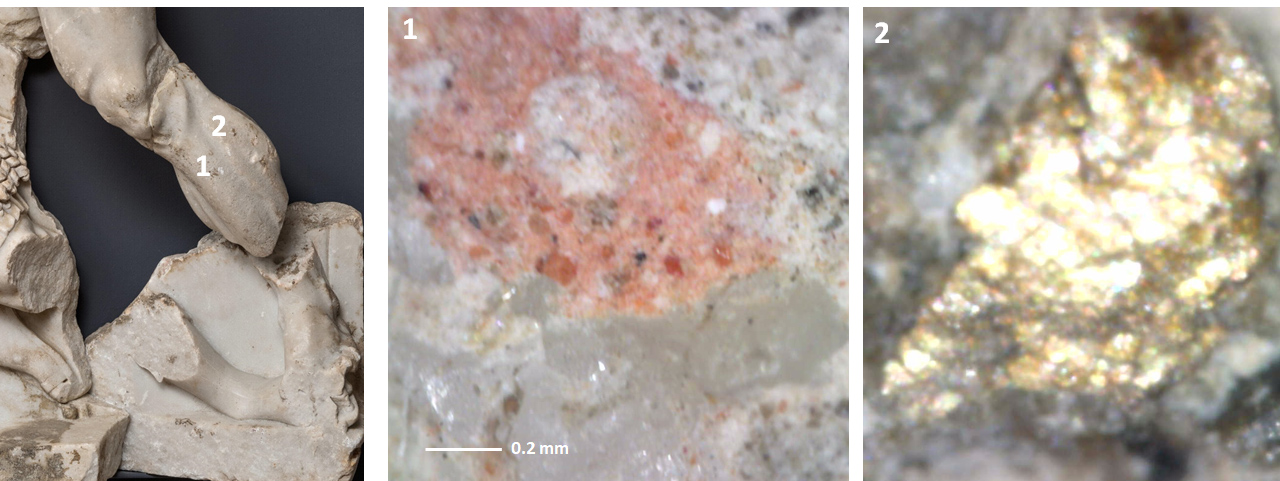
A faint trace of gold leaf gilding—subject to further compositional analysis to confirm its nature—has been identified on the calf of the left leg (fig. 24).
Black and green lines on the hips may indicate intramuscular divisions. Similar lines are also used to define facial features.
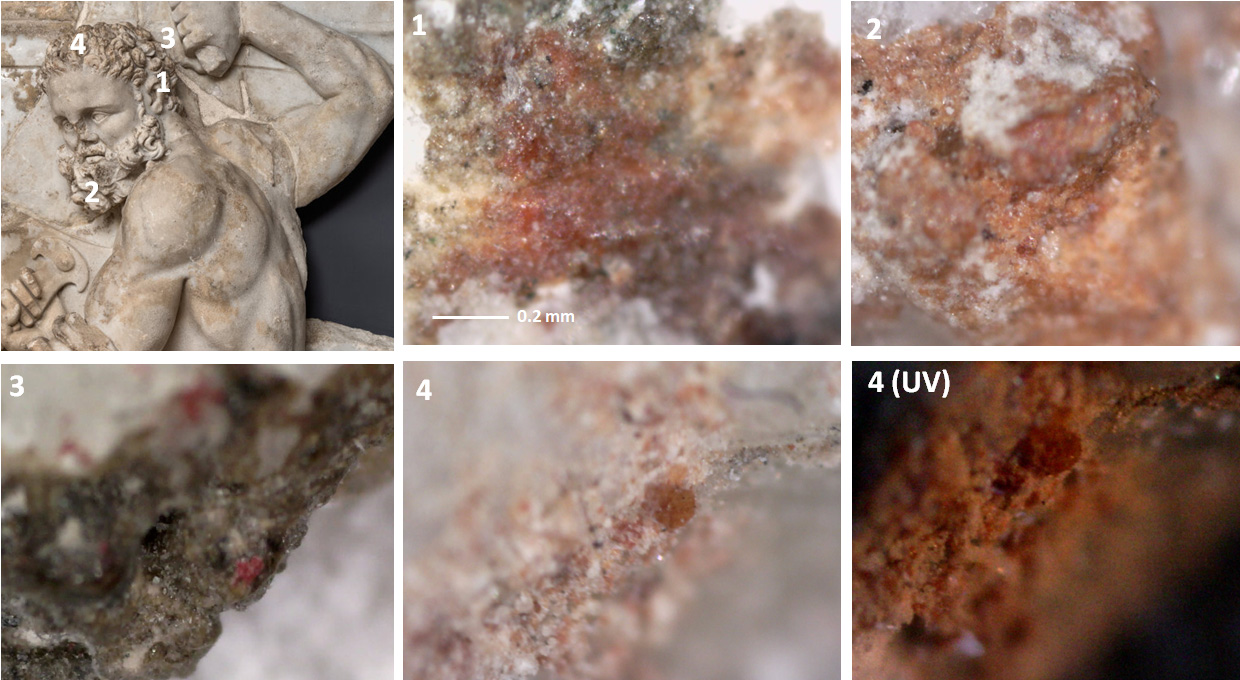
Heracles’ hair preserves traces of red pigment in various shades. When observed under UV light, the red fluoresces orange, a characteristic response of madder lake, suggesting a possible identification of the pigment used (fig. 25).
Black contour lines between the hair and the relief’s background serve to frame and accentuate the figure.
The right head of Geryon exhibits yellow pigmentation in the hair, while the skin appears significantly more orange and less pale than that of Heracles.
The cuirass presents a yellow-orange coloration; the heads on the pteryges are rendered in grey-black, and the fringes of the subarmalis are painted in black and brown tones, as is the helmet of Geryon's left head.