
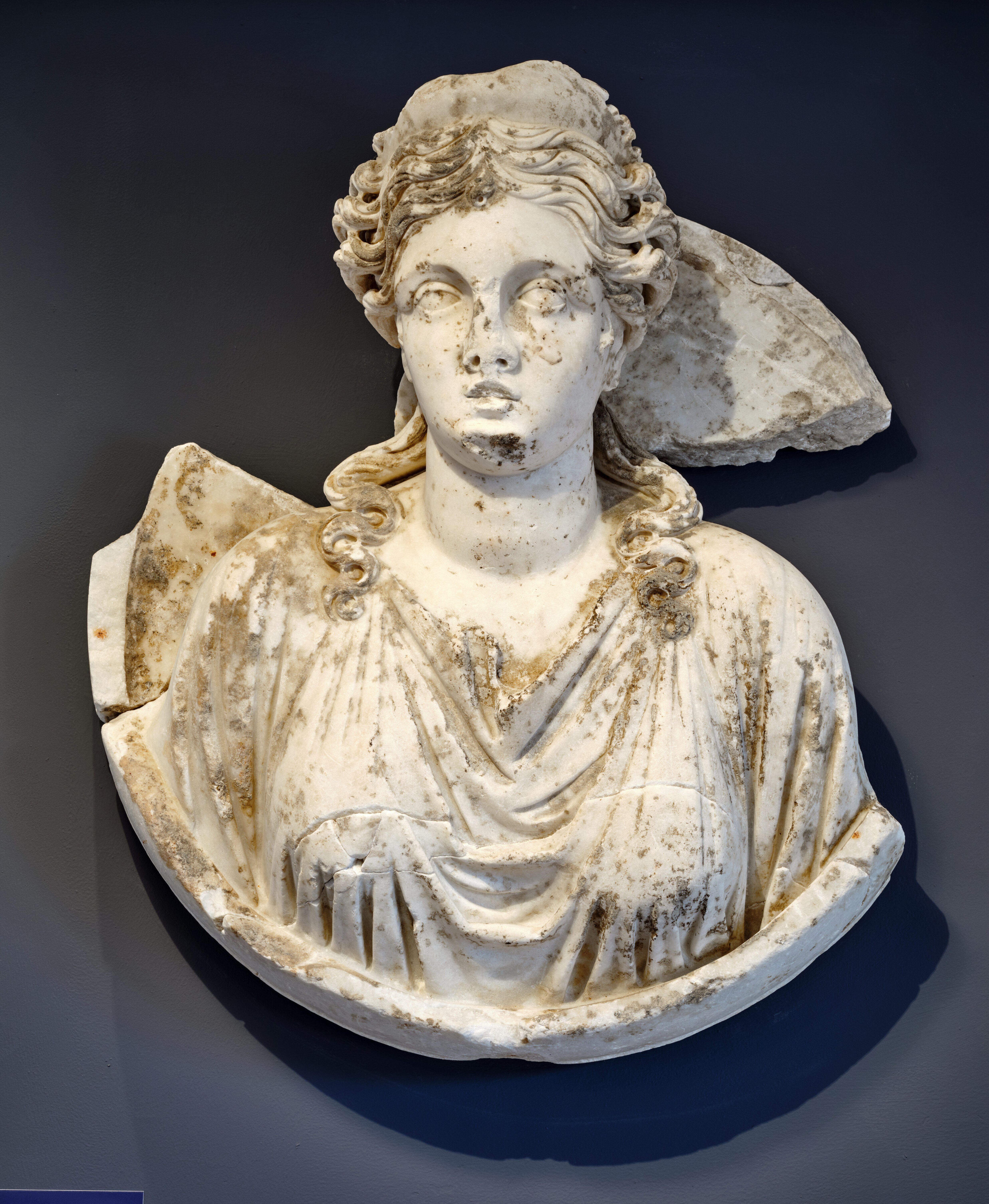
Clipeus with Diana (?) (inv. no. RA34h)
Item
- Other Media
-
 RA34h_fig. 2
 - Description
-
The clipeus preserves the bust of a female figure clad in a draped chiton.
Her hair is composed of long, wavy locks, defined by deep drill grooves, arranged symmetrically on either side of the face from a central parting, and gathered at the nape of the neck. From this point, two long ringlets descend along the clavicles. Two small curls escape the hairstyle, both in front of and behind each ear.
The head is encircled by a crescent-shaped diadem, an element that has led scholars to propose an identification with the goddess Diana. - Typology
- Relief
- Definition
- Clipeus with Diana (?) (inv. no. RA34h)
- Collection
- Toulouse, Musée Saint-Raymond
- Inventory number
- RA34h
- Provenance
- Chiragan, Roman Villa
- Date
- End of the 3rd century C.E.
- Material
- Saint-Béat marble (Haute-Garonne)
- Dimensions
- Height 86 cm; Width 74 cm; Depth 38 cm
- Analytical methods
- VIS
- UV
- MAXRF
- Imaging
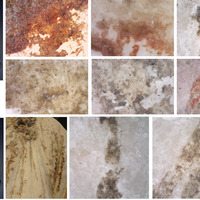
- Observation under a video microscope reveals the presence of brown on the border and background, and a white-yellow layer (54 points) on the skin (20 points). Over the latter, in the shadowy areas, such as the décolleté (14 points), a translucent gray layer is superimposed (fig. 14). Orange dots are documented on the lips and large traces of black in the hollows of the hair curls. The diadem (probably restored) shows no trace of color observable on the surface in the visible spectrum. Black lines are documented on the drapery, offset from the position of the fold in the sculpture.
- Under painting traces
- Black lines on the drape
- Pigments
- white calcium sulfate, ochres (red, orange, yellow), black vegetable sandyx
- Binder
- n.d.
- Shading
- Darker gradient
- Metallic traces
- no
- Tools marks
- Brush for preparatory lines (1.2mm)
- Background colour
- Brown
- Apparent marble parts
- no
- Restorations
- no
- Polychromy technique
- A preparatory layer of calcium sulfate was laid
- Polychromy type
- The use of different colors is intended to imitate the colored marbles of the opus sectile technique.