
Fragment of pilaster or door jamb (inv. no. RA23a)
Item
- Other Media
-
 RA23a_fig. 2
 - Description
-
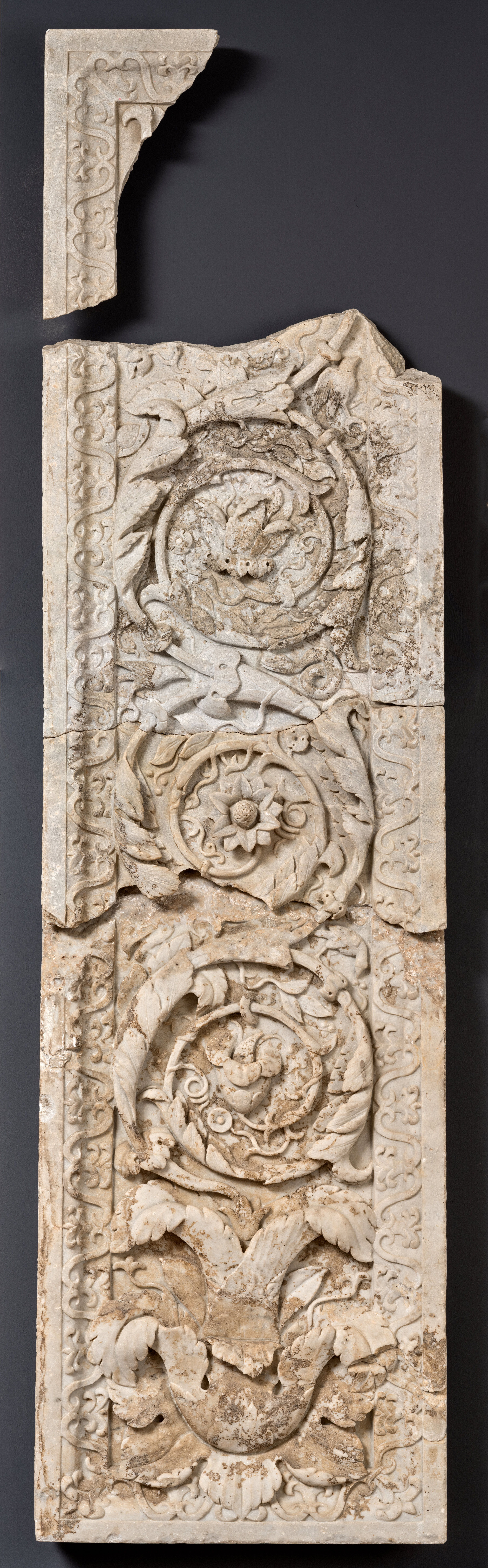
The pilaster features a double-curved moulding adorned with palm leaves. At its base, a large acanthus cluster gives rise to an elaborate scroll of foliage and flowers, inhabited by birds, butterflies, a lizard, a snake, a snail, and a cricket—elements that find clear parallels with the Ara Pacis.
It is plausible that the pilasters discovered in the villa of Chiragan served to separate the reliefs depicting the Labours of Hercules, and that, together with the large medallions portraying the gods, they formed part of a broader allegorical programme, conveying messages of victory and renewal. - Typology
- Architectural element
- Definition
- Fragment of pilaster or door jamb (inv. no. RA23a)
- Collection
- Toulouse, Musée Saint-Raymond
- Inventory number
- inv. no. RA23a
- Provenance
- Chiragan, Roman Villa
- Date
- End of the 3rd century CE
- Material
- White marble
- Dimensions
- Height 197 cm; Width 64 cm; Depth 12 cm
- Analytical methods
- UV
- VIS
- Imaging
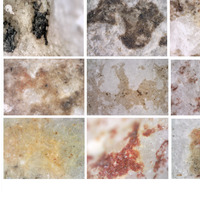
- The background of the decorative field and the moulding preserves (in 45 observation points) a layer of yellowish pigment, overlaid with a dark brown-black shade (in 32 points). The leaves of the acanthus cluster display lighter nuances of the same chromatic range. The stems of the scrolls are rendered in beige, with orange highlights used to suggest depth and to articulate the calathoi (in 37 points), while the flowers show a red androecium and bright yellow petals.
- Pigments
- Yellow, dark brown-black , beige, orange, red
- Binder
- n.d.
- Stratigraphy
- In the moulding, the yellowish pigment is overlaid with a dark brown-black shade
- Metallic traces
- N.D.