
Clipeus of Attis (inv. no. RA34l)
Item
- Description
-
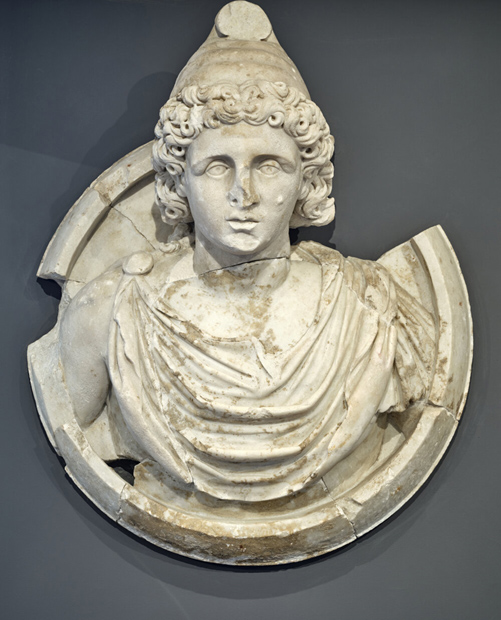
The clipeus depicts Attis, identified thanks to the presence of the Phrygian cap and the curled hair typical of the divinity. Due to the plastic treatment, the rendering and iconography, the god shows many similarities with the Amazon depicted on the relief Hercules and Hippolyta (inv. no. RA28h).
Together with the divinities portrayed in the other clipei (Hygieia, Aesculapius, Cybele, Juno, Minerva and Diana) it probably had to surmount pillars and capitals, within a complex decorative apparatus of the villa.
Artwork
- Typology
- Architectural element
- Definition
- Clipeus of Attis (inv. no. RA34l)
- Collection
- Toulouse, Musée Saint-Raymond.
- Inventory number
- RA34l
- Provenance
- Chiragan, Roman Villa.
- Date
- End of the 3rd c. BCE/beginning of 4th c. BCE.
- Material
- White marble from Saint-Béat caves, Pyrenees.
- Dimensions
- Height: 95 cm; Width: 79 cm; Depth: 43 cm.
Analytical results
- Analytical methods
- VIS
- UV
- MO VIS
- MO UV
- Autoptic examination
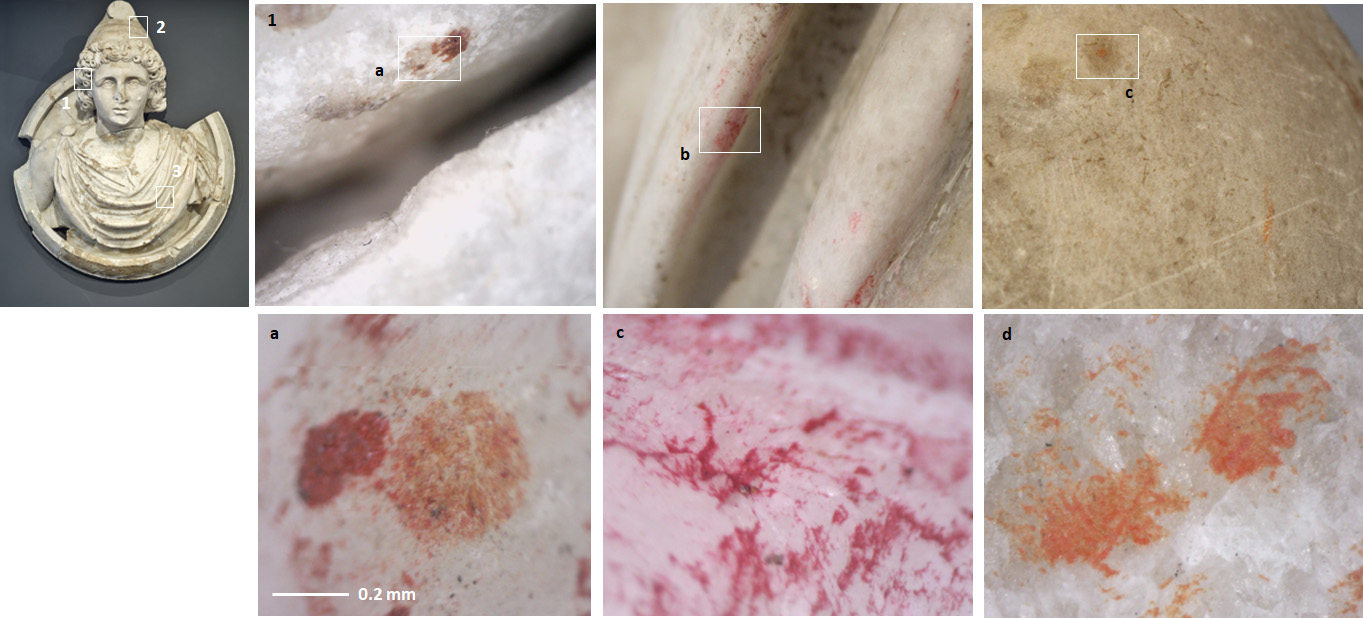
- Different traces of color are visible to the naked eye: pink-violet on the drapery, orange on the cap, brown on the background of the clipeus and red-brown on the hair.
- Imaging
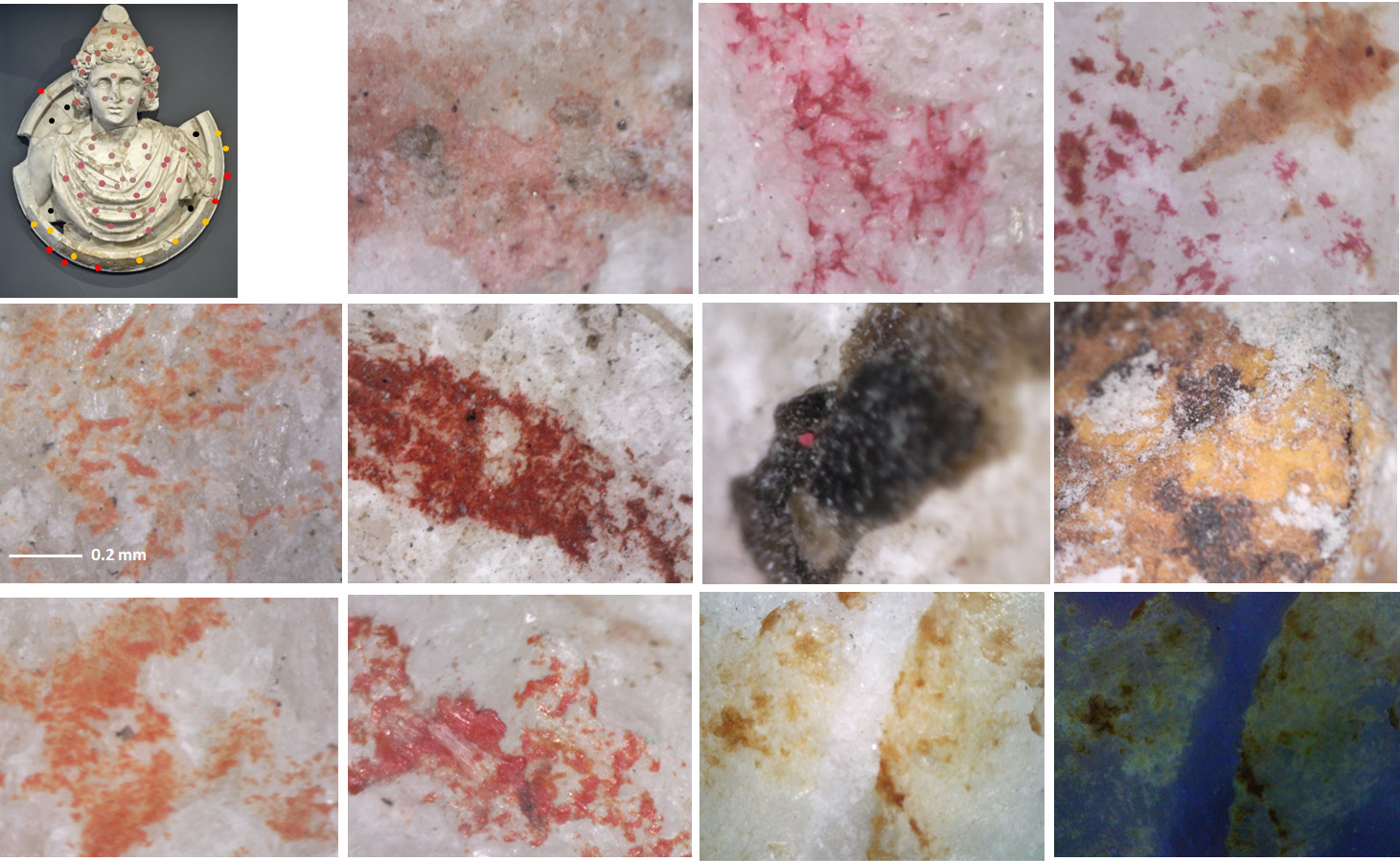
- 108 points were analyzed at the microscopic level. Thus a red line, an orange border and a black background emerged on the perimeter of the clipeus, as well as in the other clipei. The drapery has purple and orange traces that overlap to highlight the pattern of the folds. The red painted fibula stands out from the drapery. The cap shows various orange areas while the skin is characterized by a pinkish-white shade.
Polychromy technique
- Under painting traces
- no
- Pigments
- White, black, red, orange, yellow, blue, purple.
- Binder
- A translucent layer, covering the drapery, appears yellow in UV light - it could possibly indicate the use of an organic binder (wax?).
- Stratigraphy
- n.d.
- Shading
- Darker gradient (dégradé plus foncé?).
- Metallic traces
- no
- Tools marks
- no
- Background colour
- Black.
- Apparent marble parts
- no
- Restorations
- no
- Polychromy technique
- The white-pink shade used for the rendering of the skin is made up of grains of different colors (red, orange, yellow), indicating the creation of a mixture of different pigments, as can also be seen for the skin of the Aesculapius (inv. no. RA34m).
Polychromy type
- Imitation of other supports
- coloured marbles
- Polychromy type
- Imitation of colored marbles/opus sectile.