
Clipeus of Hygieia (inv. no. RA34k)
Item
- Description
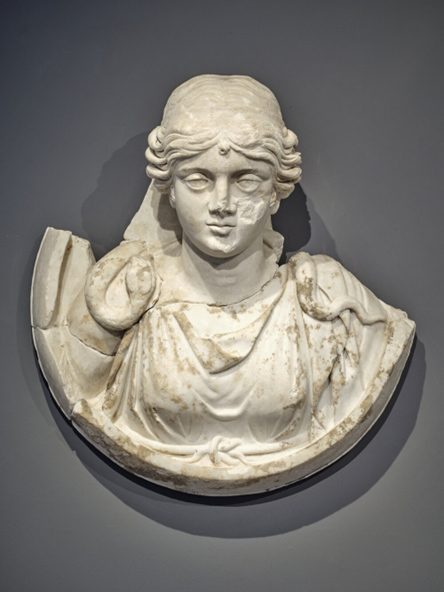
- The clipeus most likely portrays Hygieia, identified on the basis of the presence of the snake resting on her shoulders. She is particularly connected to her father Aesculapius, of whom there is a specific clipeus (inv. no. RA34m). Together with the divinities portrayed in the other clipei (Attis, Cybele, Juno, Minerva and Diana) it probably had to surmount pillars and capitals, within a complex decorative apparatus of the villa.
Artwork
- Typology
- Architectural element
- Definition
- Clipeus of Hygieia (inv. no. RA34k)
- Collection
- Toulouse, Musée Saint-Raymond.
- Inventory number
- RA34k
- Provenance
- Chiragan, Roman Villa.
- Date
- End of the 3rd c. BCE/beginning of 4th c. BCE.
- Material
- White marble from Saint-Béat caves, Pyrenees.
- Dimensions
- Height: 76 cm; Width: 73 cm; Depth: 35 cm.
Analytical results
- Analytical methods
- VIS
- UV
- MO VIS
- MO UV
- Imaging
-
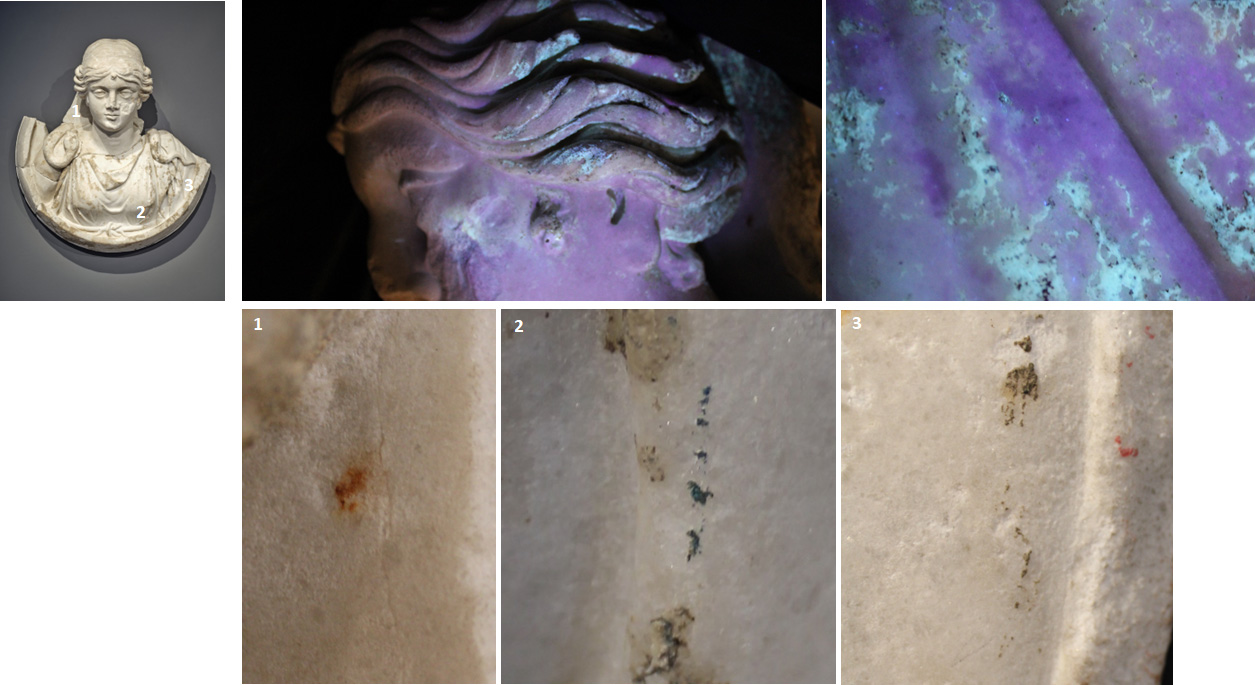
The traces of color are mainly visible in UV light, due to the notable presence of concretions. On the neck on the left there is a violet pigment, a dark blue line on the drapery, brown on the background of the clipeus and traces of bright red on the frame.
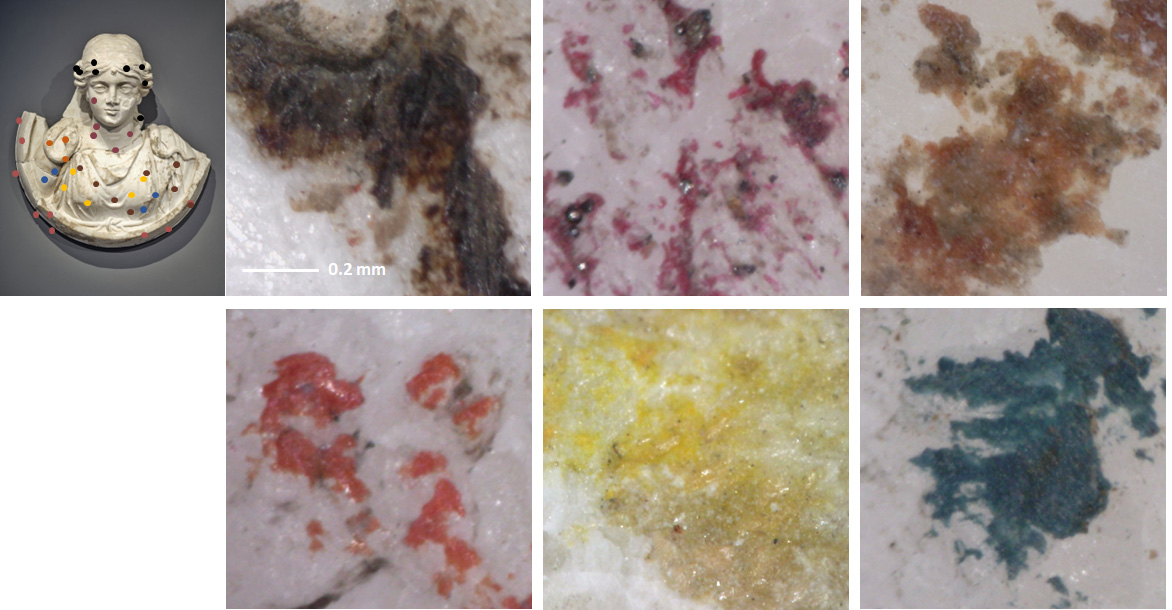
Microscopy (55 points of investigation) highlighted the presence of a dark gray-black color on the front locks of the hair, violet for the skin of the neck and face, an orange-brown pigment for draping with light and dark shades that follow the movement of the folds. A blue pigment is used to create some shadow spots in the drapery.
Polychromy technique
- Under painting traces
- no
- Pigments
- White, black, red, orange, yellow, blue, purple.
- Binder
- n.d.
- Stratigraphy
- n.d.
- Shading
-
Darker gradient (dégradé plus foncé?).
A blue pigment is used to create some shadow spots in the drapery. - Metallic traces
- no
- Tools marks
- no
- Background colour
- Black.
- Apparent marble parts
- no
- Restorations
- no
- Polychromy technique
- The pictorial rendering of the snake is created by superimposing translucent layers of color: the lower orange and the upper brown. The clipeus has a brown background with points of light created through touches of yellow and areas of shadow in blue. The frame is instead decorated with a bright red line.
Polychromy type
- Imitation of other supports
- coloured marbles
- Polychromy type
- Imitation of colored marbles/opus sectile.