
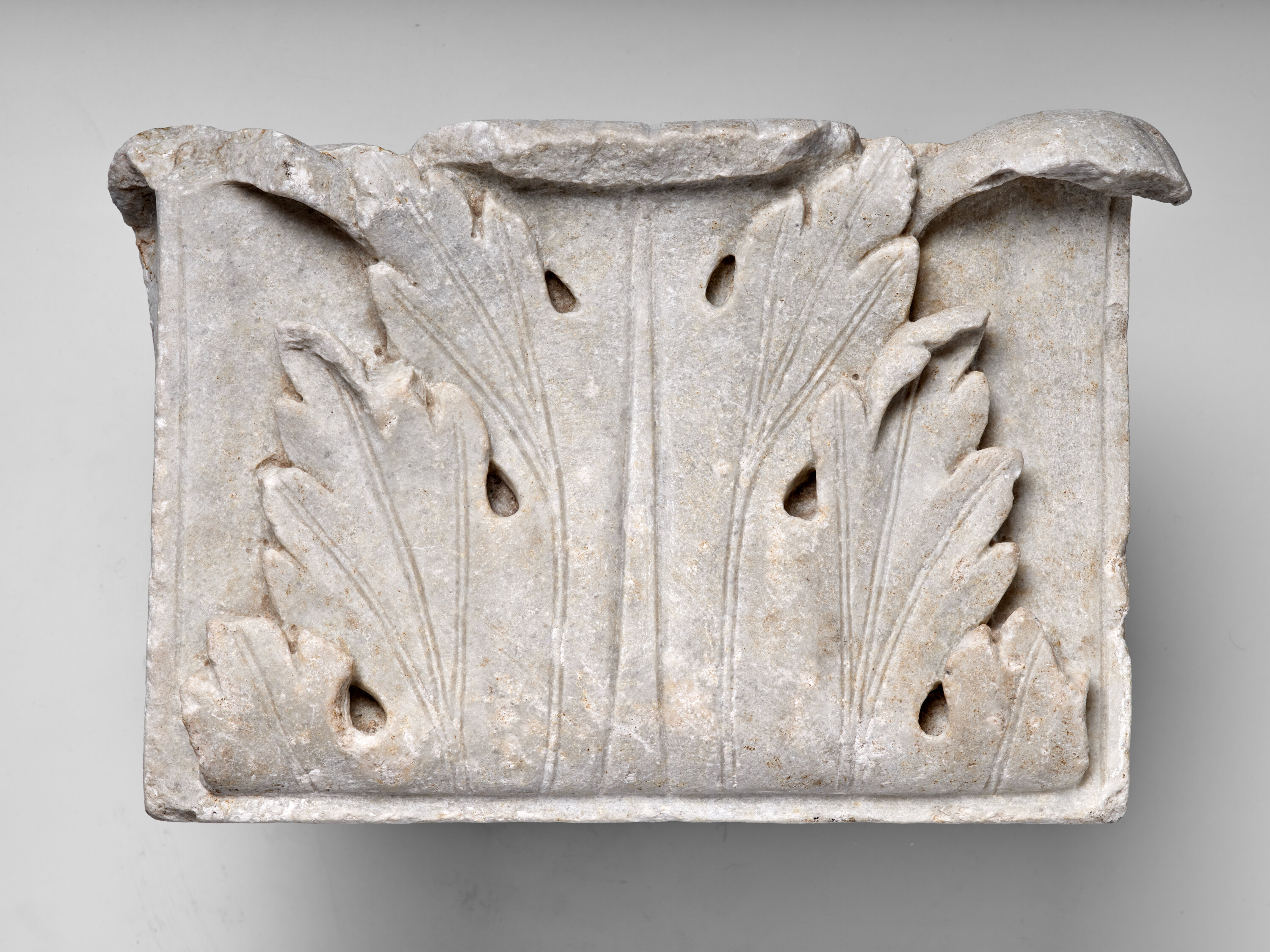
Lesene capital (inv. no. 2000.180.1)
Item
- Other Media
-
 2000.180.1_fig2
 - Description
-
This capital must have probably been part, together with the pillars or door jambs and clipei, of the decorative ensemble of the late antique villa, decorating the walls of the large western portico or a basilica hall.
The capital is adorned with thick, flat leaves, separated from each other by drop-shaped holes. If the composition is to be inscribed in the Corinthian order, the carving techniques directly recall micro-Asian environments, without however concealing the freedoms that the masters took from classical standards.
Moreover, the sculptural rendering and the way of using the drill are very similar to those found on the pillars (RA23e and RA23c). - Typology
- Architectural element
- Definition
- Lesene capital (inv. no. 2000.180.1)
- Collection
- Toulouse, Musée Saint-Raymond.
- Inventory number
- 2000.180.1
- Provenance
- Chiragan, Roman Villa.
- Date
- End of the 3rd c. BCE/beginning of 4th c. BCE.
- Material
- Marble.
- Dimensions
- Height: 20 cm; Width: 30 cm; Depth: 8,5 cm.
- Analytical methods
- VIS
- UV
- MO VIS
- MO UV
- Autoptic examination
- Few traces of color are visible to the naked eye, also due to the presence of numerous concretions.
- Under painting traces
- no
- Pigments
- White, grey-black, red, orange, yellow.
- Binder
- n.d.
- Stratigraphy
- On a white preparatory layer.
- Shading
- Darker gradient (dégradé plus foncé?).
- Metallic traces
- no
- Tools marks
- no
- Background colour
- Grey-black.
- Apparent marble parts
- no
- Restorations
- no
- Polychromy technique
-
The polychrome rendering recalls that of the RA23c and RA23e pillars. The background has traces of a grey-black pigment.
The leaves of the lower register show traces of red while orange for the leaves of the upper register. - Imitation of other supports
- coloured marbles
- Polychromy type
- Imitation of colored marbles/opus sectile.