
Pillar or door jamb (inv. no. RA23e)
Item
- Other Media
-
 RA23e_fig2
 - Description
-
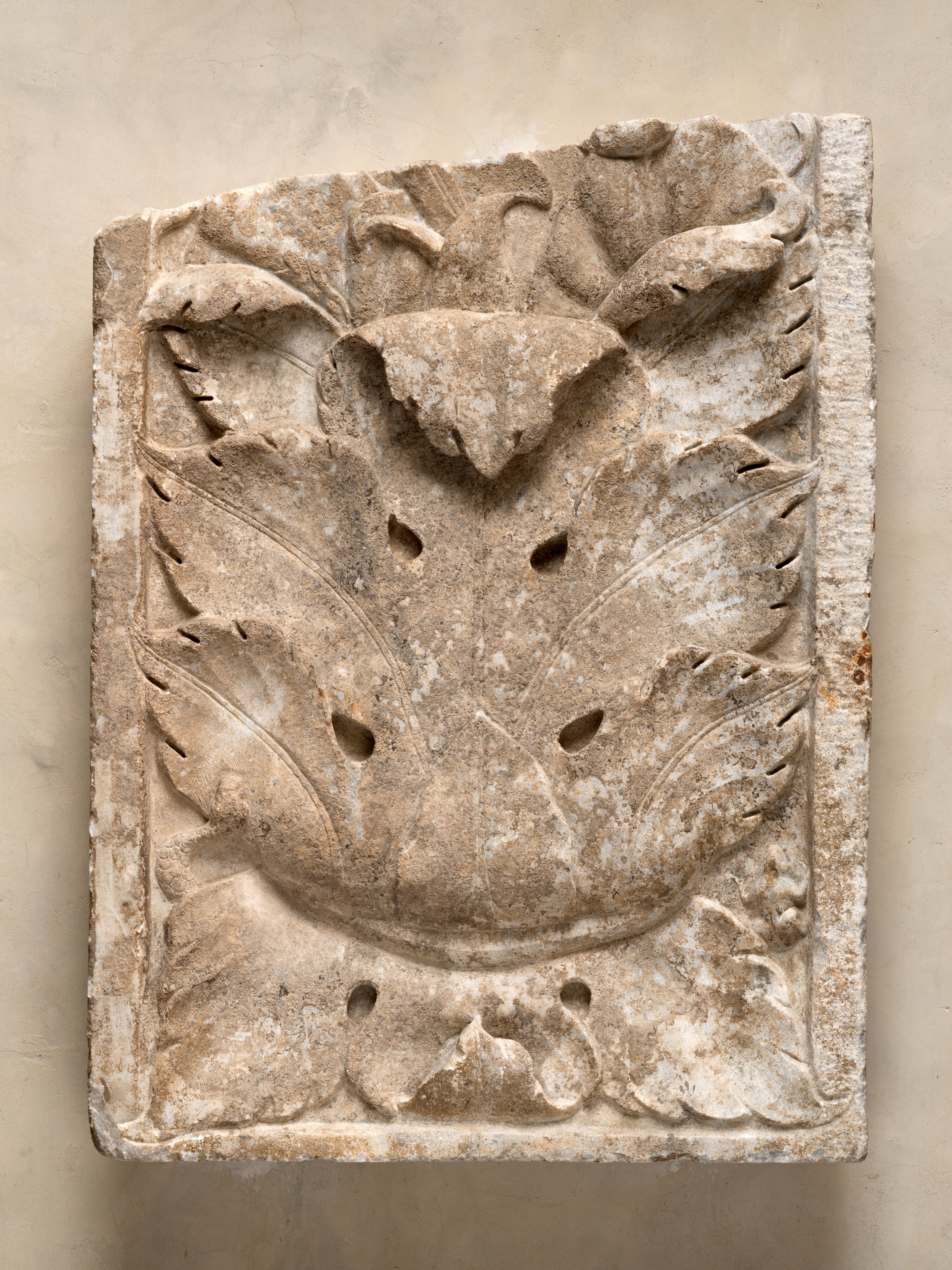
This pillar, or door jamb, must have probably been part, together with the capitals and clipei, of the decorative ensemble of the late antique villa, decorating the walls of the large western portico or a basilica hall.
The pillar, like the RA23c one, is adorned with large nerved and flattened leaves, which branch off from a large acanthus core. The leaves cover the entire field of the element, limited by simple strips. There are also a snake in the bottom left-hand corner and a frog on the other side.
The sculptural rendering and the way of using the drill are very similar to those found on the capital (inv. no. 2000.180). - Typology
- Architectural element
- Definition
- Pillar or door jamb (inv. no. RA23e)
- Collection
- Toulouse, Musée Saint-Raymond.
- Inventory number
- RA23e
- Provenance
- Chiragan, Roman Villa.
- Date
- End of the 3rd c. BCE/beginning of 4th c. BCE.
- Material
- Marble.
- Dimensions
- Height: 87 cm; Width: 64,5 cm; Depth:11 cm.
- Analytical methods
- VIS
- UV
- MO VIS
- MO UV
- Autoptic examination
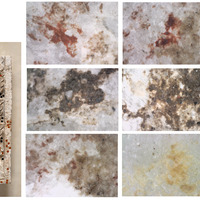
- Few traces of color are visible to the naked eye, also due to the presence of numerous concretions.
- Under painting traces
- no
- Pigments
- White, grey-black, red, orange, yellow.
- Binder
- n.d.
- Stratigraphy
- On a white preparatory layer.
- Shading
- Darker gradient (dégradé plus foncé?).
- Metallic traces
- no
- Tools marks
- no
- Background colour
- Grey-black.
- Apparent marble parts
- no
- Restorations
- no
- Polychromy technique
-
The polychrome rendering recalls that of the RA23c pillar and the 2000.800.1 capital. The background and edge have traces of a grey-black pigment.
The leaves of the lower register show traces of red, orange for the leaves of the intermediate register and gray for those of the upper register, as well as the veins of the leaves of the upper register.
The flowers are painted yellow and orange, like the animals. - Imitation of other supports
- coloured marbles
- Polychromy type
- Imitation of colored marbles/opus sectile.