-
Analytical methods
-
VIS
-
UV
-
MO VIS
-
MO UV
-
Autoptic examination
-
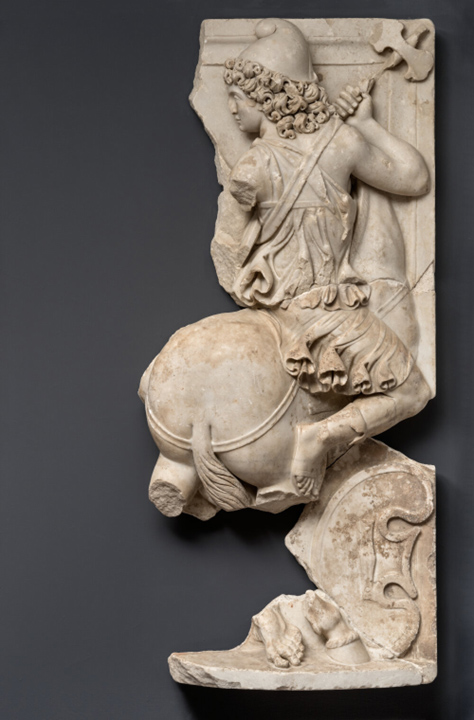
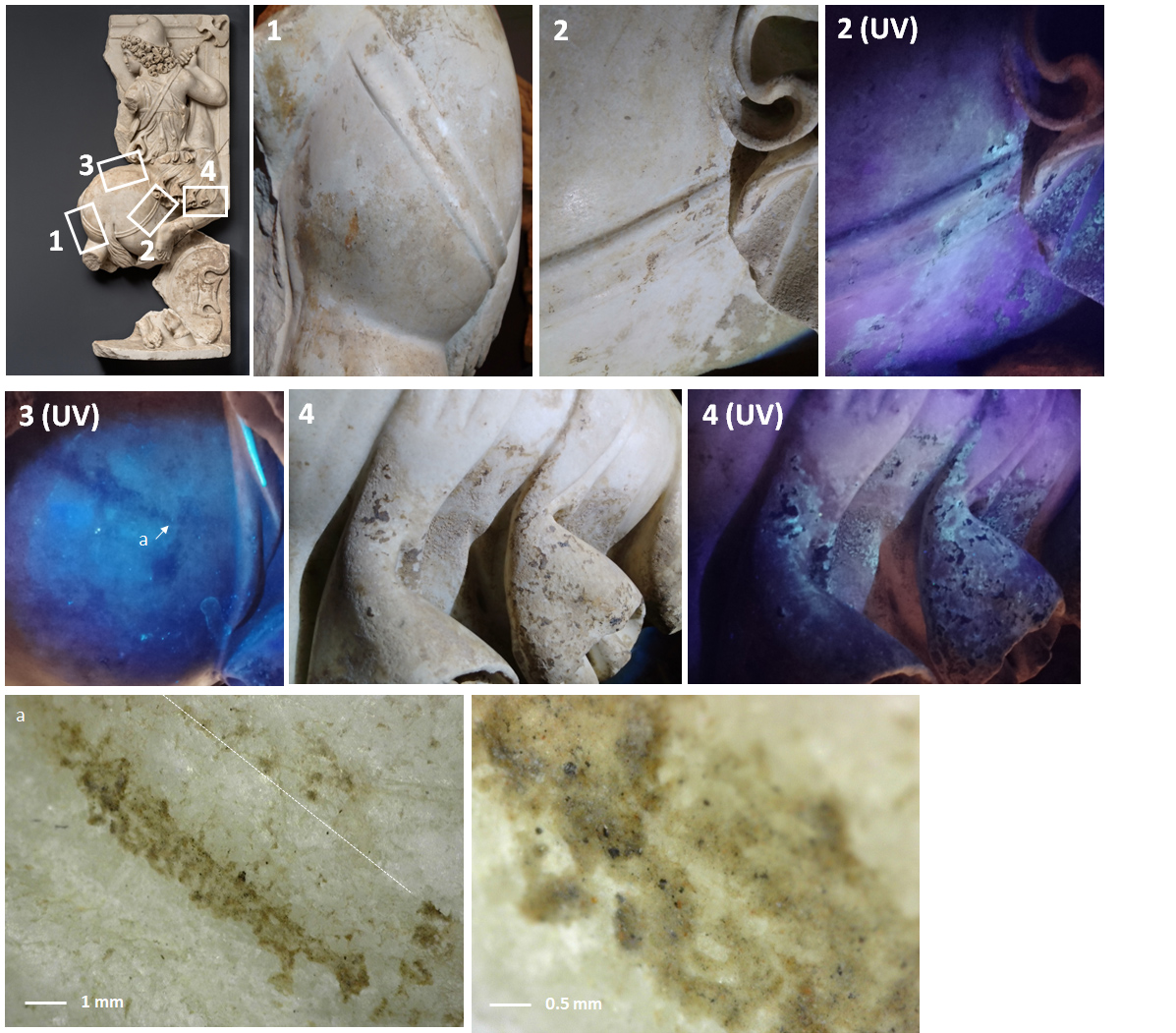
Traces of brown, red, and orange paint are visible to the naked eye on the background between Heracles's foot and the horse's base, as well as on the horizontal surface on which the hero's foot rests. The horse's coat, tail, and thong also show areas colored translucent yellow-orange, orange, black, and brown-black, respectively. The Amazon's drapery retains traces of grayish-brown, clearly visible under UV light below the concretions, darker on the lower edge.
-
Imaging
-
Microscopic examination (180 points) shows that the skin of Heracles and that of the Amazon have the same color, respectively. Hyppolita has an orangey skin color, darker than that of the hero, which allows to identify her. The frame and background also have the same treatment as the relief RA28l. The queen's head has a reddish-blond coloring on the hair and
a reddish-orange cap. The tunic was probably dark in color, with
areas highlighted in blue and parts in red with the typical fluorescence of madder lacquer . The horse's rump and tail preserve traces of yellow and orange (only on the left), while the strap is highlighted in brown. The pelta has a red rim, a gray background, and a light yellow-brown handle. This
trichromy is also found in the clipei and may be intended to imitate metal weapons. The background shows visible traces of brown-black in several places, with blue shadows between Heracles' foot and the background, as well as between the horse's hindquarters and the background.