
Clipeus of Aesculapius (inv. no. RA 34m)
Item
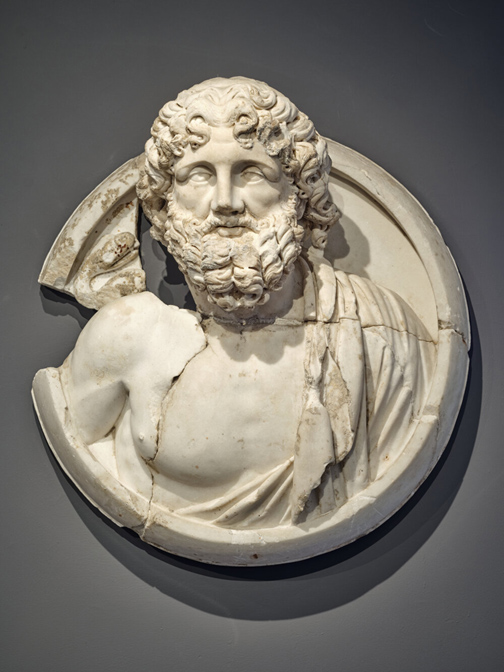
- Description
- This clipeus represent Aesculapius, the god of medicine who relieved suffering and raised the dead. The serpent carved above his right shoulder is his attribute; it refers to beneficial forces, and its moult embodies its eternal rebirth. It's part of a stylistically homogeneous group of shields depicting male and female deities, who was carried out by the workshop entrusted with this prestigious commission. Characteristic features are wide drooping upper eyelids, the treatment of hair and beard and a massive use of trepan and chisel.
Artwork
- Typology
- Architectural element
- Definition
- Clipeus of Aesculapius (inv. no. RA 34m)
- Collection
- Toulouse, Musée Saint-Raymond
- Inventory number
- RA 34m
- Provenance
- Chiragan, Roman Villa
- Date
- End of the 3rd c. BCE/beginning of 4th c. BCE
- Material
- White marble from Saint-Béat caves, Pyrenees
- Dimensions
- Width: 75 cm; Height: 78 cm; Depth: 38 cm.
Analytical results
- Analytical methods
- VIS
- UV
- MO VIS
- MO UV
- Autoptic examination
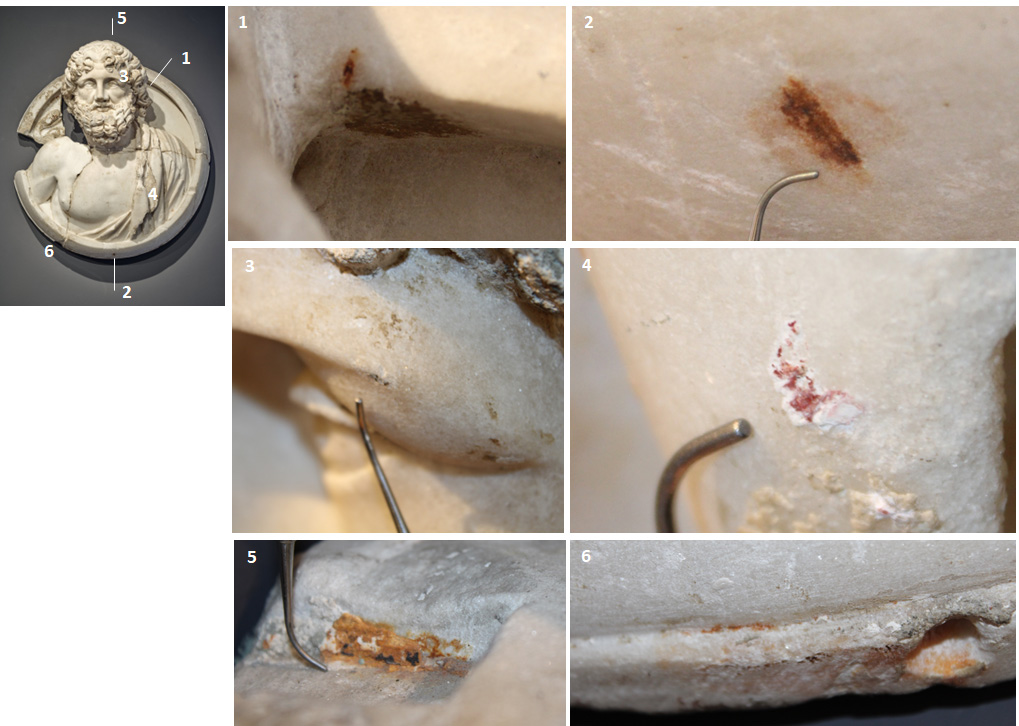
- Traces of colors visible to the naked eye are on the background and on the outer rim (dark brown), on the facial features (black on the eyebrows, eye contours and pupils). A thick dark yellow paint layer is also preserved in the mounting and casing holes: probably it was painted before being installed.
- Imaging
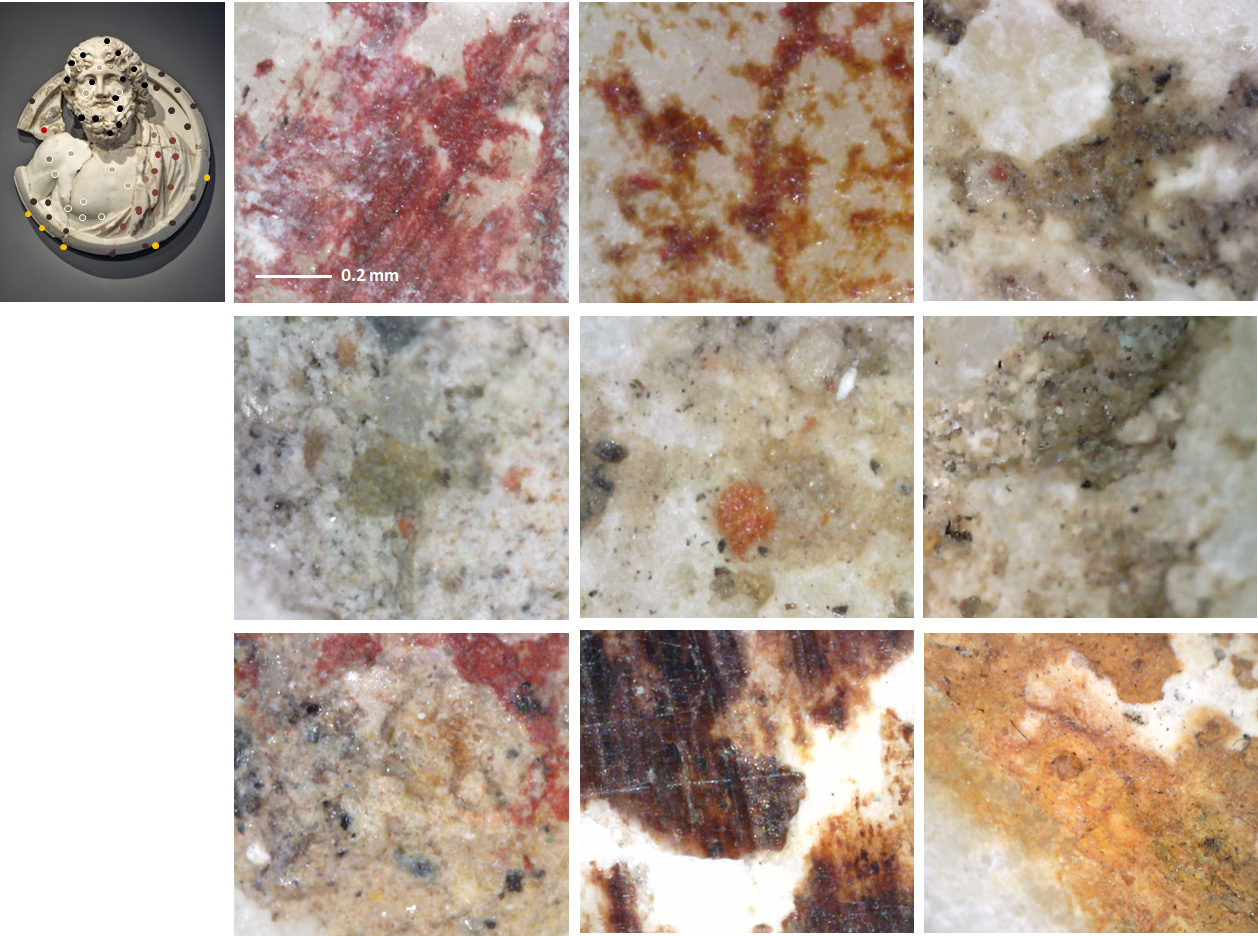
- Microscopy (120 points) reveals different traces of pigments, There is red, superimposed on a yellow preparatory layer, on the drapery; translucent brown-black on the hair, and off-white, rendered with a mixture of white, red, and orange grains, on the skin, enhanced in black around the eyes, eyebrows, and muscles. The snake exhibits a gray-brown coloration with orange grains and scales marked in red, brighter, denser, and thicker on the animal's head. The background is brownish-brown and contrasts with the border, enhanced around its perimeter in yellow with a red line.
Polychromy technique
- Under painting traces
- no
- Pigments
- white, black, red, orange, yellow, blue, purple
- Binder
- n.d.
- Stratigraphy
- n.d.
- Shading
- darker gradient
- Metallic traces
- no
- Tools marks
- no
- Background colour
- black
- Apparent marble parts
- no
- Restorations
- no
- Polychromy technique
- On the drapes and hair the colored paint is applied over a preparatory layer. This contrast with the thin, transparent layers applied directly to the marbles that completed the composition. The shine could be achieved through the use of an organic binder, such as wax.