
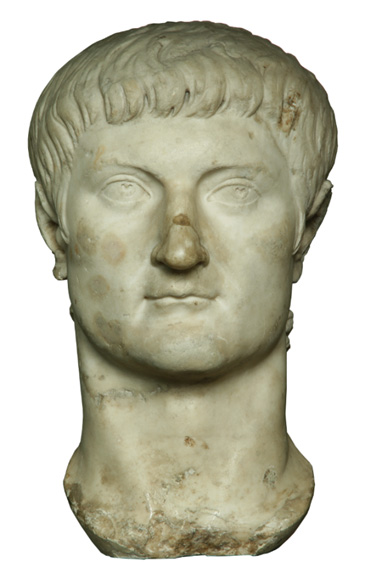
Supposed portrait of Drusus the Younger (inv. no. B.239)
Item
- Description
- The colossal imperial head is still the subject of discussion regarding the identification of the depicted man. Considered by some to be a portrait of Tiberius (F. Cumont), from others of Germanicus (V. Poulsen) or again like Drusus the Younger (J.-C. Balty). The engravings found on the pupils and front curls bring the effigy closer to those of the emperors of the Constantinian dynasty (e.g. the colossal portrait of Constantius II, preserved in the Capitoline Museums): a reworking of the 4th c. CE has therefore been proposed.
Artwork
- Typology
- Portrait
- Definition
- Supposed portrait of Drusus the Younger (inv. no. B.239)
- Collection
- Mariemont, Royal Museum.
- Inventory number
- B.239
- Provenance
- The original provenance of the portrait is unknown.
- Date
- 1st c. CE and 4th c. CE (reworking?).
- Material
- White marble.
- Dimensions
- Height: 96 cm.
Analytical results
- Analytical methods
- VIS
- UV
- MO VIS
- MO UV
- MAXRF
- Raman
- Autoptic examination
- No traces of colour visible to the naked eye.
- Imaging
-
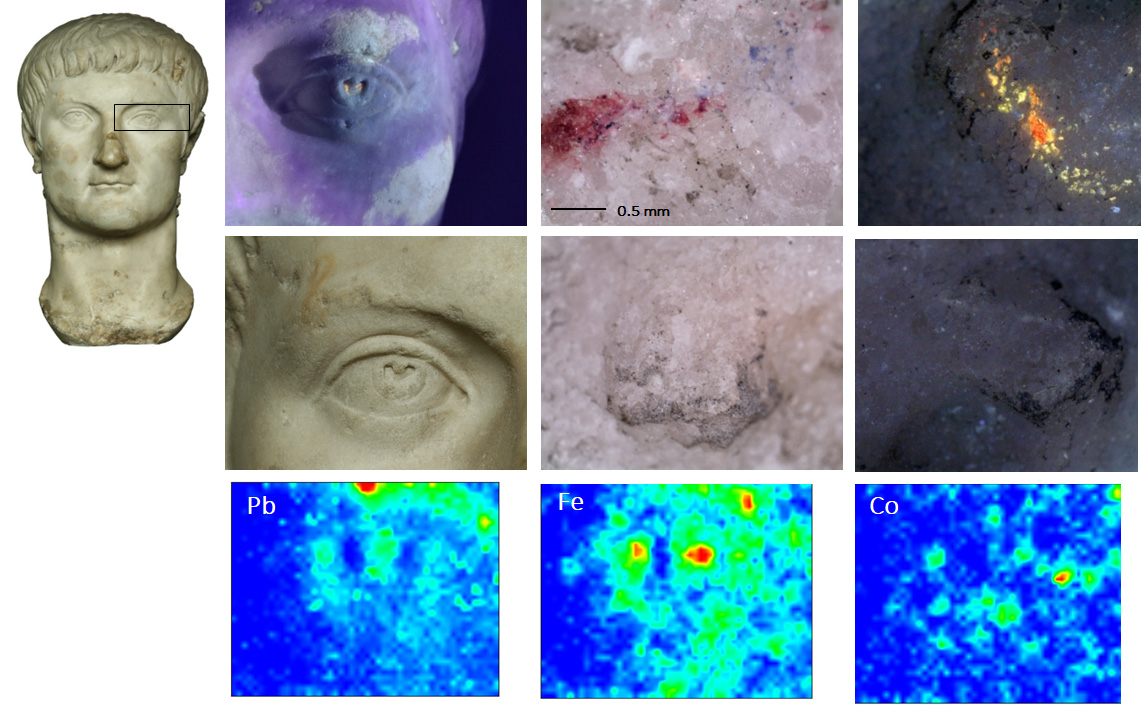
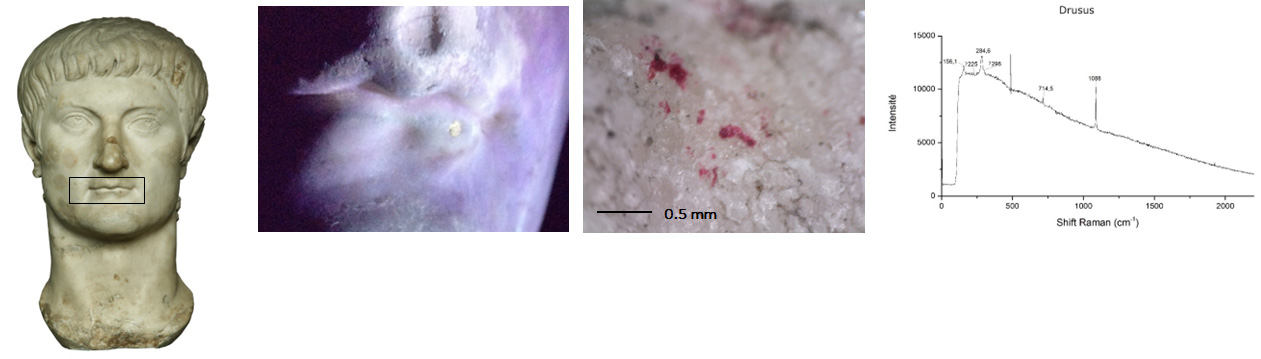
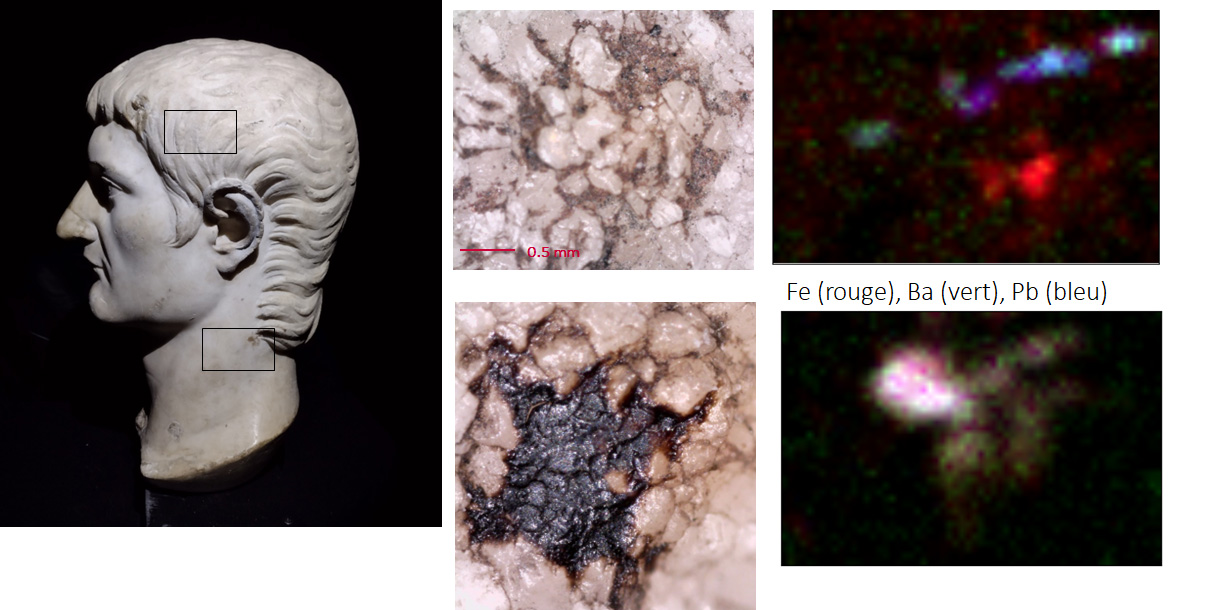
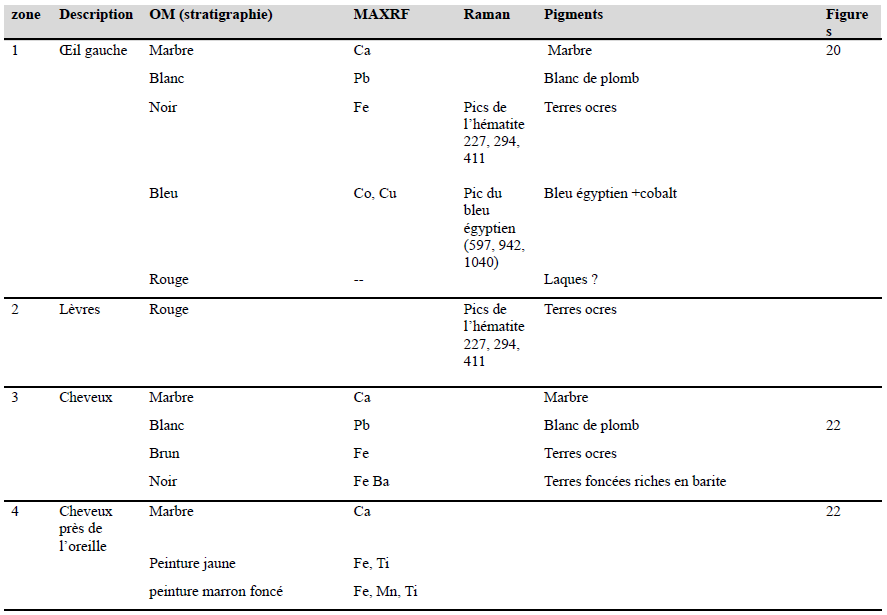
Traces of colour are particularly visible through UV light. Areas of black fluorescence are found on the hair and in the pupil of the right eye, probably linked to the presence of iron. Orange fluorescence is found on the lips and pupil of the left eye, usually attributable to madder lake. Blue fluorescence is also detected in the left eye.
Microscopy helps establish stratigraphy. In the hair the brown pigment is placed directly on the marble while in the hollows of the hair the black lines overlap the brown layer.
The bright orange fluorescence found on the lips and in the right eye corresponds to the use of a bright red pigment. The right eye retains traces of black pigment while the left one shows traces of red and blue above the black ones. This could indicate the use of a black pigment for the creation of preparatory drawings. A similar stratigraphy is found in the Treu Head of the British Museum.
Polychromy technique
- Under painting traces
- Black traces in the pupils.
- Pigments
- White lead, madder lake (?), egyptian blue, ochre (brown), ochres rich in manganese.
- Binder
- n.d.
- Stratigraphy
- On a white lead preparatory layer.
- Shading
- no
- Metallic traces
- no
- Tools marks
- Overflow of hair colour on the skin.
- Background colour
- no
- Apparent marble parts
- The absence of colour on the skin and the extremely polished surface could suggest an apparent marble rendering. However, the absence of color could be due to poor preservation.
- Restorations
- no
Polychromy type
- Anthropomorphic/realistic
- Idealized anthropomorphic rendering (clear eyes and white skin).
- Polychromy type
-
The polychrome rendering is probably attributable to the second phase of the portrait (late antiquity?) and it is based on a play of contrasts between the bright red of the lips and the dark brown of the hair, the whiteness of the apparent marble skin and the blue of the eyes.
The chromatic choice aspires to the idealization of reality, reinforcing the message of plastic art in its colossal dimensions.
Bibliography
- Bibliography
- Manca titolo del contributo