
Portrait known as "Lucilla" (inv. no. AC.622.B)
Item
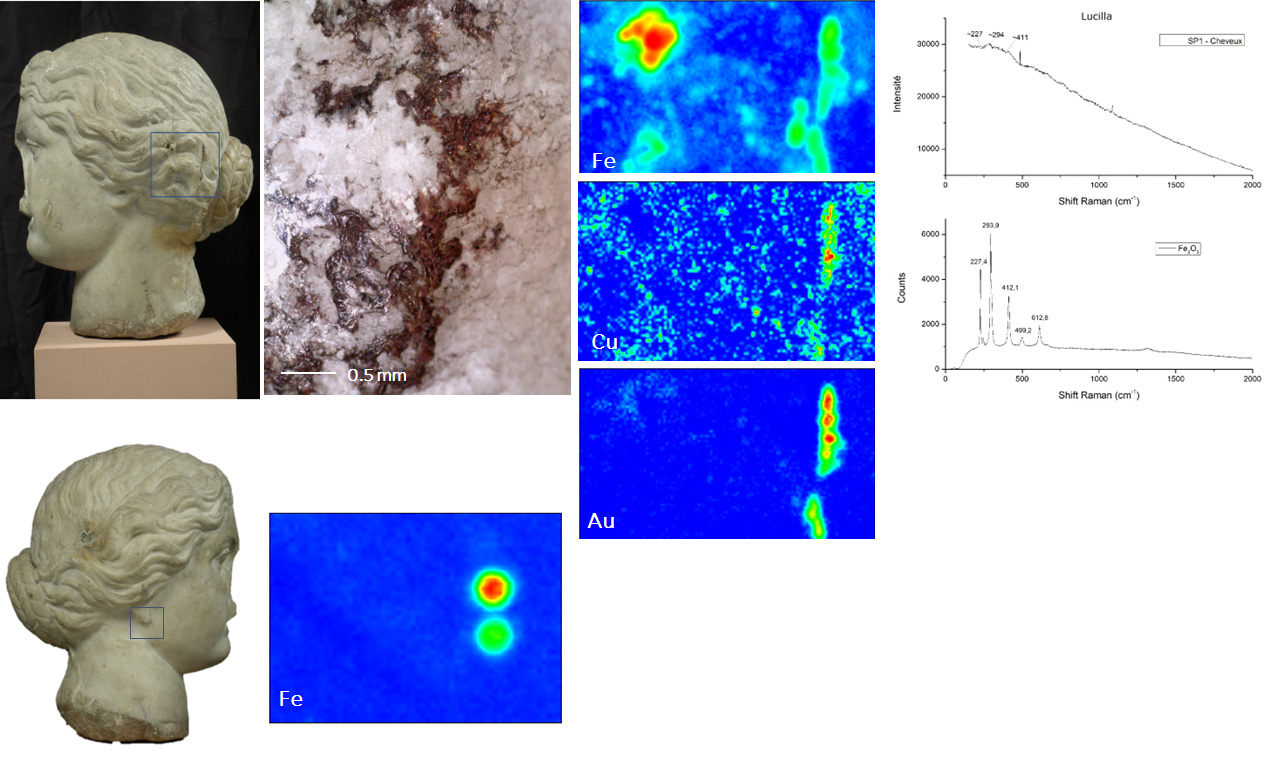
- Description
-
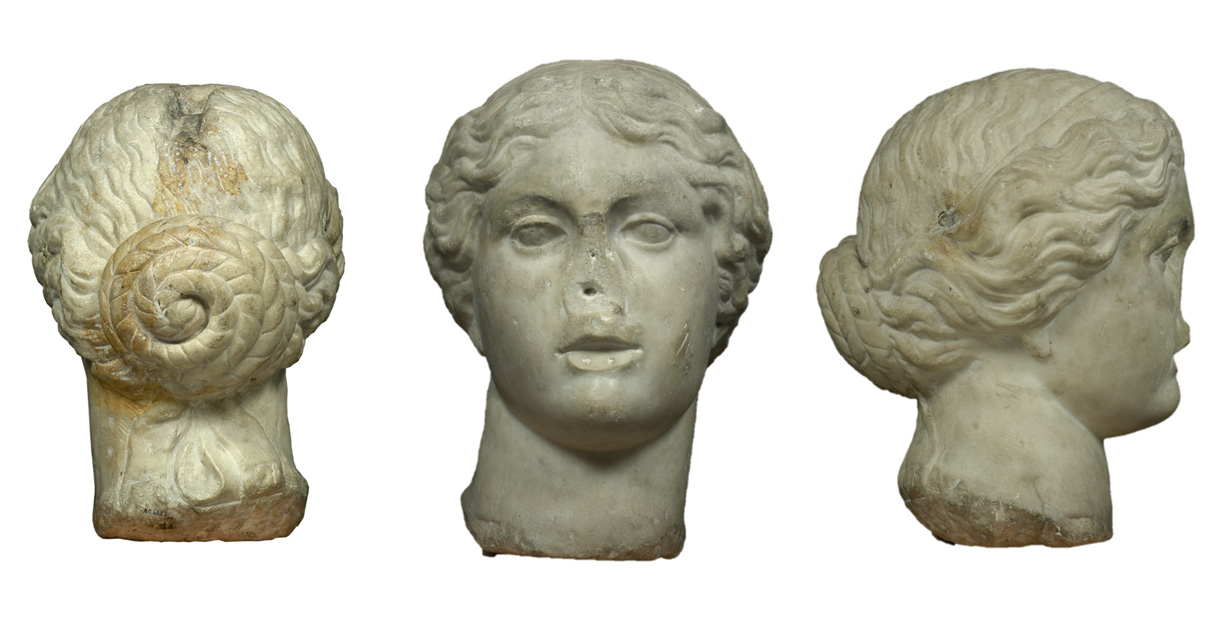
The head belonged to the Joseph Brassinne’s collection, with a purported provenance from Maastricht. Its first recorded mention dates to 1928, in Espérandieu’s catalog, where it was interpreted as a representation of Venus.
The nose and lips, likely badly damaged, were removed during a modern restoration.
The head depicts a young woman with a round oval face and firm features. Starting from the central parting, soft wavy locks are arranged, gathered at the nape into a chignon. The shape of the chignon is characteristic of the Antonine period: it is simply formed by a single large braid, woven around a continuous central lock, spiraled to the left. Based on this feature, come scholars identified the Mariemont head as a portrait of Lucilla, wife of Lucius Verus because the same hairstyle indeed appears on coin effigies and portraits of Lucilla. Others prefer to consider the Mariemont head as the portrait of the wife of the owner of a Roman villa near Maastricht, who wished to be represented before her familia and guests in a form transfigured by allusions to the Amazon of Polyclitus because of the parallels with the hairstyles of Amazons.
Artwork
- Definition
- Portrait known as "Lucilla" (inv. no. AC.622.B)
- Collection
- Mariemont, Musées Royaux
- Inventory number
- AC.622.B
- Date
- Antonine period
- Material
- White marble
- Dimensions
- Height: 31,5 cm
Analytical results
- Analytical methods
- UV
- MAXRF
- Raman
- Autoptic examination
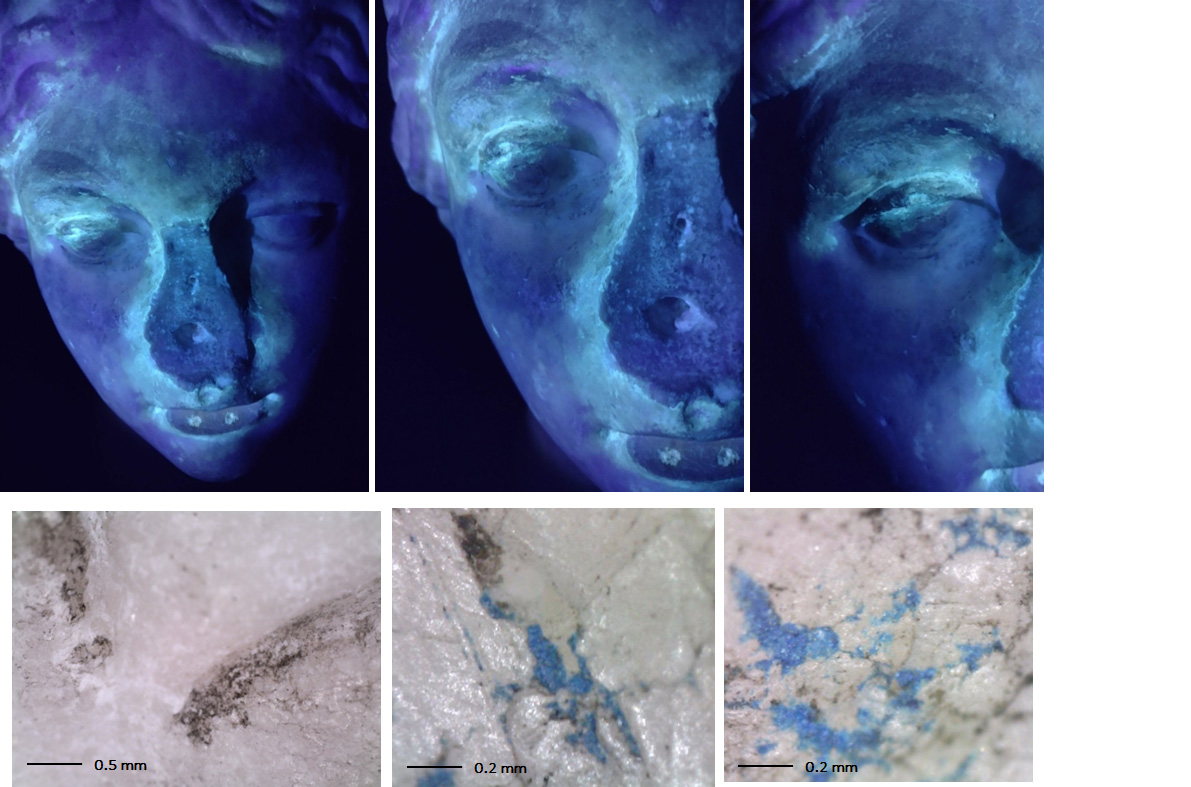
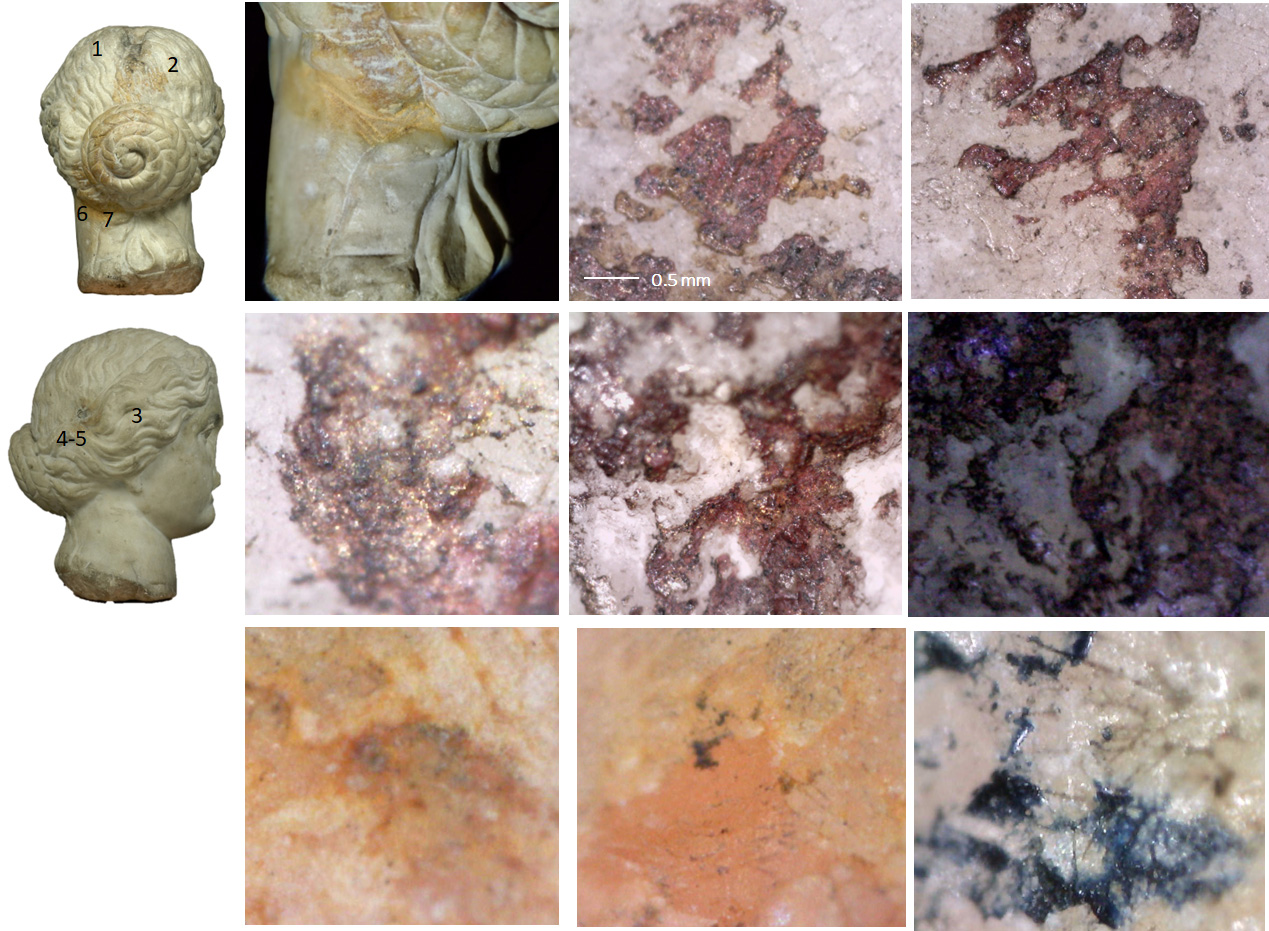
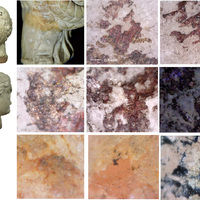
- Close observation in visible and UV light reveals black lines outlining the eyes and eyelashes—especially around the right eye and pupil; white areas highlighted with yellow on the temples and nape; and yellow and red with metallic dots on the hair. The right ear bears traces of shiny metal on its surface.
- Imaging
- Microscopic examination confirms the presence of lines in the eye contour, iris, and pupil, as well as large blue areas in these regions.
-
 AC 622 B.fig.3
- Chemical analysis
-
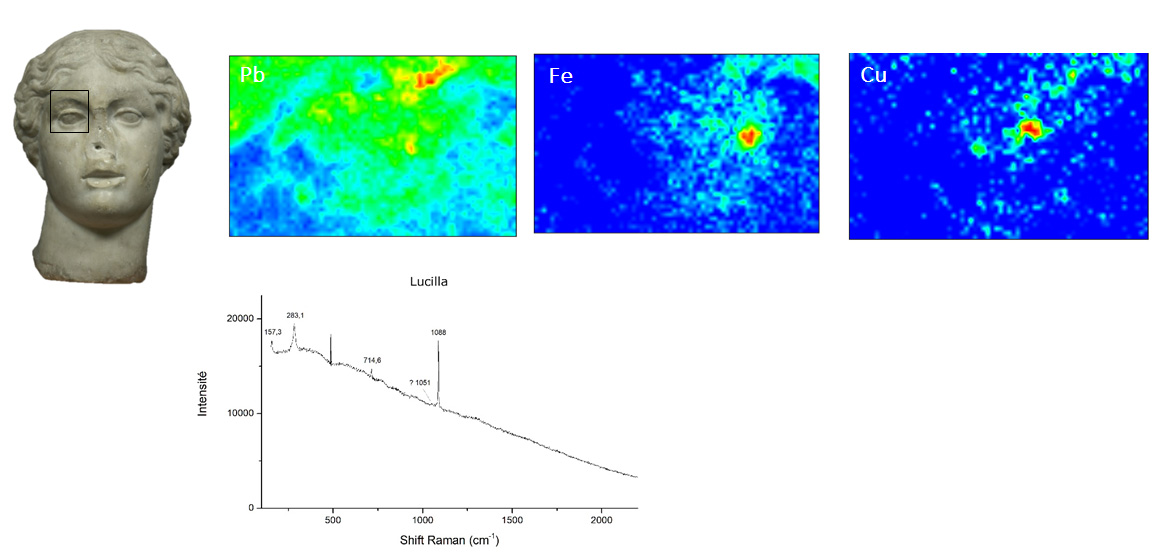
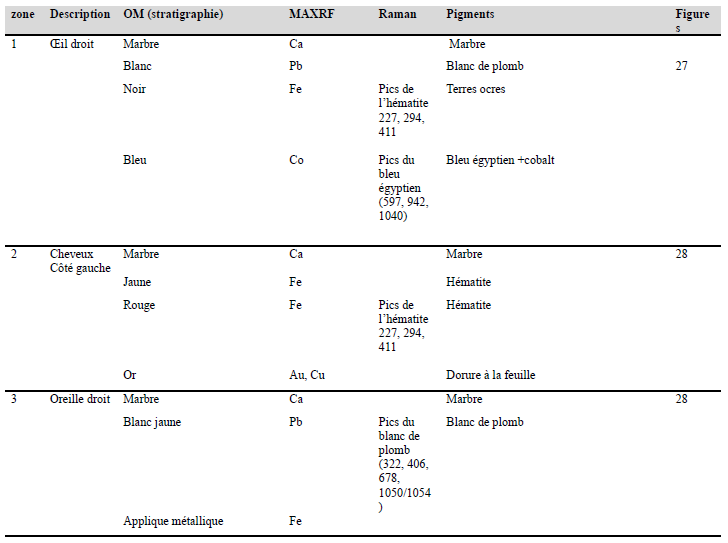
Three regions—the right eye, left-side hair, and right ear—were analyzed. Nine points (three per region) were examined via Raman spectroscopy.
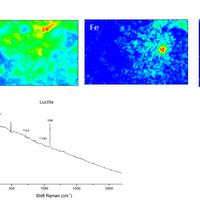
XRF analysis shows that the yellow and red hair layers served as a preparatory base for gilding. Elemental mapping reveals strong iron signals near the rivet and gold-copper signals where red overlapped—clear evidence of gold leaf application. -
See all items with this value
 AC 622 B.fig.4
Polychromy technique
- Under painting traces
-
Black lines around the eyes
- Pigments
- Lead white, carbon black, Egyptian blue, ochre (yellow, red), gold leaf
- Binder
- n.d.
- Stratigraphy
-
Lead white underlayer
- Shading
-
Ochre layer over lead white for the face
- Metallic traces
- Gold leaf on the hair
- Tools marks
- Black lines on the eyelashes and around the eye.
- Background colour
- no
- Apparent marble parts
- no
- Restorations
- no
Polychromy type
- Anthropomorphic/realistic
-
Idealized anthropomorphic (light-colored eyes)?
- Polychromy type
-
The hair exhibits a complex layering: a bright yellow layer visible at the back of the skull is overlaid by a shiny red-brown layer. Bright orange is also present on the nape. On the skin, there is a white layer with yellow applied in places.
The skin was lightened with lead white and enhanced with yellow ochre in shadowed areas.
The black lines around the eyes were painted with hematite.
The blue color likely corresponds to Egyptian blue with cobalt, similar to earlier identified techniques (e.g., the Drusus head).
A metallic residue on the right ear suggests a former earring attachment.
The idealized image—reinforced by the chosen statuary type—is further enhanced by a chromatic scheme of partially or fully gilded hair, metallic ear appliqués, lightened skin, and bright eyes (to be interpreted further). However, the presence of shading still grounds the portrait in earthly realism.
Bibliography
- Bibliography
- R. Stupperich, Un portrait féminin idéalisé d'époque romaine au Musée De Mariemont, in Les cahiers de Mariemont. Bulletin du Musée royal de Mariemont, 14, 1983, pp. 22-33.
- G. Donnay, Portrait de Lucilla, in G. Faider-Feytmans G (ed.), Rome, ses origines et son Empire (Trésors inconnus du Musée de Mariemont I), Mariemont 1966, p. 67.