
Portrait of Commodus (inv. no. A.4144)
Item
- Description
-
Miniature portrait of Commodus, partially covered with concretions, first caught our attention because of its iconography and format.
The miniature format suggests a domestic and probably cultic use, in a lararium or a simple niche. It belongs to type 4 of Fittschen’s classification. It would therefore have been created in 177, when Commodus was named co-emperor with his father Marcus Aurelius. The Brussels replica, however, belongs to a group of rather imprecise copies, in which the sideburns and mustache motifs have been heavily schematized and simplified. The Brussels head could be considered a posthumous version of the first portrait of Commodus as sole emperor.
Artwork
- Definition
- Portrait of Commodus (inv. no. A.4144)
- Collection
- Brussels, Musée Art & Histoire
- Inventory number
- A.4144
- Date
- After 192 ?
- Material
- White marble
- Dimensions
- Height: 15 cm
Analytical results
- Analytical methods
- VIS
- VIL
- MAXRF
- Raman
- Autoptic examination
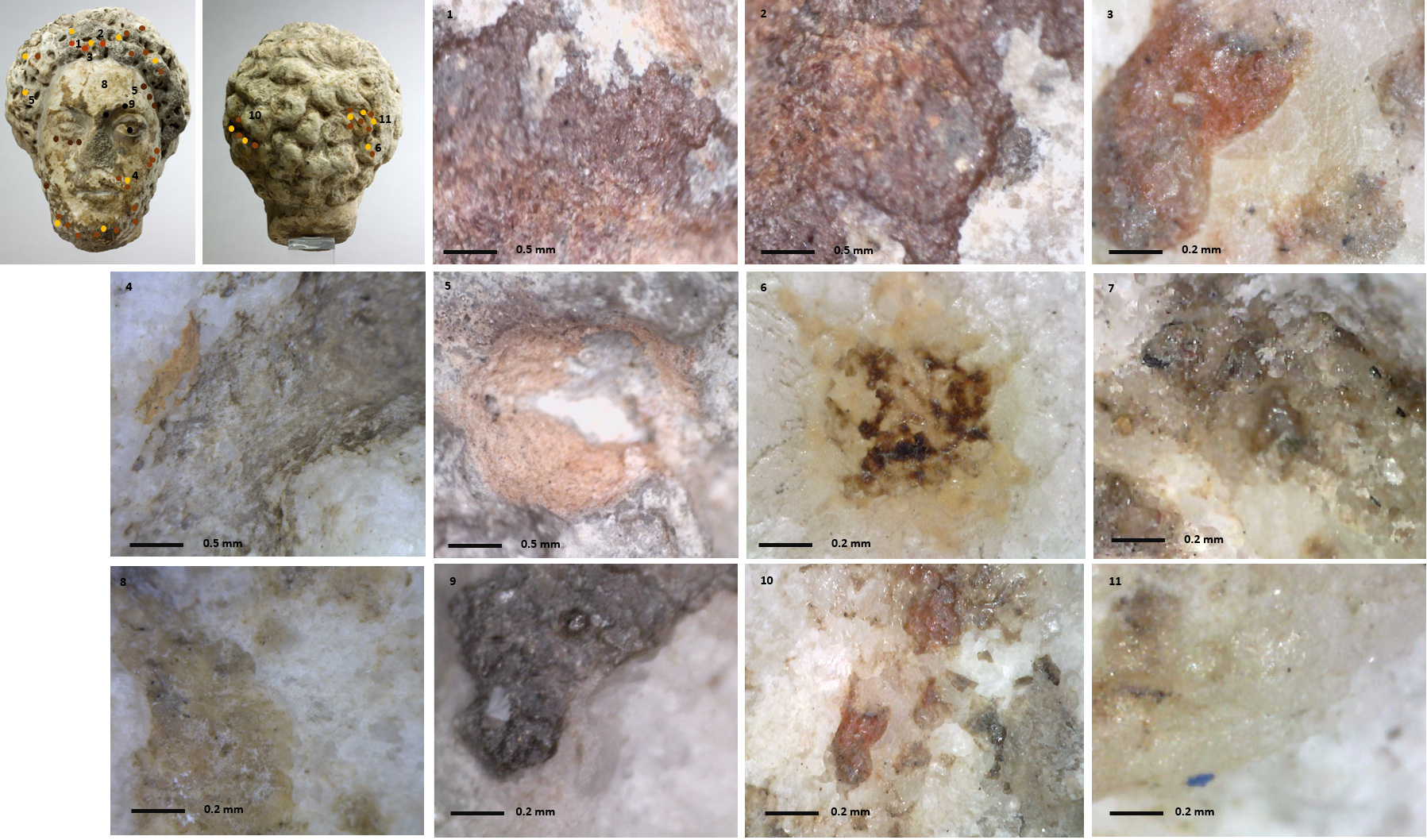
- Traces of color visible to the naked eye have been detected in the ear cavities (brown), in the hair between the curls (bright orange), notably on the lock falling on the forehead, at the level of the mustache, especially on the left (orange and brown), in the pupil of the left eye (black), and on the skin of the neck (yellow-orange).
- Imaging
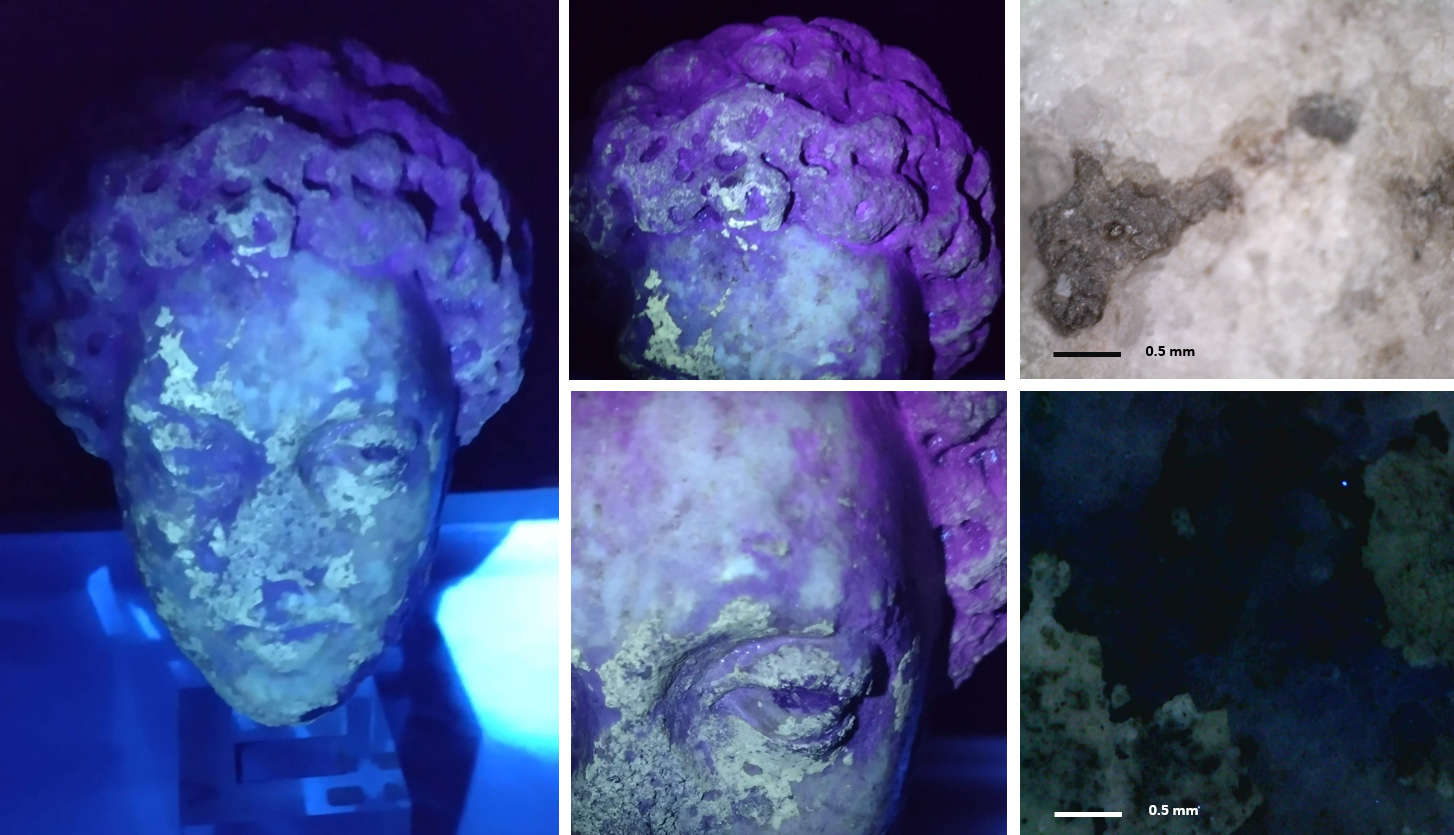
- VIS and UVL images of the statue clearly show the difference between the concretions, which appear white, and the areas where the color is preserved, which appear black under UVL. This observation confirms the distribution of color on the hair, facial features, and skin. Microscopic observation in the areas appearing black under UVL allows us to define the stratigraphy of the painted layers and the distribution of colors. The hair was painted with a yellow underlayer, over which a darker orange layer and a third red layer—documented only in the central lock—were superimposed. In various places within the curls’ recesses, the yellow underlayer is visible beneath an orange layer sometimes highlighted with blue dots. The beard, mustache, and sideburns are treated the same way as the hair at the back of the head. The mustache is outlined by a line of bright orange/yellow paint. The mustache, beard, and hair are bright orange with red highlights and blue shadows, chromatically distinct from the skin, which was light yellow with brown highlights in shadowed areas like the lacrimal caruncles. Gray is also noted on the edges of the face and neck. The pupil and eyebrow of the left eye are painted black.
Polychromy technique
- Under painting traces
- n.d.
- Pigments
- Lead white, vegetal black, vermilion, ochre (yellow, red)
- Binder
- n.d.
- Stratigraphy
-
Preparation layer of lead white
- Shading
-
Points of Egyptian blue; layering of dark pigments in the hollows of the curls; highlight on the central lock.
- Metallic traces
- no
- Tools marks
-
On the left moustache, a brushstroke (> 1 mm) is visible.
- Background colour
- no
- Apparent marble parts
- no
- Restorations
- no
Polychromy type
- Imitation of other supports
- metallo
- Polychromy type
-
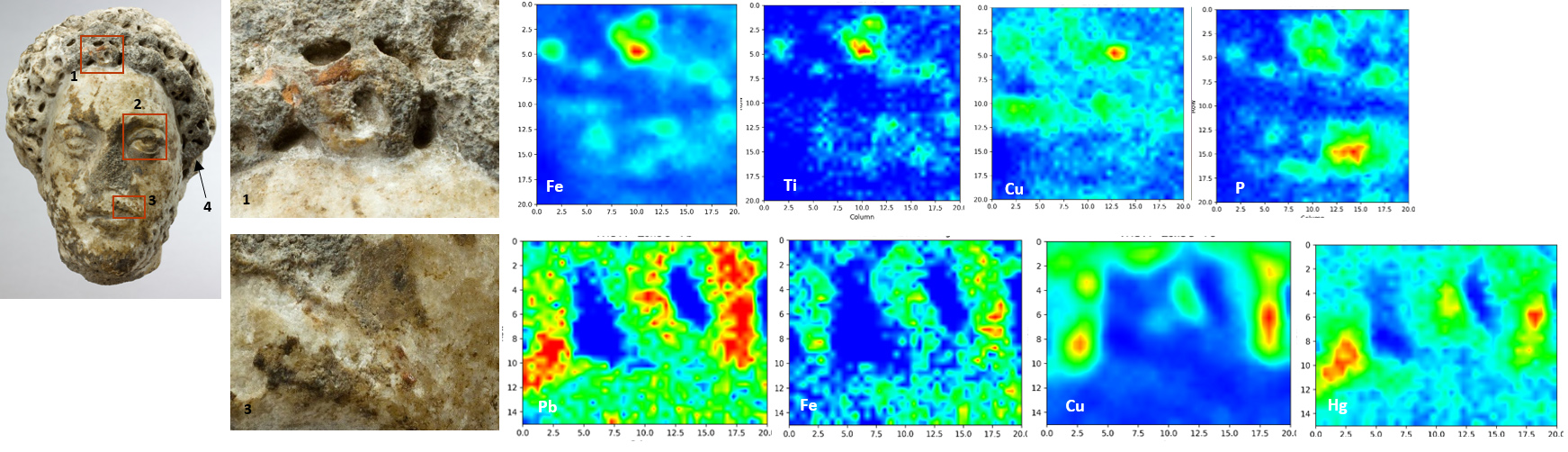
The bright yellow-orange layer detected on the beard, mustache, and hair can be associated with the lead and iron signals. It could be sandyx, a mixture of ochre and lead, or more likely lead white (preparatory layer) with ochre superimposed.
The presence of mercury on the lock of hair on the forehead suggests the use of vermilion/cinnabar, frequently found in Roman paintings of Antiquity.