
Sarcophagus of the Orant (inv, no. FAN 1992.2512)
Item
- Description
-
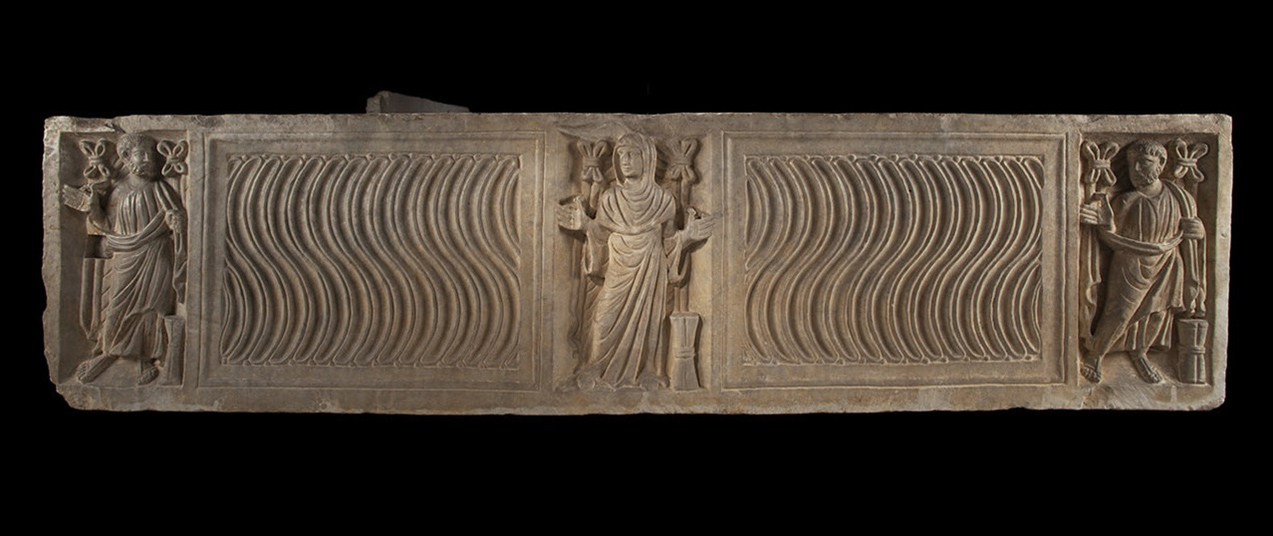
The sarcophagus is carved from a single block of Carrara-type architectural marble and sculpted only on its main face.
Its design is divided into five panels in the typical strigil motif, a scheme found on about ten of the fifteen known sarcophagi in Arles, though here it is accentuated by a refined architectural framing. The decoration is bounded by a smooth border; the S-shaped strigils, elegant and pearled, run along the top and bottom and are enclosed within a moulded rectangle.
At the center stands a veiled orant in high relief, set against a backdrop of drapery tied with two oversized knots. She turns her head slightly to her left and holds her hands in prayer (expansis manibus). Her tunic’s folds are dynamically rendered, with deeply cut and hollowed sleeves creating movement that contrasts with the static strigils. At her feet, clad in closed shoes, sits a bundle of volumina on the right side.
At each end are two male figures, symmetrically posed and also emerging from knotted parapetasmata, each with a bundle of volumina at their feet. Turning their heads in profile toward the central figure, they wear short “caps” hairstyles and chiseled beards; the pupils are rendered with central cylindrical drill holes. They wear long tunics with round collars and broad folds, along with a pallium. Their right hand is raised in a gesture of acclamation or greeting, while the left hand holds a fold of fabric.
Discovered in 1847 during the construction of the PLM railway line, the sarcophagus was unearthed in the Saint‑Pierre‑de‑Mouleyrès sector of the Alyscamps necropolis. It likely belonged to a necropolis surrounding an early Christian basilica dedicated to Saints Peter and Paul—known from an inscription—dating to the early 6th century.
Artwork
- Definition
- Sarcophagus of the Orant (inv, no. FAN 1992.2512)
- Collection
- Arles, Musée Départemental de l'Arles Antique
- Inventory number
- FAN 1992.2512
- Date
- Second third of the 4th century C.E.
- Material
- Marble of Carrara
- Dimensions
-
Length: 222 cm;
Height: 54 cm;
Width: 68 cm
Analytical results
- Analytical methods
- UV
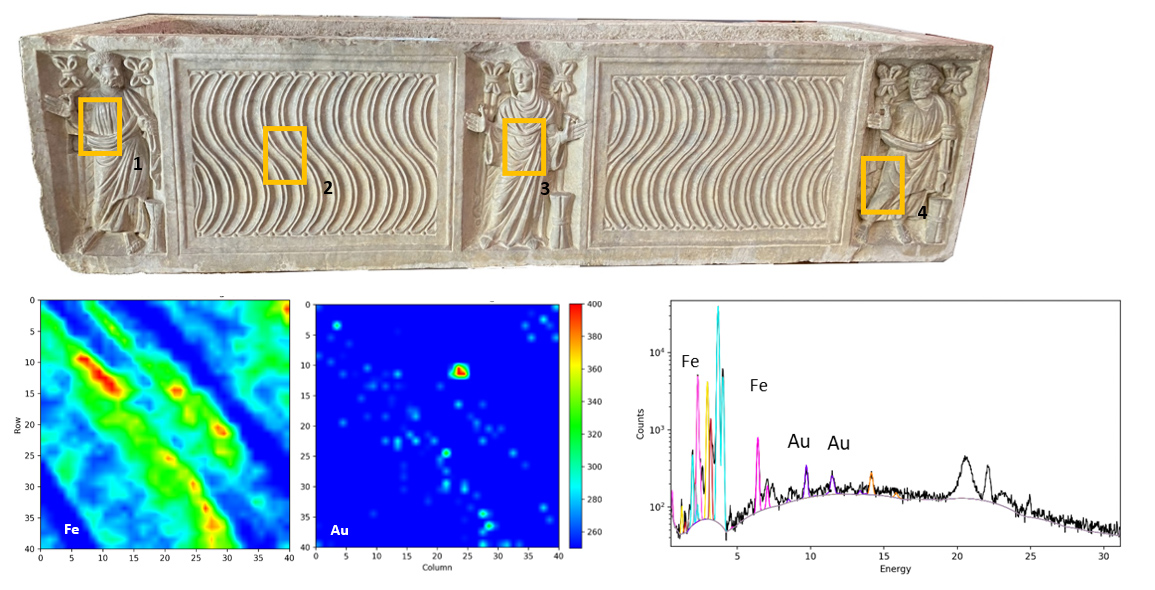
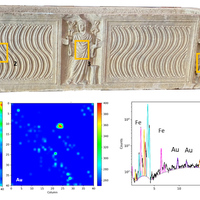
- MAXRF
- Autoptic examination
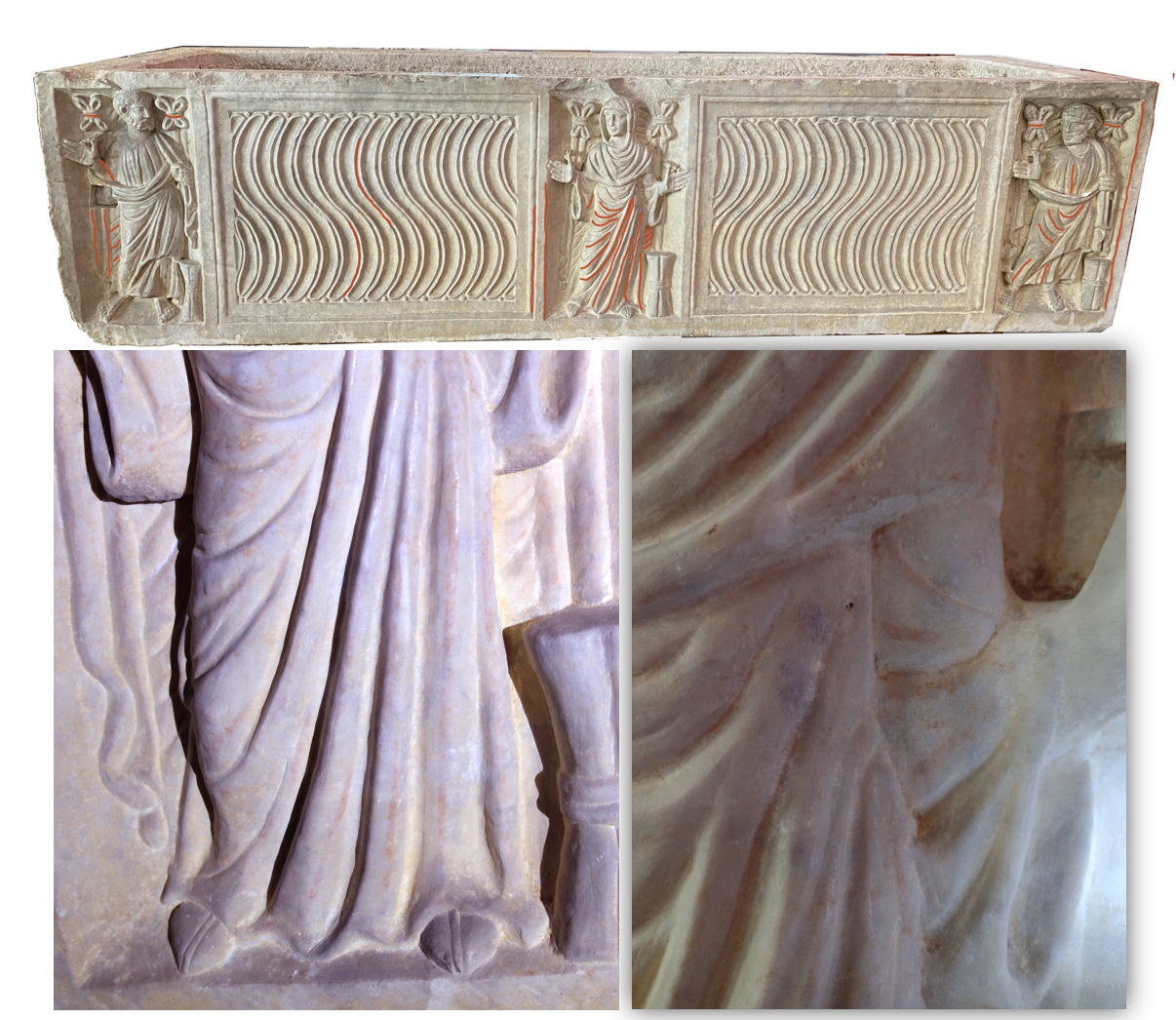
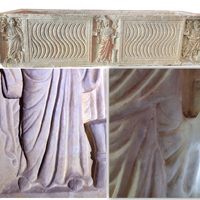
- Under normal lighting, visual inspection reveals several red lines misaligned with the sculptural program. These are not placed on the convex surfaces but on the flat planes below or above the relief—for instance, in background areas, drapery folds, and strigils. These red lines appear on the moulded frame, the strigils, the parapetasma knots, and the drapery surfaces of the orant and side figures.
- Imaging
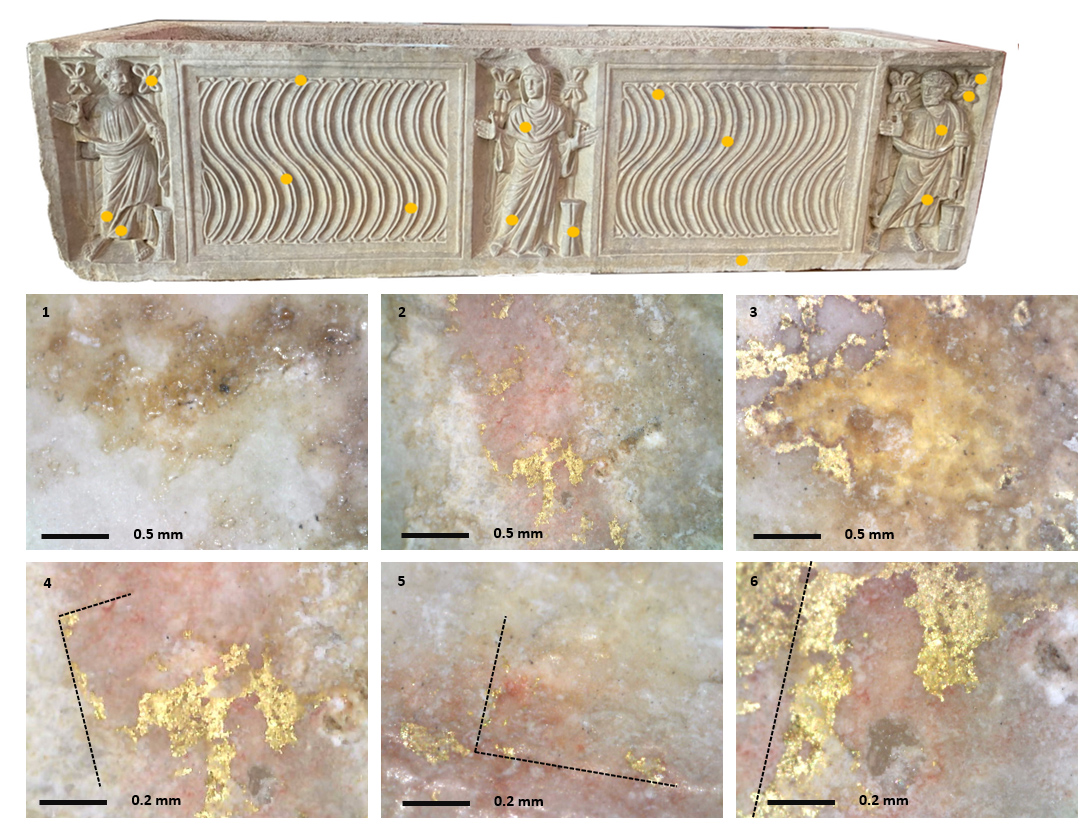
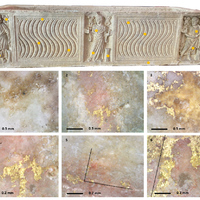
- Video‑microscope examination under visible, UV, and polarized light confirmed traces of gilding and revealed its stratigraphy. A thin yellow layer, applied directly on the marble and likely liquid when laid due to its translucency, is covered by a slightly fluorescent UV coating—possibly a residual organic binder. The red guide lines were drawn onto this yellow ground. Gold leaf overlaps these red lines and is sealed with a later fixative or protective layer. In several locations, rectangular gold leaf corners were observed over the red lines with slight overhang—strong evidence these were precise installation guides, not just decorative edges.
Polychromy technique
- Under painting traces
- Red lines along the median axis of the folds of the drapery and the strigils.
- Pigments
-
Ochre, gold leaf.
- Binder
- n.d.
- Stratigraphy
- Directly on the marble
- Shading
- no
- Metallic traces
- Gold leaf
- Tools marks
-
Red stroke of 7 mm (brush)
- Background colour
- Gold?
- Apparent marble parts
- no
- Restorations
- no
Polychromy type
- Polychromy type
-
The red lines extend beyond outlining figures to framing elements, strigils, and garments. Since they are misaligned with the relief’s carved lines, they likely served as guidelines for gold leaf application rather than mere decoration.
Gold leaf traces observed under microscopy on the Orant sarcophagus suggest gilding was applied not only to figurative motifs but also to aniconic elements: the garments of the three figures, the ribbons in the parapetasmata knots, the volumina bundles, strigil heads, pearls, and the frame may all have been gilded. However, the evidence is too fragmentary to reconstruct confidently—it remains unclear whether the gilding covered the entire sculpture or only echoed specific details, as with most linear‑style polychrome sarcophagi. - Immagini Tipologia della policromia
-
 FAN 1992.2512.fig.4