
Christian sarcophagus with scene of the Crossing of the Red Sea (inv. no. ACH.85.00.1)
Item
- Description
-
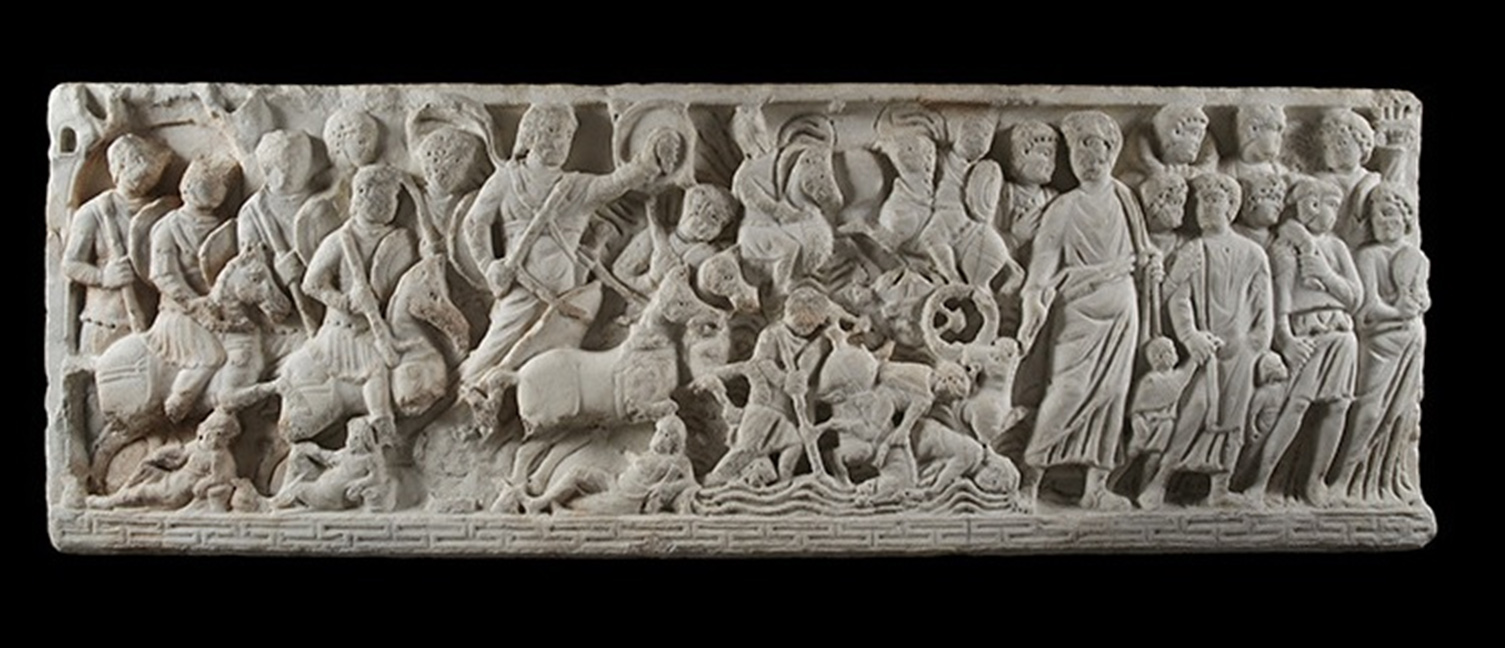
The main face of the basin shows a worn, burned and broken relief in some places. The lower edge is decorated by a continuous row of T-shaped meanders. The central scene belongs to the Old Testament and is particularly common in the sarcophagi of Arles (six examples). The episode of the Crossing of the Red Sea is laid out on a continuous frieze articulated in three paratactic scenes: the army of the egyptian king leaving the city at the sight of three personifications; the drowning of the soldiers in the Red Sea; beardless Moses closing the waters after the passage of the Israelites. The procession is led by Mary, sister of Moses, who plays the tympanum and is preceded by a column of fire.
The theme of the Crossing of the Red Sea, elaborated in the first half of the 4th century CE, spreads rapidly. In the sarcophagus under examination, the episode is elaborated through the juxtaposition of two compositional schemes: on the one hand the tumult of the battle sarcophagi and on the other the order of the rows of the processions. The result is a very dense scenography. The composition, in line with that of the other specimens, indicates the use of a template and thus the spread of a prototype. The decorative effects, underlined by the repeated use of the drill, are reminiscent of the Theodosian era.
The sides of the basin are decorated with imbrication motifs surrounded by a rectangle (opus pavonaceum), also found in other sarcophagi of Arles (about ten copies), Gaul (ten examples) and Rome (two specimens).
Artwork
- Typology
- Sarcophagus
- Definition
- Christian sarcophagus with scene of the Crossing of the Red Sea (inv. no. ACH.85.00.1)
- Collection
- Arles, Musée Départemental de l'Arles Antique.
- Inventory number
- ACH.85.00.1
- Provenance
- Arles, Necropolis of the Alyscamps (uncertain).
- Date
- 4th c. CE
- Material
- White marble.
- Dimensions
- Width: 200 cm; Height: 66 cm; Depth: 80 cm.
Analytical results
- Analytical methods
- VIS
- UV
- MO VIS
- MO UV
- MAXRF
- Autoptic examination
-
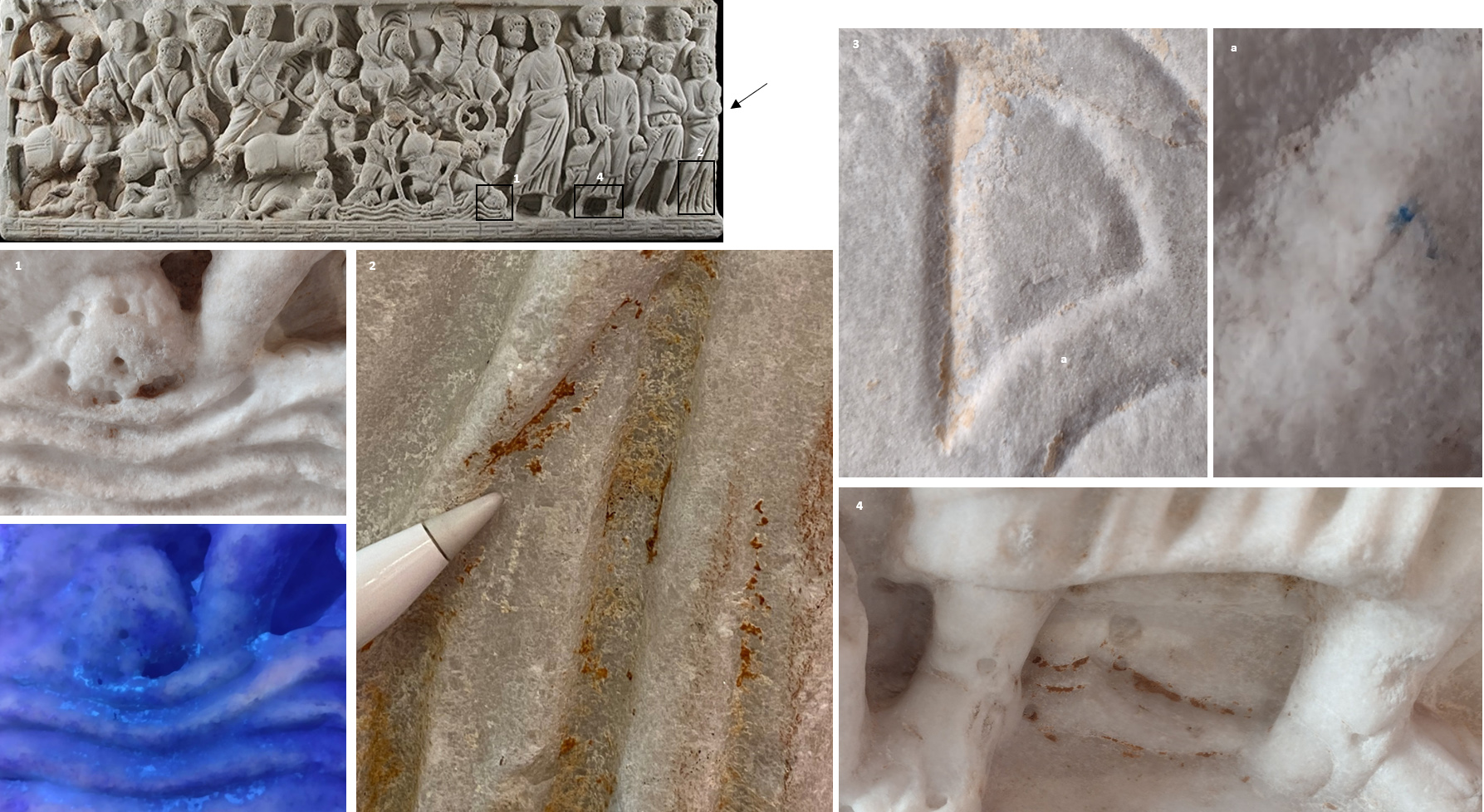
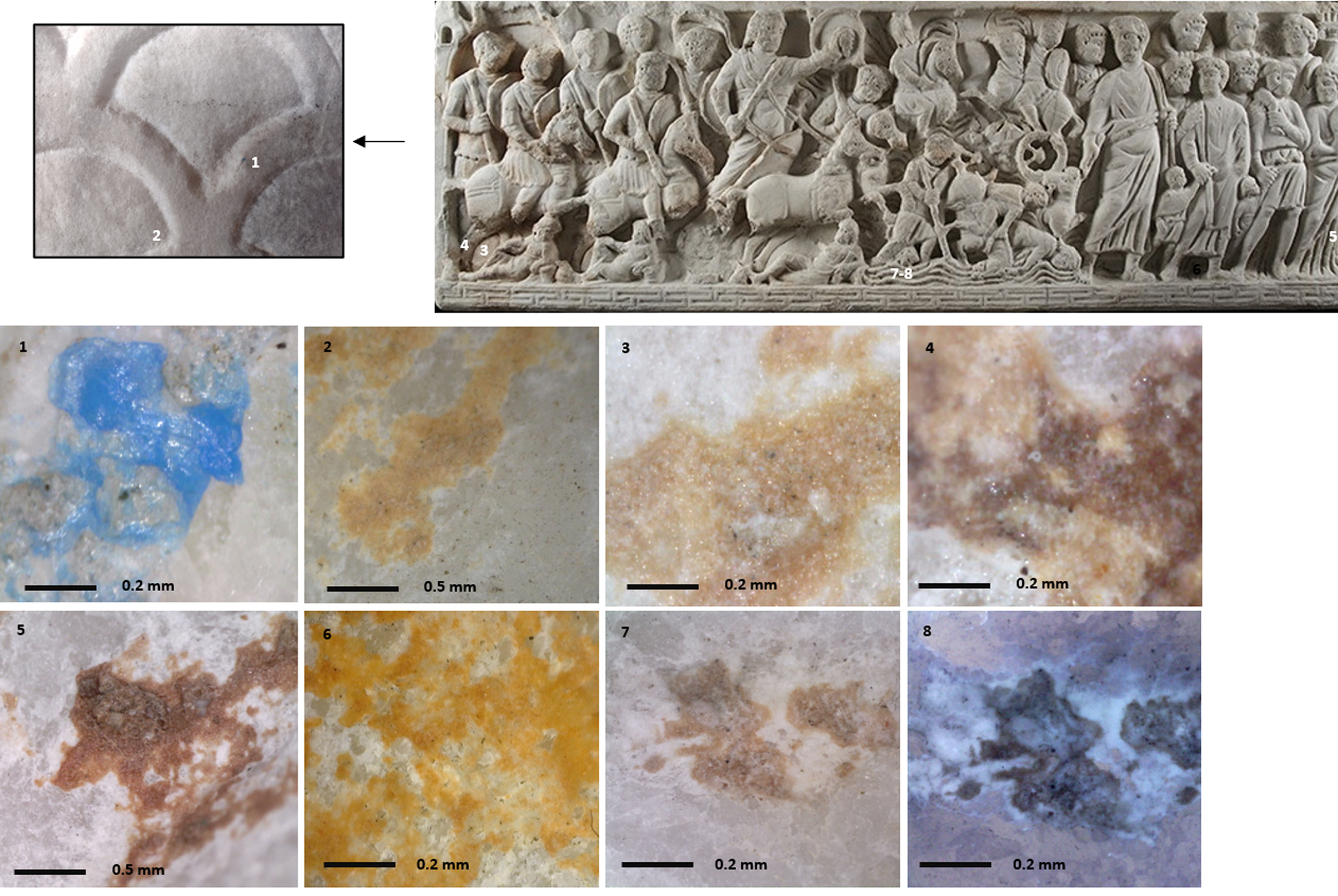
Traces of a uniform yellow layer on the sides, on the lower edge of the main face (meander), on the sea, on the robes of the Israelites and of Mary. Traces of a red pigment highlight the edges of the robes.
The yellow layer is superimposed on a white one that laid directly on the marble.
Polychromy technique
- Under painting traces
- no
- Pigments
- White lead, ochres (yellow, red).
- Binder
- n.d.
- Stratigraphy
- On a white lead preparatory layer.
- Shading
- no
- Metallic traces
- no
- Tools marks
- no
- Background colour
- Yellow.
- Apparent marble parts
- no
- Restorations
-
no.
Traces of modern pigments (black, blue and yellow) are visible, probably caused by rubbing. - Polychromy technique
-
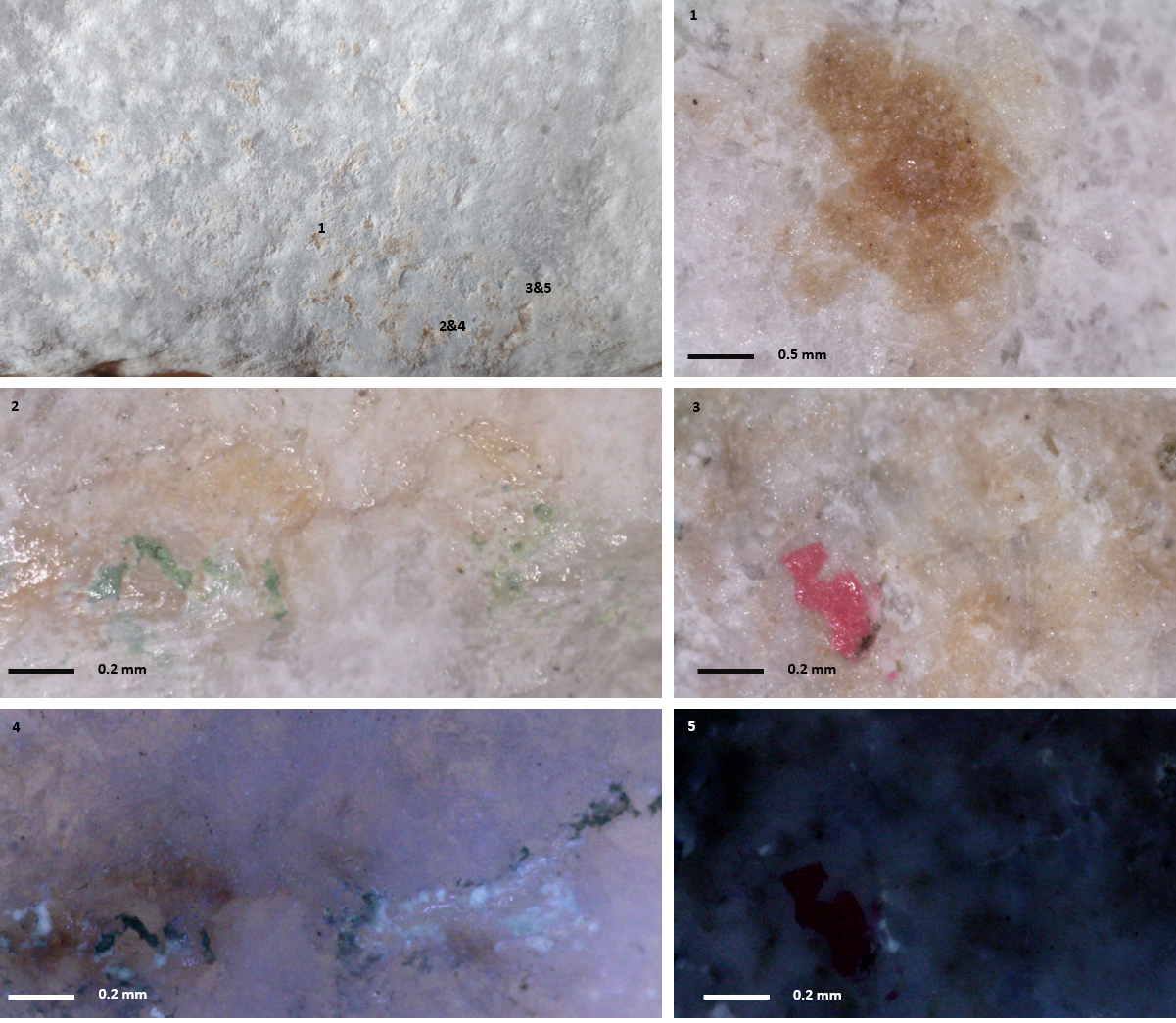
On the sides, the imbrication motifs are painted with a white preparatory layer, followed by a thick yellow layer. The lower edges of the sides show pink, green and violet traces on a translucent yellow layer (probably in liquid form).
The main face presents traces of yellow and brown pigments and the overlapping of several layers (from the lightest to the darkest).
Polychromy type
- Highlighting motifs
- The blue points on the sides might highlight the imbrication motifs.
- Polychromy type
-
The contrast between the thick yellow layer of the imbrication motifs and the translucent yellow layer of the lower edges might indicate two different polychrome phases. However, the stratigraphy cannot confirm this hypothesis.
The yellow and brown tones used on the main face help to differentiate the figures from the background and enhance the plastic work.
In conclusion, the uniform and covering yellow layer found throughout the basin, together with some areas accentuated by a red pigment, has been interpreted as a cheap imitation of gilding.