
Statue of a Satyr teasing a panther (inv. no. A.1143)
Item
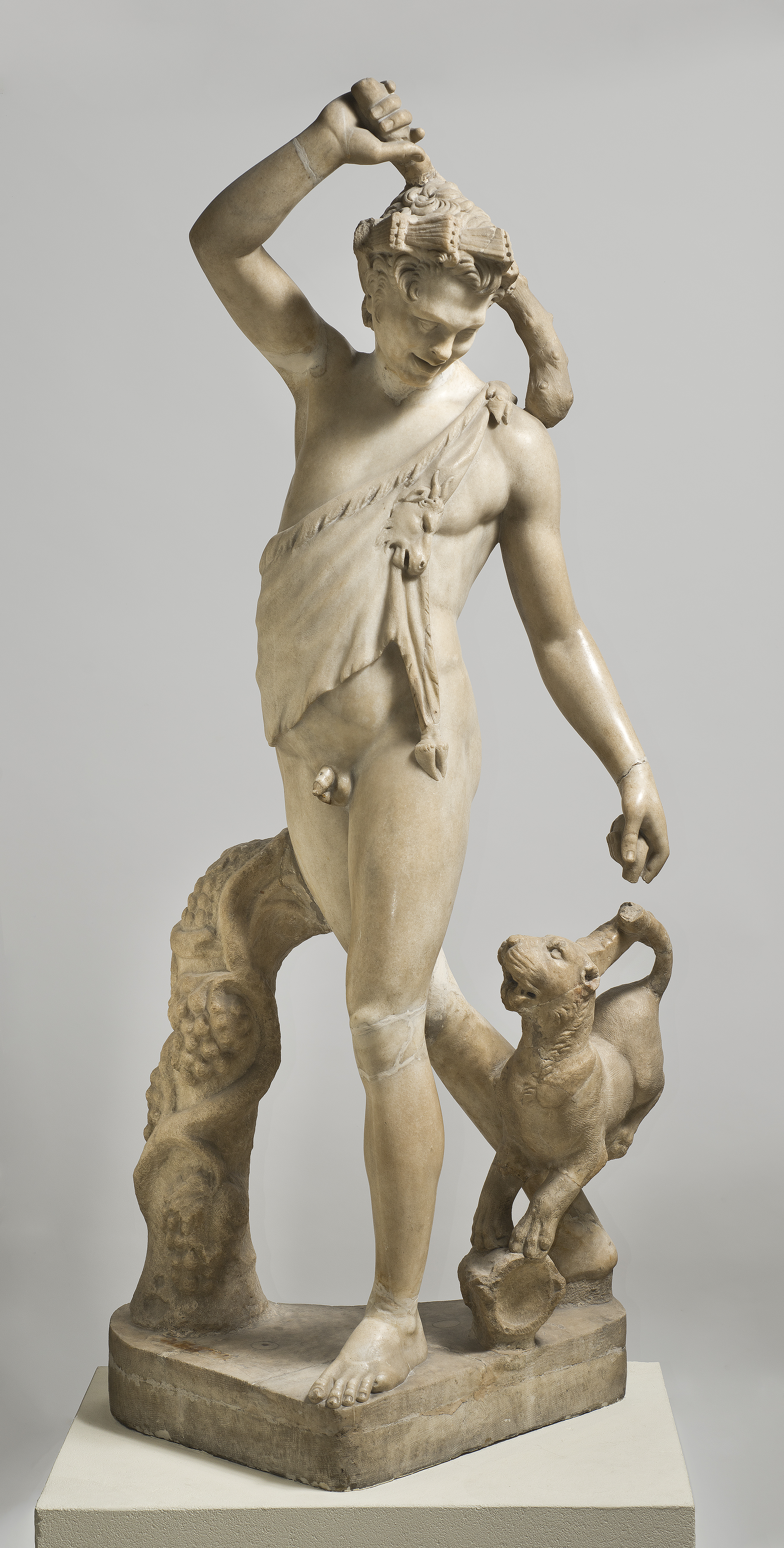
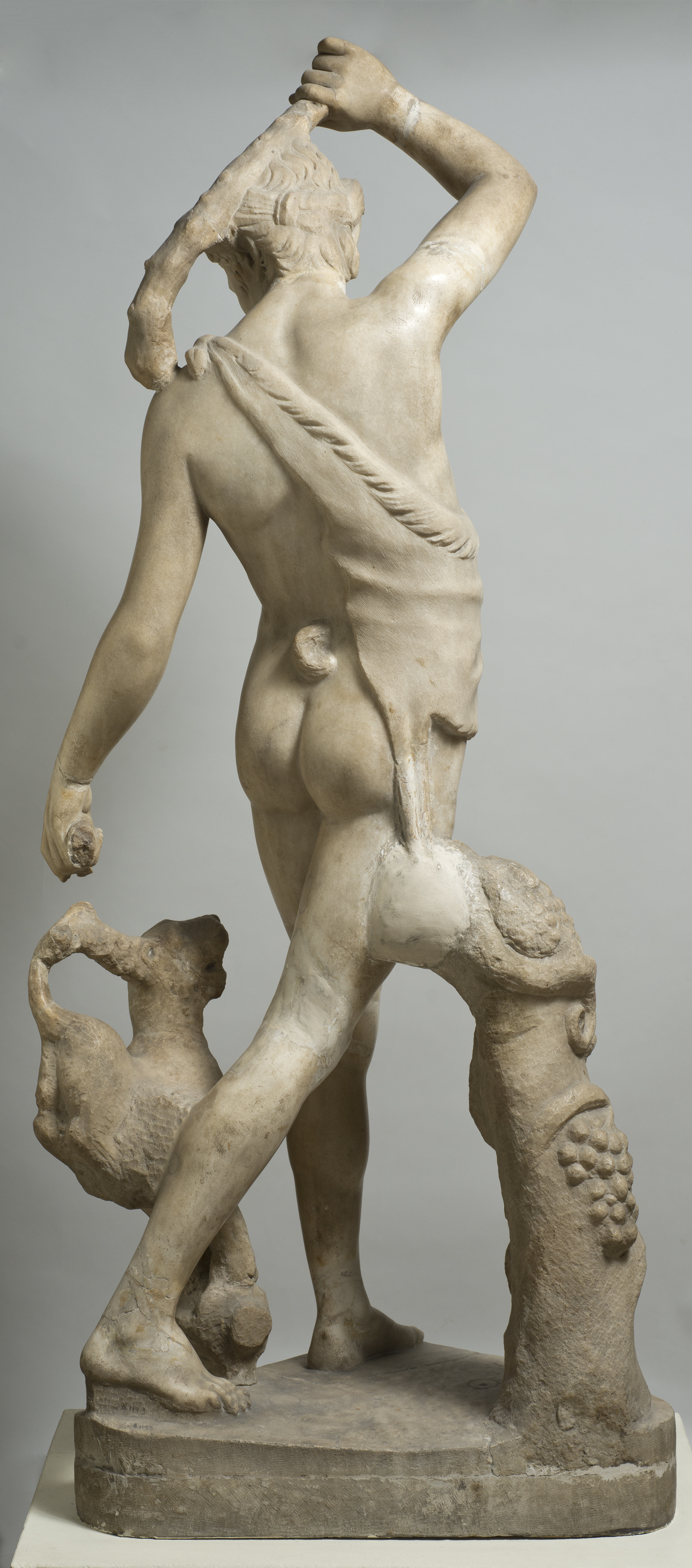

- Description
-
The statue depicts a dancing satyr, dressed in a goatskin (nebris). He is holding a curved stick (pedum) with his right hand and tugging at the tail of a panther with his left. The animal is jumping or being lifted by the satyr and it rests the front legs on a drinking vessel (cantharus). The support is in the form of a tree trunk covered with vines. The plinth is triangular.
The statue is well preserved: a recent cleaning operation has limited the extent of restorations.
The skin of the satyr was carefully polished, while the surface of the support was simply finished with a chisel. The skin of the panther and the nebris have been smoothed with a rasp. The back of the statue is slightly less well finished, suggesting that it was displayed against a wall or in a niche.
The dynamic pose suggests that the statue could be an imitation of a metallic original of 3rd-2nd century BCE.
Artwork
- Definition
- Statue of a Satyr teasing a panther (inv. no. A.1143)
- Collection
- Brussels, Musée Art & Histoire.
- Inventory number
- A.1143
- Provenance
- Probably found during excavations in the Villa Negroni estate on the Esquiline (Rome, Italy), on 19 November 1777.
- Date
- 1st c. CE
- Material
- Bright white marble with large crystals, probably Parian (not dolomitic Thasian).
- Dimensions
-
Height without plinth: 137 cm; Height of the plinth: 9 cm.
(scale of 4/5 life-size).
Analytical results
- Analytical methods
- VIS
- UV
- MO VIS
- MO UV
- MAXRF
- Raman
- Imaging
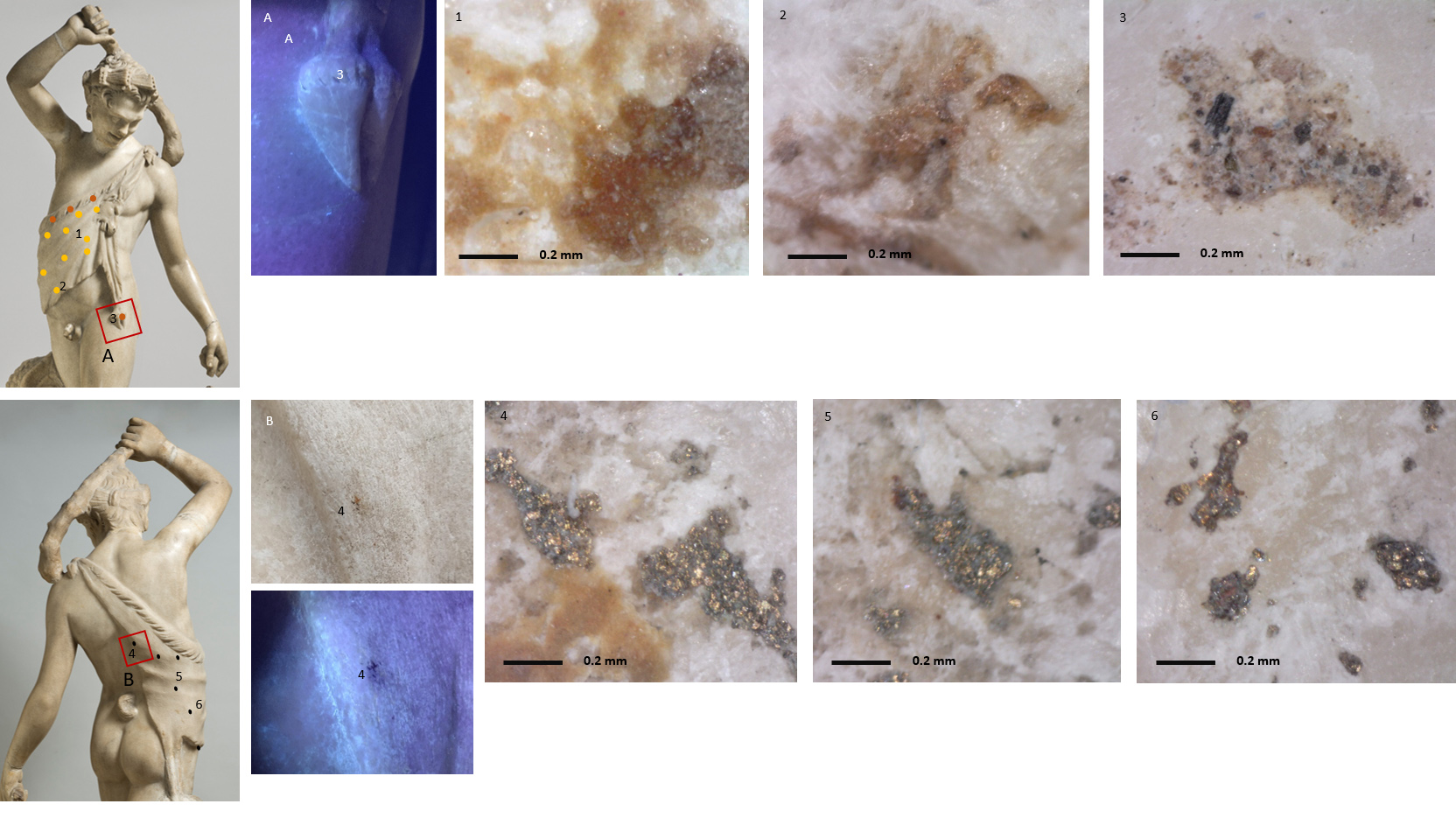
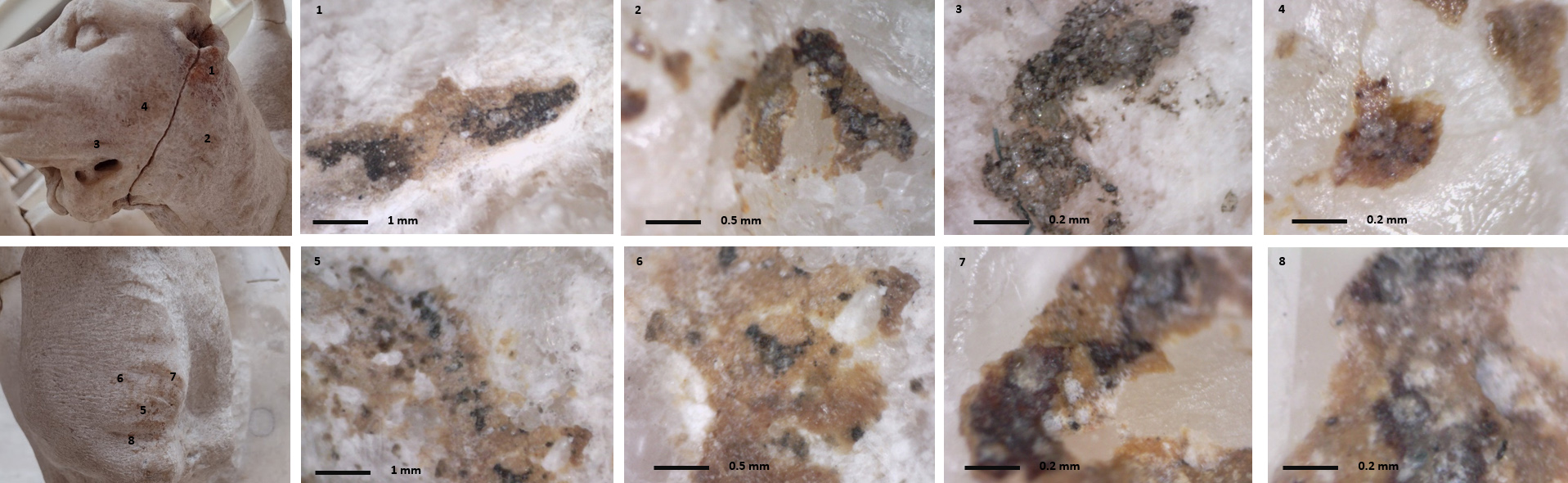
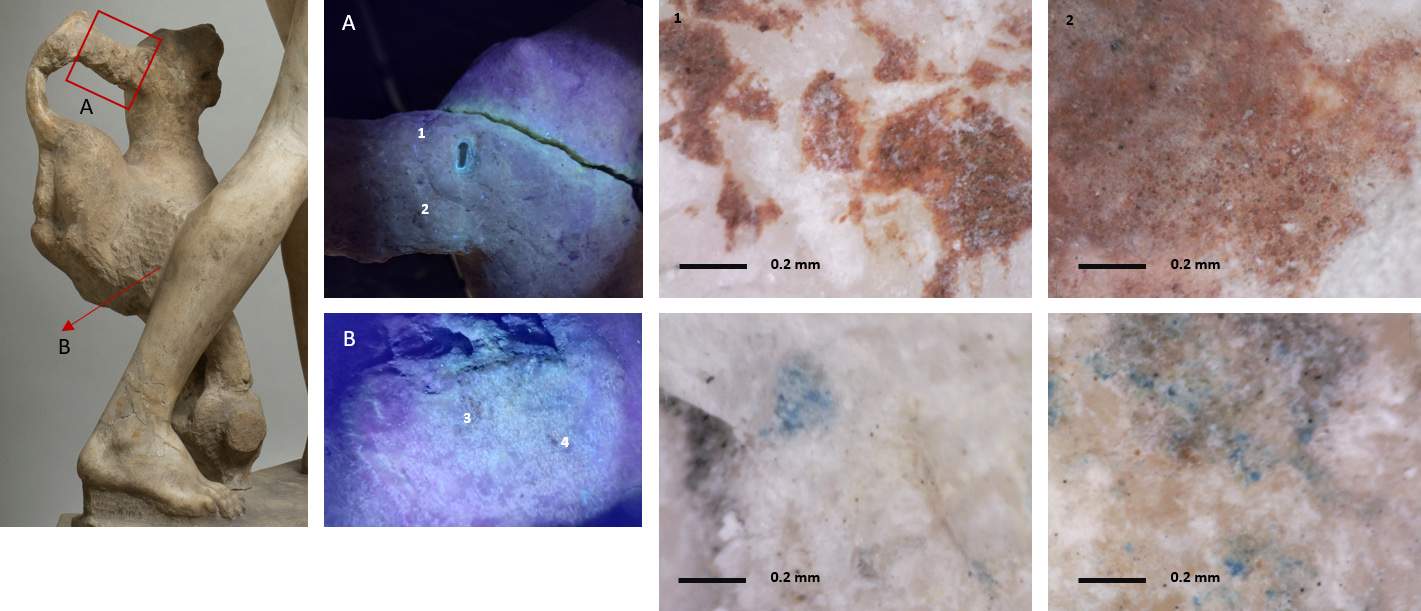
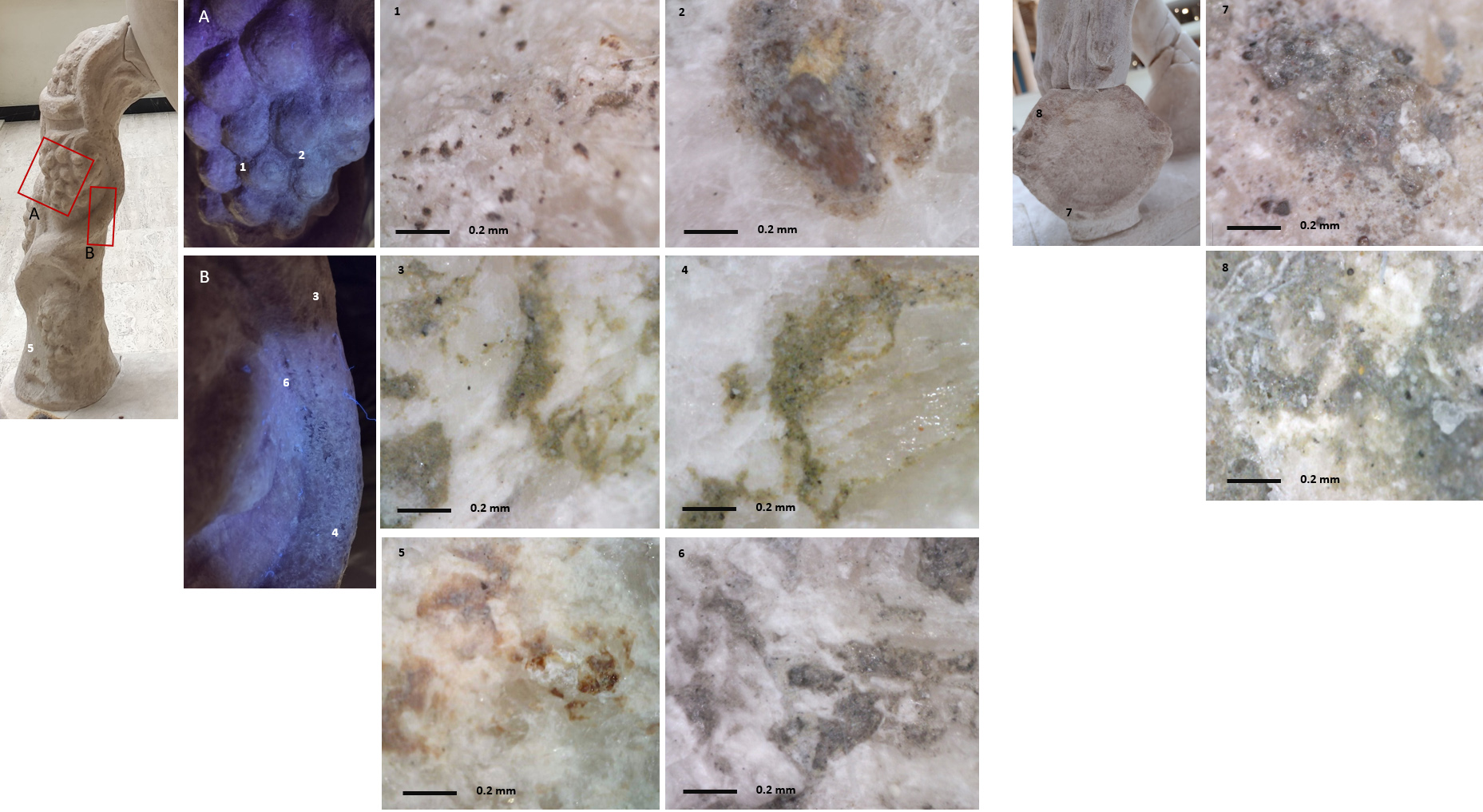
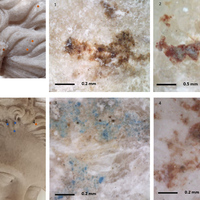
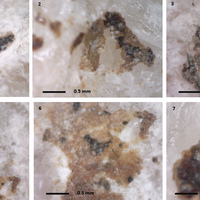
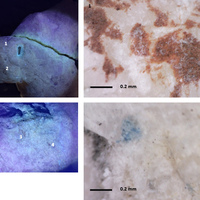
- VIS and UV Imaging have allowed to locate the traces of colour on the panther, the tenons, the satyr's cup, crown, lips and eyes.
-
 A.1143_fig3
-
 A.1143_fig4
-
 A.1143_fig5
-
 A.1143_fig6
-
 A.1143_fig7
- Chemical analysis
-
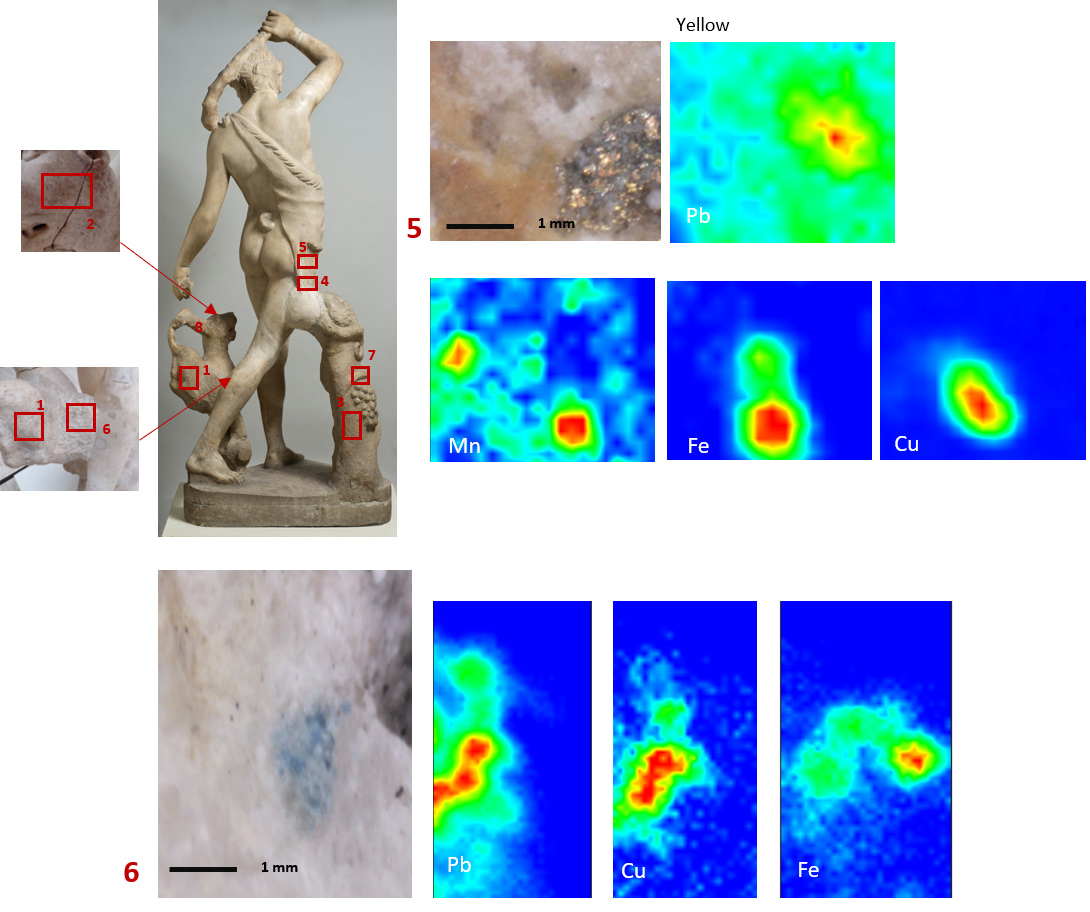
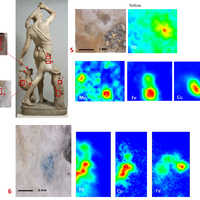
MA-XRF (7 zones) and Raman analysis (4 points) have been carried out.
A lead signal corresponding to the extention of white preparatory layer has been detected on the panther, the tenon and the nebris.
The iron signal in MA-XRF linked to the haematite peaks in Raman suggest the use of yellow and red ochre earths (sometimes combined with titanium and zinc) on the panther, on the vine leaves, on the nebris and on the tenon between the panther's snout and tail.
Copper and iron signals in MA-XRF and chrysocolla peaks in Raman point to the use of Egyptian blue on the tenon between the satyr's leg and the panther, as well as the leaves.
Traces of phosphorus, iron, manganese, copper and zinc, probably corresponding to carbon black, have been detected on the black spots on the panther and nebris.
The shiny effect on the surface of the nebris and the metallic appearance point to the use of copper foil. -
See all items with this value
 A.1143_fig8
Polychromy technique
- Under painting traces
- n.d.
- Pigments
- White lead, vegetable black, Egyptian blue, ochres (yellow, red), green earth (also known as "terre verte").
- Binder
- n.d.
- Stratigraphy
- Several strata of colour are laid on a white lead preparatory layer (which appears white or white-yellow).
- Shading
- no
- Tools marks
- no
- Background colour
- Tenons: blue and red.
- Apparent marble parts
- Skin of the Satyr.
- Restorations
- no
- Polychromy technique
-
The satyr's nebris has a white undercoat on which yellow and brown traces are spread. Superimposed on the latter are black spots with golden dots. The crown shows traces of brownish-brown and the hair of red, with shadow effects created with Egyptian blue on the central lock.
The body (legs and muzzle) of the panther shows a white layer superimposed on a yellow one, covered by a black one.
The tenon between the panther's muzzle and tail retains traces of red. The tenon between the animal and the satyr's leg at the back of the piece shows traces of yellow paint, superimposed by a grey paint mixed with blue grains. The tenon with vines is rendered in a colourful, realistic manner: brownish pigment on the trunk; green, yellow and blue on the leaves; purple on the grapes and black on the stem.
The vessel shows traces of a fine grey mixture with red and yellow grains superimposed on a white layer.
Polychromy type
- Anthropomorphic/realistic
- Idealized anthropomorphic rendering: realistic rendering of the attributes that contrast with the apparent marble skin.
- Polychromy type
-
The use of the blue and the red on the tenons may be linked to the original disposition of the statue in front of a bucolic fresco with blue sky.
The absence of colour on the satyr's flesh, in contrast to the polychromy of Dionysian attributes might underline the divine nature of the faun, reminding the religious role of the represented subject in a private context, helping to position man in relation to the divine plan, even within the confines of his own home.
- Item sets
- Musée d'Art&Histoire (Bruxelles)