
Christian sarcophagus with scene of the Traditio Legis
Item
- Description
-
The sarcophagus belongs to the funerary monuments attributed to the necropolis of the Alyscamps (Saint-Honorat sector), although its exact origin is undocumented. It was seen in the nave of the Church of Saint-Honorat at the beginning of the 17th century by N. Fabri de Peiresc "retro altare maius" (BNF, ms. 6012, f. 46). It is thought to have entered the collections of the Lapidary Museum in 1807, established by imperial decree in the Church of Saint Anne, before being transferred to the Departmental Museum of Ancient Arles.
The sarcophagus is fragmentary: the lid, the back, and the rear halves of the sides are missing. It is currently preserved in three joined fragments (the main front and the two, partially lost, lateral sides). However, F. Benoît mentions an earlier assembly in two parts, joined lengthwise at the lateral sides, which would explain the selection of the scenes on the sides, serving as visual “endings” (the undulation of water).
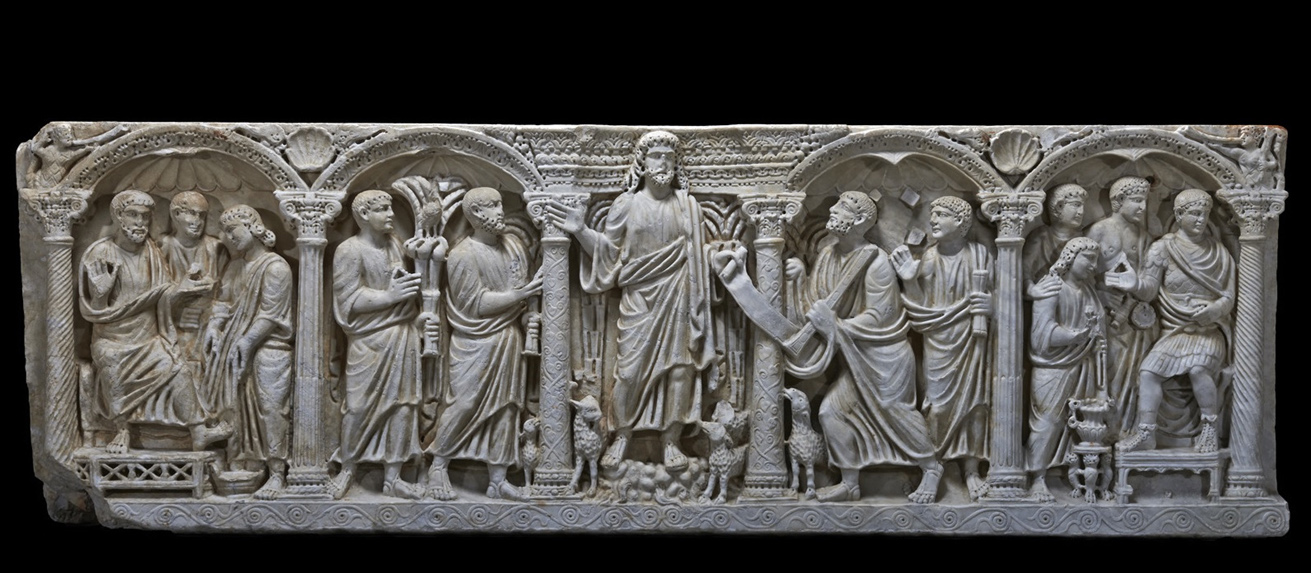
On the main face, a scene of the Traditio Legis is depicted: Christ as Teacher handing the Law to Saint Peter, under the gaze of the other apostles. Five panels are delineated by a columned architectural framework: four shell-shaped niches with arches flank a central panel topped by an architrave. The decoration displays a strong iconographic unity, emphasizing the semantic significance of its content. At the center, Christ is shown mature (bearded, with long hair), flanked by sheep and palm trees, standing atop the mountain from which flow the four rivers of Paradise. He hands the open scroll of the Law to Saint Peter, who approaches from the right carrying the Cross, accompanied by another apostle. On the left, Saint Paul is separated from another apostle by a phoenix atop a palm tree. At their feet is a sheep—the largest one appears on Peter’s side. All figures look toward Christ. Two New Testament episodes echo this scene (reprising the water motif) and mirror each other in composition (each featuring a seated figure at either end): the washing of the feet on the left, and Christ’s appearance before Pilate with the washing of hands on the right. In these scenes, Christ is depicted as youthful. On the short sides, two additional biblical episodes are represented: the Miraculous Spring on the left, and the Baptism of Christ in the Jordan on the right.
The overall work is finely executed, with remarkable ornamentation. Every section of the main face is richly decorated. Particular attention is paid to the architectural rendering: varied motifs layered on the architrave, molded friezes on the arches; the spaces between the arches are adorned with tritons and shells; the columns are alternately twisted, fluted, or decorated with vine scrolls; their bases are ornamented—a rare feature among Arles sarcophagi—and the capitals are composite. The lower molding of the sarcophagus is also adorned with scrollwork. Variations in the relief’s depth and the masterful use of the drill allow for intricate detail (tripod feet, perforated seat, Peter’s sandal in flat relief).
The craftsmanship of this sarcophagus identifies it as a Roman work from the late 4th century. Its composition closely follows that of the sarcophagus of Pope Pius II preserved in the Vatican Grottoes, of which it may be a replica. It is distinguished, however, by slightly different architecture: here, the architrave breaks the monotony of the arches, and the figure of Christ—protruding significantly from the background—is reminiscent of other Traditio Legis examples featuring city gates, such as the one discovered in the Mausoleum of the Anicii in Rome, now in the Louvre and dating from the same period.
Artwork
- Typology
- Sarcofagi
- Definition
- Christian sarcophagus with scene of the Traditio Legis
- Inventory number
- Arles, Musée Départemental de l'Arles Antique, inv. FAN.1992_2487
- Provenance
- Arles, Necropolis of the Alyscamps (Saint-Honorat sector)
- Date
- 4th century A.D.
- Material
- White marble
- Dimensions
- Width: 224 cm; Height: 72 cm
Analytical results
- Analytical methods
- UV
- VIS
- MO VIS
- MO UV
- MAXRF
- Autoptic examination
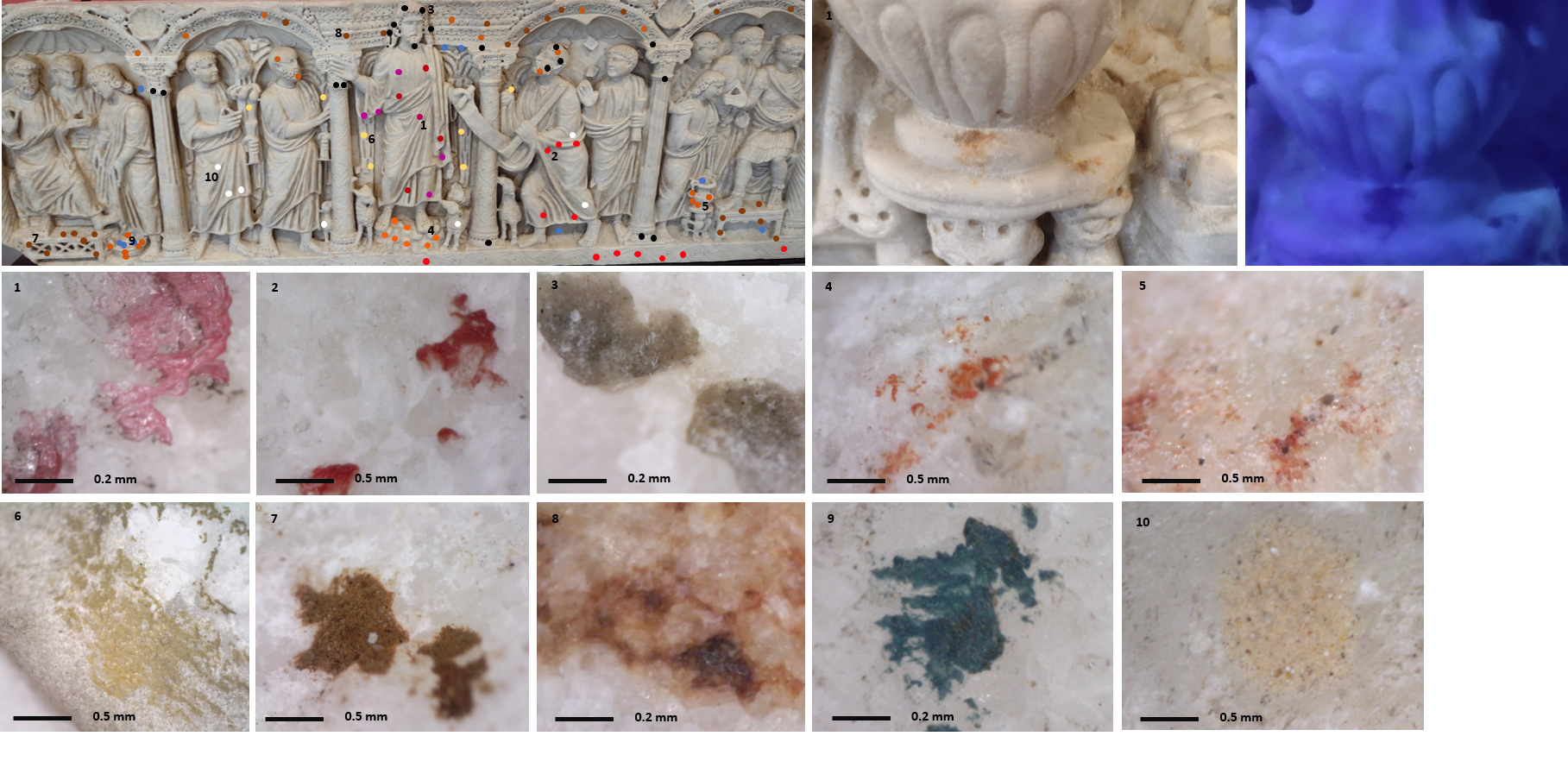
- The visual examination under white light in a darkroom did not reveal any obvious traces of color, except for micro-residues of yellow-orange on the pitcher in the scene of Pilate washing his hands, and blue in the background between the figure of Christ and the palm tree to his right.
- Imaging
- Observation under ultraviolet light did not show any particular fluorescence but revealed black absorption areas that may indicate the presence of iron, either from post-depositional processes or from a paint layer based on hematite-rich earth pigments. A total of 180 observation points were selected in the areas showing black absorption under UV light. All these points were examined using a video microscope under visible and polarized light (Dino-lite Edge), and traces of color were detected in each case.
-
 FAN.1992_2487_fig2
Polychromy technique
- Under painting traces
- no
- Pigments
- Ochre (yellow, red, brown, purple), Egyptian blue
- Binder
- n.d.
- Stratigraphy
- Directly on the marble
- Shading
- no
- Metallic traces
- no
- Tools marks
- no
- Background colour
- Blue
- Apparent marble parts
- no
- Restorations
- no
- Polychromy technique
- The traces of color are too scant and allow for interpretative variations. For example, the purple or red of Christ’s tunic might have referred only to the hem and the clavi or to the entire garment. The blue spots observed in the background could enhance the shadows and chiaroscuro achieved plastically with the drill, or they might be remnants of a blue background. Despite these uncertainties, the distribution and nature of the documented colors suggest that the figures were fully covered in color rather than simply painted with linear outlines.
Polychromy type
- Anthropomorphic/realistic
- Yes
- Polychromy type
-
The probable full coloration of the garments and decorative parts, as well as the blue background, brings this sarcophagus closer to that of the Via Anapo, dated a century earlier. In the latter, the blue background—clearly a classical reminiscence—is visible to the naked eye, and the figures of the Erotes are entirely painted. By contrast, in our case, no paint remains on the faces or skin, and the later dating encourages speculative comparison with other painted supports. The color scheme appears close to that of early Christian mural painting, as evidenced, for example, by the Traditio Legis fresco in the ad decimum catacomb of Grottaferrata (fig. 17): on a blue background, a dark-skinned Christ with a white tunic and purple clavi hands the scroll of the Law to Peter, who wears a tunic whose shadows are rendered in reddish-brown; as on the Arles sarcophagus, the mountain of Paradise here is reddish-brown, and the trunks of the palms are yellow-green. This reveals a familiarity between the arts, not only iconographically and semantically but also chromatically. By contrast, the color combinations and palette used differ in the Traditio Legis scenes of the mosaics in Santa Costanza and the Naples baptistery, where a blond Christ with a golden-yellow tunic and purple clavi delivers the Law to an elderly Peter with white hair.
A further reflection, arising from the observation of the preserved colors, concerns the potential role that color assumes in the reading of the image, reinforcing the reciprocal and symmetrical play typical of early Christian sarcophagus compositions. Color likely facilitated the iconographic reading by conferring meaning, establishing a visual hierarchy, and articulating parallels between the images.